Mount Arashiyama
Mount Arashiyama
West of Kyoto, Mount Arashiyama brings together a bamboo grove, Zen temple Tenryu-ji, wild macaques, a scenic train and hot springs.
West of Kyoto, Arashiyama combines a river gorge, wooded hills and major Zen heritage. The district clusters within a few square kilometers a historic bridge, a celebrated bamboo grove, UNESCO-listed temples, wild macaques and several hot springs. Here's how to experience it without missing the essentials.
Why visit Mount Arashiyama
Arashiyama literally means "mountain of the storm." The site has been cherished for over a thousand years for its seasonal landscapes: cherry blossoms in spring, blazing maples in autumn, green bamboo year-round. Its concentration of attractions makes it one of the most comprehensive day trips from Kyoto, with a rare balance between nature, history and thermal relaxation.
A history rooted in the Heian period
During the Heian period (794 to 1185), Arashiyama served as a retreat for the imperial court. Nobles enjoyed boat excursions on the Ōi River, whose course changes name by section (Hozu upstream, Katsura downstream). In the 13th century, Emperor Go-Saga imported cherry trees from the Yoshino hills, establishing the site's contemplative vocation.
The Togetsukyo Bridge, which still structures the landscape today, owes its name ("Bridge of the Moon's Crossing") to Emperor Kameyama in the 14th century: during his night walks, he believed he saw the moon cross the structure. This layering of imperial anecdotes and classical landscapes explains Arashiyama's cultural status in the Japanese imagination.
What to see and do
Togetsukyo Bridge
It's the central landmark of the district. The bridge spans the Ōi River and offers a clear view of Mount Arashi in the background. The panorama changes dramatically with the seasons, peaking in spring (sakura) and autumn (kôyô).
The Sagano bamboo grove
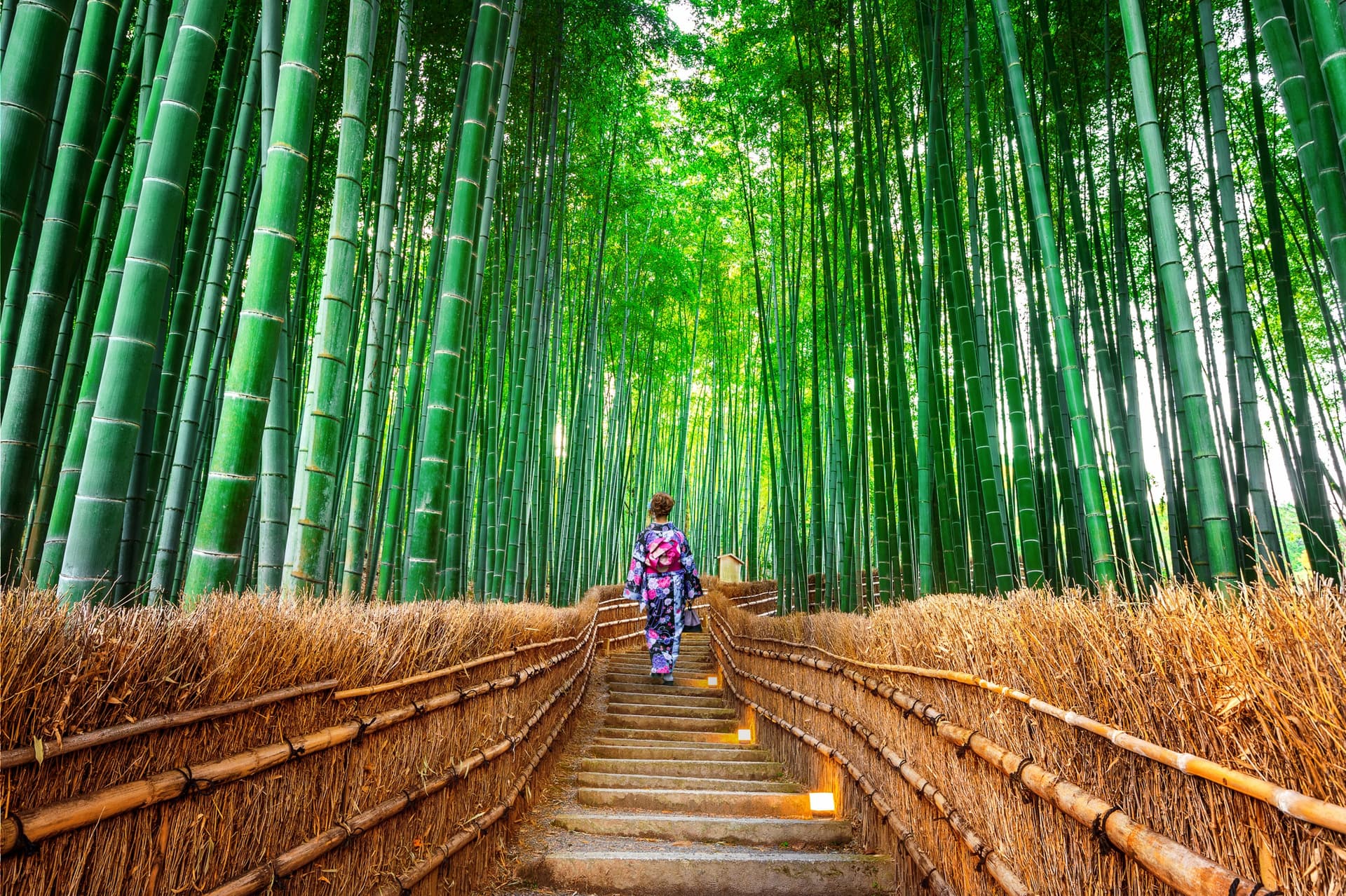
The path winds through a concentration of giant bamboo for about 500 meters. Access is directly from the main street, but also via the Nonomiya Shrine or Tenryu-ji gardens, which helps avoid peak hours. For soft light and fewer crowds, aim for early morning.
Tenryu-ji Temple
Founded in 1339 by shogun Ashikaga Takauji, Tenryu-ji is one of Kyoto's five great Zen temples and is listed as a UNESCO World Heritage site. While the buildings have been reconstructed several times, the garden has retained its original appearance. It was designed using the shakkei method, or "borrowed landscape": the surrounding hills are integrated into the composition, visually extending the central pond.
Iwatayama Monkey Park
About twenty minutes' walk from Togetsukyo Bridge, the park is home to roughly a hundred Japanese macaques in the wild, accustomed to human presence. The path to the summit is short but climbs steeply. At the top, an observation platform overlooks Kyoto and offers close views of the monkeys at play.
Torokko Sagano train
This scenic train connects Saga-Arashiyama to Kameoka in about twenty minutes, following the Hozu River gorge. The open-air cars fully showcase the fall maple foliage and spring cherry blossoms. Booking is highly recommended during peak season.
Hozu River boat descent
From Kameoka, traditional boats descend the Hozu gorge back to Arashiyama. The route combines calm passages and small rapids, with boats offering refreshments and drinks at the midway point. Duration varies by water flow and chosen route; expect around two hours for the full descent.
Hot springs
The district has several onsen to end your day. The Hanaikada ryokan offers a rotenburo (outdoor bath) with views over Togetsukyo Bridge. The Tenzan-no-yu establishment stands out with Kyoto's first sodium and calcium chloride spring open to the public.
When to visit
Arashiyama is worth visiting year-round, but each season sets its own mood:
- Spring (late March - early April): cherry blossoms in full bloom, ideal for o-hanami. Very high crowds.
- Summer: dense greenery, warm light, more moderate crowds outside weekends.
- Autumn (mid-November): flamboyant kôyô on the maples, the most photogenic period alongside spring.
- Mid-December: Hanatoro illuminations for about ten days, the nighttime route lit up.
For the bamboo grove, prioritize arrival at opening time or late afternoon, when tour groups have dispersed.
How to get there from Kyoto
Three railway lines serve Arashiyama from central Kyoto:
- JR Sagano (San-in): from Kyoto Station, get off at Saga-Arashiyama station. Journey of about fifteen minutes, this is the fastest option.
- Hankyu: connection at Katsura, terminus at Arashiyama station, south of Togetsukyo Bridge.
- Keifuku Randen Tramway: scenic line from western Kyoto, stopping right near the shopping street.
Half a day is enough for the main sites (bamboo grove, Tenryu-ji, bridge). Plan a full day to add the monkey park, Torokko and an onsen.
Nearby
Arashiyama is part of a network of mountainous and spiritual sites around Kyoto:
- Mount Hiei, spiritual guardian northeast of Kyoto with the Enryaku-ji complex.
- Mount Kōya, a major center of Shingon Buddhism, best combined on a broader Kansai itinerary.
- Kinosaki museums, extending thermal experience on the north coast of Hyōgo.
Frequently asked questions
Frequently asked questions
The path is free to access, but very crowded between 10am and 4pm. Early morning or late afternoon offers a calmer atmosphere and softer light for photos.
Half a day covers the essentials: Togetsukyo Bridge, bamboo grove and Tenryu-ji. A full day allows you to add Iwatayama monkey park, Torokko Sagano and a stop at an onsen.
The fastest way is the JR Sagano line to Saga-Arashiyama station, in about fifteen minutes. The Hankyu line and Keifuku Randen tramway are alternatives depending on your starting point in Kyoto.
Spring for cherry blossoms and autumn for maples are the two peak scenic periods. Mid-December offers Hanatoro illuminations for about ten days.
Yes, provided you're comfortable with a twenty-minute climb. The macaques roam freely: you must follow guidelines (don't touch them, don't feed them outside the observation cabin).
Include Arashiyama in your trip
Arashiyama is a natural stop on a Kyoto stay, best combined with the historic center, the Higashiyama district or an excursion to Nara. To build a bespoke itinerary blending imperial cities, sacred mountains and thermal traditions, explore our trips to Japan.
Nearby
Interested in this visit?
We can include it in your personalised itinerary.