The Five Lakes of Fuji
The Five Lakes of Fuji
At the foot of Mount Fuji, five volcanic lakes offer panoramic views, lava caves, museums and water sports just 1 hour 45 minutes from Tokyo.
North of Mount Fuji, the region of five lakes (Fujigoko) comprises five bodies of water of volcanic origin spread along the southern border of Yamanashi Prefecture, at approximately 1 km altitude. Kawaguchiko, Saiko, Yamanakako, Shojiko and Motosuko each offer a different vantage point on Fuji's summit, water activities, museums and several remarkable natural sites. It is also the main access point for hikers planning to climb the volcano.
Why visit the Five Lakes Fuji region
- Five distinct viewpoints over Mount Fuji, including the panorama from the northern shore of Motosuko reproduced on the 1,000 yen note.
- A unique geological heritage: lava caves, crystalline ponds of Oshino Hakkai and Aokigahara Jukai forest.
- A wide variety of activities: cruises, cycling, hiking, water sports, hot springs and art museums.
- Convenient logistics close to Tokyo (1 hour 45 minutes by bus from Shinjuku) for those wishing to explore the base of Fuji without traveling far.
History and formation of the lakes
The five lakes were born from lava flows produced by successive eruptions of Mount Fuji. These flows fragmented what was once a single body of water: today, several of the lakes remain connected through underground circulation, which explains the stability of their levels. The same volcanic activity carved out the lava caves of Narusawa, Wind Cave and Bat Cave, with the most well-known dating from the 864 eruption.
What to see and do around each lake
Lake Kawaguchiko
This is the most accessible and most frequently visited lake, the usual starting point for climbing Fuji. On clear days, the northern shore offers a clear reflection of the summit. Walking, cycling, cruising and canoeing are popular here. Several major sites are concentrated in this area:
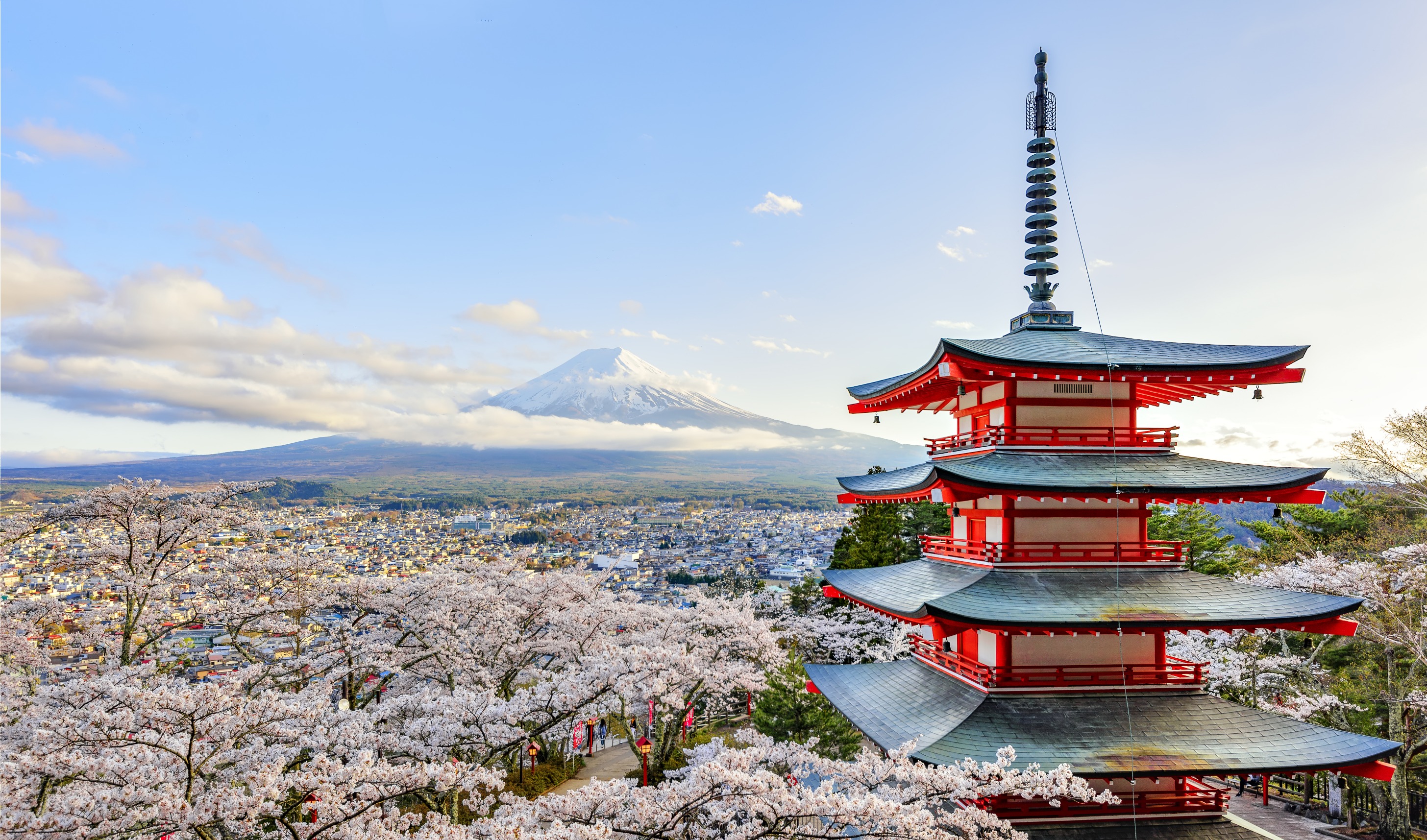
- The Chureito Pagoda, with its framed view of Fuji.
- The Kachi Kachi Ropeway, which serves Tenjoyama Park.
- The Itchiku Kubota Art Museum, dedicated to hand-dyed kimonos, and the Kawaguchiko Art Museum, devoted to Fuji.
- The Kawaguchiko Music Forest, a themed park featuring automata and gardens, and the Fuji-Q Highland amusement park.
Lake Yamanakako
Closer to the volcano, Yamanakako is the largest of the five lakes and reaches 980 m altitude. The volcano's proximity brings the summit visually closer. The Panorama-dai viewpoint, perched at 1,090 m, is one of the most appreciated vantage points for sunrise and sunset. The lake is suitable for fishing, water skiing, windsurfing and camping. At its western end, the Benifuji no Yu hot spring allows visitors to enjoy a warm bath facing Fuji. Hana no Miyako Park, spanning 300,000 m², displays vast seasonal flower fields from April through October.
Midway between Kawaguchiko, the village of Oshino Hakkai lines up eight crystalline ponds fed by filtered Fuji water, designated cultural heritage for their historical role in purification rituals.
Lake Saiko
Located about 1 km west of Kawaguchiko, Saiko has a circumference of 10.5 km. Only its western tip offers a direct view of Fuji, the other shores being enclosed by forested ridges. The lake is surrounded by campsites and hiking trails crossing the Aokigahara Jukai Forest — a forest with a heavy reputation that visitors should not leave marked trails to explore. Three lava caves resulting from the 864 eruption can be visited nearby:
- The Narusawa Ice Cave, where temperature never exceeds 3°C; used as a natural ice storage since the early 20th century, it can be toured in a loop among stalactites and ice blocks.
- The Bat Cave, the longest (approximately 350 m), which no longer houses colonies today.
- The Wind Cave, at constant temperature, long used to store acorns and silkworm cocoons.
Lake Shojiko
The smallest of the five lakes with a circumference of 5 km, Shojiko is located 5 km west of Saiko, on the edge of Aokigahara. All its shores offer a view of Fuji, but the southwest shore, where the Eboshi-dake viewing platform stands, offers the clearest framing. The lake remains calm, with few hotels, and is well suited for discrete water activities and camping.
Lake Motosuko
With depths exceeding 140 m, Motosuko ranks among Japan's ten deepest lakes. It is also the westernmost lake in the region and the one with the clearest waters. Windsurfing, canoeing and fishing are popular here. The Moguran boat, equipped with glass windows below the waterline, allows visitors to observe carp, kokanee salmon, rainbow trout and chub. The view from the northern shore is the one that appears on the back of the 1,000 yen note.
When to visit the Five Lakes Fuji
- April-May: cherry blossoms blooming around Kawaguchiko and Chureito, mild temperatures.
- June: lavender fields on the shores of Kawaguchiko and Saiko.
- July-August: official Fuji climbing season, water sports, but crowds and frequent mist on the summit.
- October-November: autumn foliage, often clear skies, excellent Fuji reflections.
- December-February: dry air, maximum visibility of the snow-capped summit; some facilities close.
Practical information
- The region can be explored in 2 to 3 days to enjoy several lakes; one day is sufficient if you stay around Kawaguchiko.
- Local bus lines (Red Line, Green Line, Blue Line) connect the main sites with stops at each attraction.
- Bike rental from the tourist office and some hotels is convenient around Kawaguchiko and Yamanakako, where terrain remains flat.
- For photography, prioritize early morning: Fuji is often clear before clouds form.
- The lava caves require warm clothing even in summer and often have slippery ground.
How to get there from Tokyo
By bus
Direct buses from the Shinjuku bus station reach the region in approximately 1 hour 45 minutes, with stops at Fuji-San and Kawaguchiko stations. Some services extend to Yamanakako. This is the simplest option and often the least expensive.
By train
From Shinjuku, the JR Chuo Line reaches Otsuki, where you take the Fujikyu Line to Kawaguchiko station. The complete journey takes approximately 2 hours 15 minutes. The Fuji Excursion express train, on certain days, provides direct service from Shinjuku to Kawaguchiko without transfers.
On location
Local buses and bikes cover most sites around Kawaguchiko and Yamanakako. For Saiko, Shojiko and Motosuko, more remote, car rental or Blue Line buses remain the most efficient solutions.
Nearby attractions
The Fuji region is part of a vast network of sacred mountains in Japan. To extend your trip, several summits and monastic sites merit a detour:
- The Mount Kōya, a major center of Shingon Buddhism in the Kii Peninsula.
- The Mount Hiei, which overlooks Kyoto and houses the Enryaku-ji complex.
- The Mount Tsukuba, iconic peak of the Kanto region, accessible by ropeway.
- The Mount Inasa, near Nagasaki, renowned for its night panoramas.
Frequently asked questions
Frequently asked questions
Kawaguchiko is the most accessible and offers the iconic reflection of Fuji from its northern shore. For a more dramatic framing and fewer crowds, the northern shore of Motosuko, reproduced on the 1,000 yen note, is unbeatable. Yamanakako brings the summit visually closer thanks to its proximity.
One day allows you to cover Kawaguchiko and its museums. To explore all five lakes with Saiko's caves and a hot spring at Yamanakako, allow 2 to 3 days.
Yes. Local buses Red, Green and Blue Lines connect the main sites from Kawaguchiko station. A car is more convenient for Shojiko and Motosuko, which are more remote.
The forest can be visited safely on its marked trails, which lead notably to the lava caves. Its reputation stems from a painful history: it is recommended not to leave the paths, as the volcanic ground interferes with compasses.
Winter, from December to February, offers the best visibility thanks to dry air and snow on the summit. Autumn (October-November) combines clear skies with colorful foliage.
Plan your trip
The five lakes region fits naturally into an itinerary combining Tokyo, Hakone and central Honshu. To build a customized journey including Fuji, consult our trips to Japan.
Interested in this visit?
We can include it in your personalised itinerary.