Kaminoyama Hot Springs
Kaminoyama Hot Springs
At the foot of Mount Zao in Tohoku, Kaminoyama Onsen offers six public bathhouses, five free foot baths, a castle and a beautifully preserved samurai quarter.
The Kaminoyama hot springs, in Yamagata Prefecture in northern Honshu, rank among Tohoku's historic thermal stations. At the foot of Mount Zao, the town features six public bathhouses, numerous ryokans and a network of free foot baths accessible throughout the urban area.
Why visit Kaminoyama Onsen
Kaminoyama brings together three elements that define a distinctive Japanese hot spring town: water renowned since the 15th century, a fabric of historic establishments frequented by locals, and cultural heritage that extends far beyond the baths themselves. You'll discover neighbourhood sento where local life continues, a hilltop castle offering views across Mount Zao, a well-preserved samurai quarter and fruit farms on the town's outskirts. The town lends itself to a short stay combining bathing, walking and regional gastronomy.
The local water, slightly alkaline with a faint mineral aroma and salty taste, is known for its hydrating properties and remains gentle, suitable for bathers of all ages.
History of the thermal station
Kaminoyama Onsen's history begins in the mid-15th century. Legend tells of a wandering monk who observed a crane tending its wounds in a marsh of hot water at the base of Mount Zao. News spread through the region and locals began visiting the site to bathe. Over the centuries, Kaminoyama became one of Tohoku's frequented thermal towns, positioned at the crossroads of a trade route and agricultural land.
A few metres above the Shimo-Oyu bathhouse stands the Yunoue Kannon Temple, founded in the 12th century. Its name means "Kannon above the hot water", a direct reference to the spring flowing below.
What to see and do
The six public bathhouses
Kaminoyama has six communal sento scattered throughout the town:
- Shimo-Oyu: the most iconic, housed in a weathered concrete building with lineage tracing back to the Edo period. Gender-separated pools, murals depicting scenes of daily life. Heavily frequented by locals.
- Shinko no yu: in the north of town, simple, retro atmosphere.
- Yuzawa no yu: in a residential quarter, circular bathtub in a bright setting.
- Shikoku-cho, Nakayu and Hayama Shozusa: three outlying establishments, quieter.
Entry to public bathhouses remains very modest. Ryokans sometimes open their baths to day visitors, typically with a small surcharge or a package including a meal. The Koyo Ryokan, in the Hayama Onsen sector to the southwest, is regularly ranked among Japan's finest ryokans for cuisine and service.
Five free foot baths
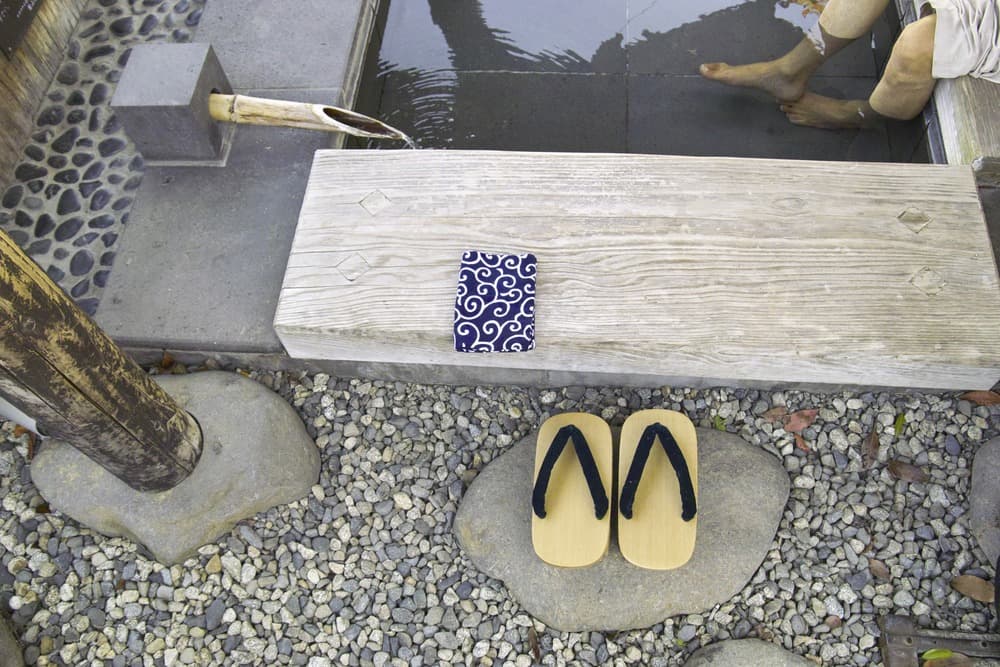
Five ashiyu are distributed throughout the town, accessible at no charge. Four are located in the urban area, including one immediately near Kaminoyama Onsen JR Station, convenient for a pause before or after your train. The fifth sits on Hayama Hill, beside the castle.
Kaminoyama Castle and the samurai quarter
Kaminoyama Castle overlooks the town from a hilltop, roughly fifteen minutes' walk from the station. Its observation terrace opens onto Mount Zao and the Yamagata Plain. Beyond lie Tsukioka Park and Tsukioka-jinja Shrine, with a foot bath installed on the grounds.
Lower down, a small samurai quarter lines four houses dating back two centuries, still inhabited by descendants or used as community spaces. Only the Miwa House is open to the public: wooden interior, garden, period furnishings.
Orchards, wine and konnyaku
Kaminoyama's surroundings are agricultural. Several farms offer cherry picking from June to mid-July, followed by pears, then grapes in September and October. Takeda Winery, one of Japan's oldest wine producers, opens its vineyard to visitors by reservation. On the culinary side, the restaurant Konnyaku Bansho specialises in konnyaku, a jelly made from konjac root, offered as a topping, meat substitute or noodle accompaniment.
Practical information
- Public bathhouses: very low entry fee, cash payment, soap and towel sometimes sold on-site.
- Foot baths: free, open all day, bring a towel.
- Ryokans: day access at some establishments, variable surcharge. Reservation recommended for overnight stays.
- Etiquette: shower required before bathing, no swimwear, long hair tied back, towels kept out of the water.
When to visit
The onsen experience is enjoyed year-round, though each season offers a different setting:
- Winter (December–March): the most sought-after season for bathing, sometimes with snow and Mount Zao's ski resort nearby.
- Spring (April–May): cherry blossoms around the castle, mild temperatures.
- Summer (June–August): cherry season, hiking on Mount Zao.
- Autumn (September–November): pears and grapes, maple colours on the heights.
How to get there
Kaminoyama Onsen Station is served by the JR Yamagata Shinkansen line, with frequent daily connections from Tokyo. The journey takes roughly 2 hours 30 minutes. Most bathhouses and ryokans are about fifteen minutes' walk from the station, in the town centre.
Several passes cover this route: the JR East Tohoku Area Pass, the Japan Rail Pass and the JR East South Hokkaido Pass. Which to choose depends on your overall Japan itinerary.
Nearby
If you're exploring Japan's mountainous and thermal regions, several sites extend the experience:
- Mount Tsukuba, another sacred mountain accessible from Tokyo.
- Mount Kōya, a major centre of Shingon Buddhism.
- Mount Hiei, near Kyoto, temples and panoramic views.
- Museums of Kinosaki, in another celebrated hot spring town.
Frequently asked questions
Frequently asked questions
Planning your visit
Kaminoyama Onsen fits easily into a Tohoku itinerary or a broader journey between Tokyo and northern Honshu. To build a tailor-made trip blending hot spring towns, mountains and heritage, explore our Japan travel suggestions.
Interested in this visit?
We can include it in your personalised itinerary.