Mount Nokogiri
Mount Nokogiri
Just 90 minutes from Tokyo, Mount Nokogiri combines a breathtaking vista over the bay, an ancient temple, and one of Japan's largest Buddha statues.
A view from "hell", an ancient temple, a thousand small Rakans (statues of Buddha's disciples), and one of the largest Daibutsu in Japan… Mount Nokogiri, located not far from Tokyo, absolutely deserves a full day's excursion during your trip to Japan.
History
During the Edo period, Japanese established a quarry on this mountain to extract soft and high-quality stone from volcanic tuff. The site supplied numerous major construction projects in Edo, which later became Tokyo, including the Yasukuni-Jinja temple and Waseda University, founded in 1869 and 1882 respectively. Extraction continued until 1982. Originally named Kenkon-zan, the mountain was renamed Nokogiri (Nokogiriyama), meaning "the sawed mountain", a reference to the quarry that carved its landscape.
Mount Nokogiri and its temple appear in a work by Japanese painter Utagawa Hiroshige II (1826–1869), "Nihon Temple on Mount Nokogiri, Boshu (Awa) Province" from the series "One Hundred Famous Views of the Various Provinces".
Discovering Mount Nokogiri
Rising to 329 meters above sea level on the edge of Tokyo Bay, in the Boso Peninsula, Nokogiriyama is one of three famous mountains in Chiba Prefecture, alongside Mount Ishihara and Mount Kano. It's a popular attraction thanks to its observation platform and giant Buddha.
Hell's Viewpoint of Mount Nokogiri
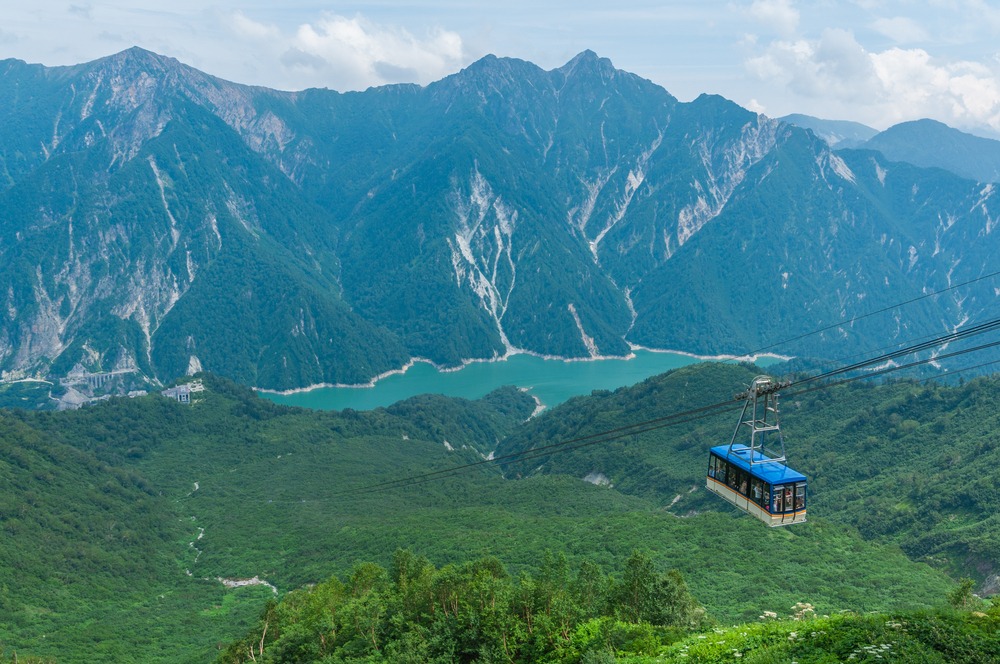
Mount Nokogiri stands out from other mountains in the region due to its extraordinary rock formations and jagged cliffs that inspired its name. Today, the old paths once used by carts during the quarry era have been converted into hiking trails across the mountain. If you're not up for a full climb on foot, there's a cable car that takes you to the summit from the town of Kanaya, on the north side of the mountain.
Once at the top of Nokogiriyama, head to Jigoku Nozoki, or "Hell's Viewpoint", to enjoy a 360° view over the Boso Peninsula. On clear days, you can see Mount Fuji and the Miura Peninsula in the distance. The sheer drop is dizzying at this vantage point—don't venture too close to the edge. On-site, you'll find binoculars to better appreciate the panorama, a restaurant, a souvenir shop, and various play areas for children.
A Reassuring Divine Presence
The stairs and trails of Mount Nokogiri are home to countless sculptures. Master Ono Jingoro and his disciples created a total of 1,553 Buddha statues on the mountain between 1779 and 1800. During the Meiji era, an anti-Buddhist movement swept through Nokogiriyama and decapitated a large portion of the statues. Some pieces still bear marks on the neck.
Let the Rakans guide you to Nihon-ji temple in the heights, a site of the Sodo school of Buddhism founded by monk Gyoki in 725. One of Japan's largest seated Buddhas welcomes you on-site. The Magaibutsu of Nokogiriyama measures 31.05 meters! Officially called Yakushi Ruriko Nyorai, it represents the "Medicine Buddha", referring to the medicinal bowl it holds in its left hand. In tradition, it is "the pure land within a lotus flower", an ode to peace and tranquility. Near the temple, a traditional tea salon welcomes you for a refreshing moment in a picturesque setting.
Beneath the Jigoku Nozoki, the statue of Hyaku shaku Kannon, the Goddess of Mercy, is equally impressive. Carved directly into the rock face in 1966, the sculpture honors those who lost their lives during World War II.
Into the Heart of Nature
The forest is home to many creatures; you may encounter insects and snakes along the way, especially in summer. Be sure to wear good hiking shoes to avoid injury.
On the flora side, some of the country's most beautiful plant species thrive on the mountain. The most coveted attraction is a 800-year-old Japanese cycad. It was the first shogun of Kamakura, Minamoto no Yoritomo (1147–1199), who is said to have planted them. At the end of your getaway, descend to the small fishing village of Hama-Kanaya to relax at the Nokogiriyama Kanaya Onsen, then enjoy some fresh seafood!
If traveling by train, the nearest station is Hana-Kanaya, located on the JR Uchibo Line. From Tokyo, take the special express Sazanami train. The journey takes about an hour and a half. If you prefer the bus, head to Tokyo or Shinjuku Station and board a vehicle bound for the city of Kisarazu, then take a local line to Hana-Kanaya. If you're driving, follow the four-lane Aqua Line expressway to Kisarazu, then head south. You can also reach Hana-Kanaya by sea via the Tokyo Wan Ferry.
There are various ways to explore Mount Nokogiri, with each route offering its own points of interest. While the mountain isn't particularly high, the trails alternate between climbs and descents, which can tire beginner hikers. For those choosing the cable car from Kanaya, the journey takes barely 5 minutes and costs 930 yen round-trip. If you're driving, there's a mountain toll road departing from the town. Note that bicycles and motorcycles are not permitted.
The Mount Nokogiri cable car operates from mid-February through mid-November daily from 9 a.m. to 5 p.m. In winter, operations close at 4 p.m. Separately, a fee is required to explore the mountain (600 yen for adults and 400 yen for children; maps and brochures in English are available).
Want to discover this destination?
Our local advisors design your tailor-made trip.