Onsen, Japan's Thermal Hot Springs
Onsen, Japan's Thermal Hot Springs
For Japanese people, an onsen is a way of life and a natural antidote to stress. This deeply relaxing practice has captivated travelers as well. Whether in a group or solo, visitors immerse themselves without hesitation in the thermal waters and savour every moment of warmth and tranquility.
For Japanese people, an onsen is a way of life and a natural antidote to stress. This deeply relaxing practice has captivated travelers as well. Whether in a group or solo, visitors immerse themselves without hesitation in the thermal waters and savour every moment of warmth and tranquility. Some onsens reward bathers with sublime views. The mineral-rich waters of volcanic springs then bestow their therapeutic benefits. By the end, you emerge revitalized, ready to embrace your journey through Japon with renewed vigour.
History
It is said that hot springs once possessed their own "kamis"—the Shinto deities of Japon. The earliest inhabitants of the archipelago are believed to have established their villages around these basins, which also attracted game through their mineral richness. The Nihongi (720 AD) mentions Arima onsen, founded in 631 in Hyōgo Prefecture, as Japon's first thermal spring. Dôgo onsen, in Matsuyama, is equally ancient.
Long reserved for sacred rituals, onsens began to be utilized for therapeutic purposes during the Kamakura era (1185–1333). Monks performed Shinto purification rituals in temples, while feudal lords, during the conflicts of the Sengoku period (1477–1573), found respite between battles.
During the Edo era (1603–1868), thermal centres gradually formed around hot springs. Japanese visitors initially came for extended cures, but tourists soon began booking one- or two-night stays. The practice of onsens became woven into the very fabric of Japon's culture. Several cities gained renown for the quality of their thermal waters. Hakone, for instance, has boasted its hot baths since the 8th century.
Discovering the Onsens
Onsens, much like sushi, form one of the cornerstones of Nipponic culture. Scattered across forests and mountains, along coastlines, and through cities and countryside villages, over 3,000 onsens satisfy the relaxation desires of millions of Japanese and international travelers each year. Let us unveil these small steaming paradises in the land of the rising sun.
The Most Highly Rated Onsens
In Matsuyama, on Shikoku island, the waters of Dôgo onsen have comforted bathers since the 8th century. The imperial family knows the place well. Built in the late 19th century, the wooden structure housing the baths inspired Hayao Miyazaki's "Spirited Away". Northwest of Tokyo, Kusatsu onsen at 1,200 metres altitude boasts Japon's highest hot spring flow thanks to numerous volcanic sources scattered throughout the Gunma mountains. On weekends, many Tokyo residents make the journey to restore themselves in the Yabatake.
On Kyushu island, Beppu onsen forms Japon's largest thermal spring complex. The city is perpetually shrouded in steam that rises from drains, onsens, and ryokans lining the streets. Finally, there is Gero onsen in Gifu Prefecture, praised by the poet Hayashi Razan during the Edo era.
Rotenburos, the Open-Air Hot Baths
While there are no "poor" onsens in Japon, location and vistas make all the difference. Open-air onsens, called rotenburos, are particularly prized for relaxing in warmth while contemplating the landscape. In Shirahama town, the Saki-no-yu onsen borders the Pacific Ocean, where you can watch waves crash nearby. At the Kawayu thermal station in the Kii mountains, bathers soak directly in the Oto River, nestled within a hillside of pines. In the Kii Peninsula, Katsuura rotenburo sits beside turquoise coves.
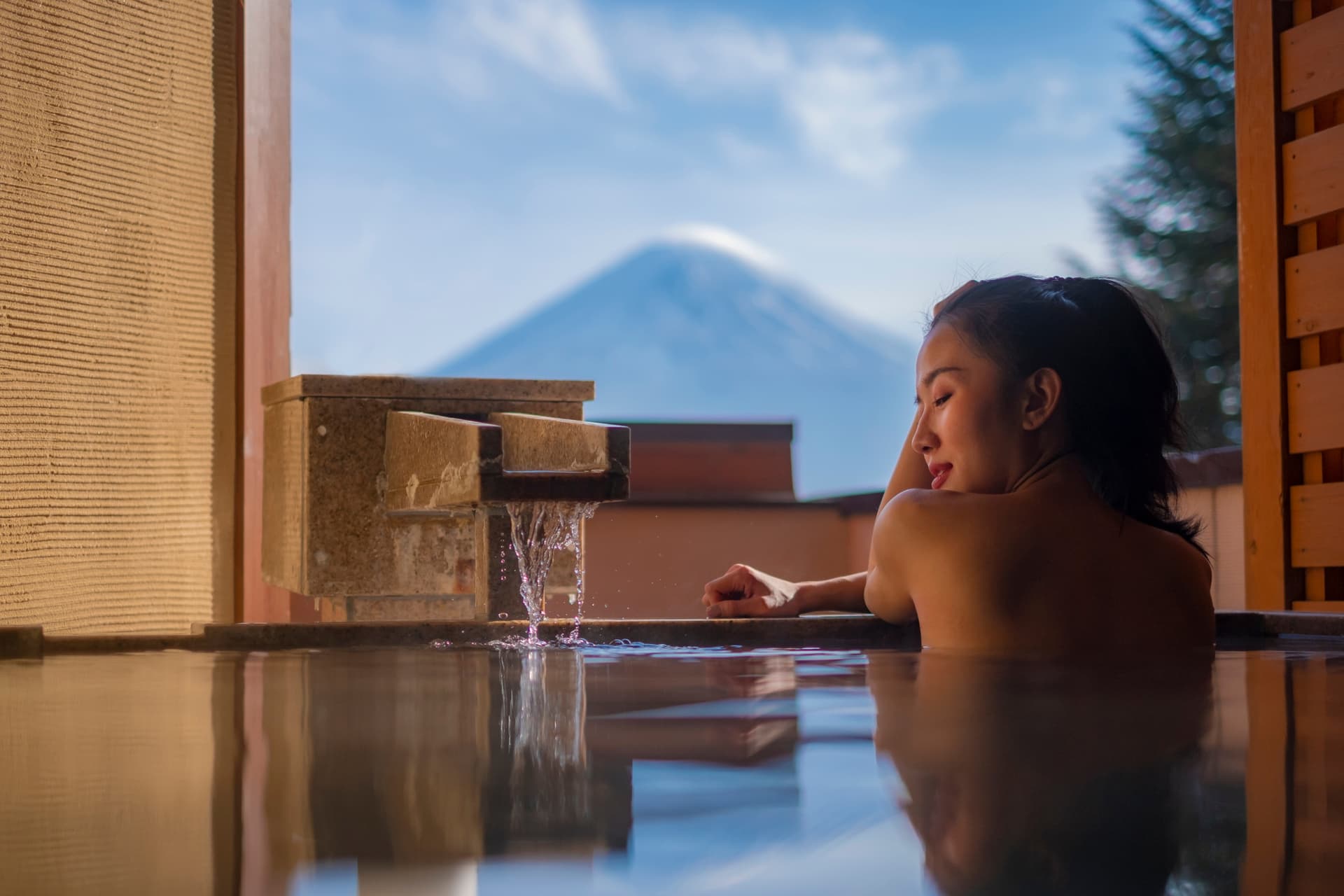
For Mount Fuji enthusiasts, Hottarakashi onsen, which features two thermal baths, offers splendid views of Japon's highest peak and the Kofu Valley. Tamatebako, in southern Kagoshima Prefecture, also has two rotenburos—one with a perspective over the sea and Mount Kaimon, the other revealing Takeyama Rock. At Takaragawa, there are four rotenburos comfortably situated on the banks of a mountain river. Then note Furô onsen, not far from Shirakami-Sanchi, a site designated as UNESCO World Heritage. Be aware: men are not alone in appreciating a soak in volcanic waters. In the Jigokudani natural park, in the heart of the Japanese Alps, Japanese macaques equally cherish hot spring baths.
Practical Advice
Onsens and public baths are not intended for washing. You must shower before entering nude into the hot sulphurous or clear waters. Some basins are free; the better-equipped ones charge a fee. Each establishment has a changing room for your belongings and a shower area for washing. You can typically rent a towel on-site.
Onsens exist in various forms: indoor onsens or rotenburos, mixed or separated for men and women, private or public. They differ in their mineral content. The most renowned basins mostly belong to Ryokans, traditional Japon inns. Do not confuse onsens with sentôs, whose water comes from the tap.
Tattoo Restrictions
Many onsens and sentôs do not permit tattoos, as these are considered the mark of yakuzas. This rule is strictly applied throughout the country and applies to foreign visitors as well. You can always try to cover a small tattoo with an adhesive bandage, but the best approach is to ask the onsen staff whether an exception is possible. Ask them: "Irezumi wa daijōbu desu ka" (Are tattoos allowed?). Many thermal centres and onsens are now more lenient with foreign visitors on this matter. If one onsen refuses you entry, you will find another that accepts.
Rates
Some of Japon's finest onsens are accessible free of charge. Simply bring your towel, undress, do a quick rinse, then splash into the water. For paying stations, the cost remains modest—around 500 yen on average. The most luxurious onsens may charge entry at 4,000 yen.
Give it a go!
Our local experts arrange this activity for you.