Lake Towada
Lake Towada
The largest caldera lake on Honshu, nestled between Aomori and Akita prefectures, Lake Towada combines volcanic landscapes, the Oirase Gorge, and contemporary art.
Lake Towada is the largest caldera lake on the island of Honshu. Stretching across the prefectures of Aomori and Akita, it spans 46 km in circumference with a maximum depth of 327 m, and ranks among the Tohoku region's most significant scenic sites.
Why visit Lake Towada
Designated in 1927 as one of eight scenic views of Japan by Tokyo Nichi Nichi Shimbun and Osaka Mainichi Shimbun, Lake Towada combines multiple attractions: a pristine volcanic setting, remarkably clear blue waters, and direct access to the Oirase Gorge, one of northern Japan's most prized river walks. The site has been part of the Towada-Hachimantai National Park since 1936, ensuring protection of its forest landscapes.
Four observation platforms positioned around the lake offer different vantage points, from sweeping vistas to the more intimate cove of Nakayama.
A caldera that remained wild for centuries
The caldera housing the lake formed tens of thousands of years ago following successive volcanic eruptions. The region remained wild and uninhabited until the end of the Edo period (1603–1868). The Nambu clan, rulers of the Morioka domain, were the first to harness the Oirase River, which flows from the lake, to irrigate the Sanbongihara plain—present-day Towada city.
The lake itself originally had no fish. It was Wainai Sadayuki who introduced the first trout in 1903, establishing the foundation for local fishing. Half a century later, in 1953, sculptor Kotaro Takamura's statue Otome no Zo ("The Statue of Maidens") was installed on the shore at Yasumiya to mark the park's 15th anniversary. Depicting two women facing one another, it remains the site's most iconic and reproduced symbol today.
What to see and do
Yasumiya, the gateway
The small settlement of Yasumiya, on the southern shore, serves as the bus terminus and base for most visitors. It is also a popular camping spot in summer. The Otome no Zo statue and the Towada-Jinja shrine are just a short walk from the center.
The boat crossing to Nenokuchi
Tourist boats shuttle between Yasumiya and Nenokuchi, on the eastern shore, hugging the forested cliffs of the caldera. The crossing takes roughly one hour. For a more active experience, canoes and small boats are available for rent at Yasumiya.
Oirase Gorge
The Oirase River originates at Nenokuchi, and its gorge is among the Tohoku's most celebrated. A marked trail of 14 km follows the waterway to Yakeyama, punctuated by waterfalls, rapids, and ancient mosses. The route is flat and accessible; bicycles can be rented on-site for those preferring a faster pace.
Towada Art Center
Some 30 km from the lake, in the city of Towada, the Towada Art Center is a contemporary art museum where each gallery is dedicated to a single artwork. Spaces are connected by glass-walled corridors opening onto the street. Works by Yoko Ono, Yayoi Kusama, Yoshitomo Nara, and Ron Mueck, among other international artists, are on view.
When to visit Lake Towada
- Spring (April–May): boat services resume and vegetation flourishes after snowmelt.
- Summer (June–August): mild temperatures ideal for hiking along the Oirase and paddling on the lake.
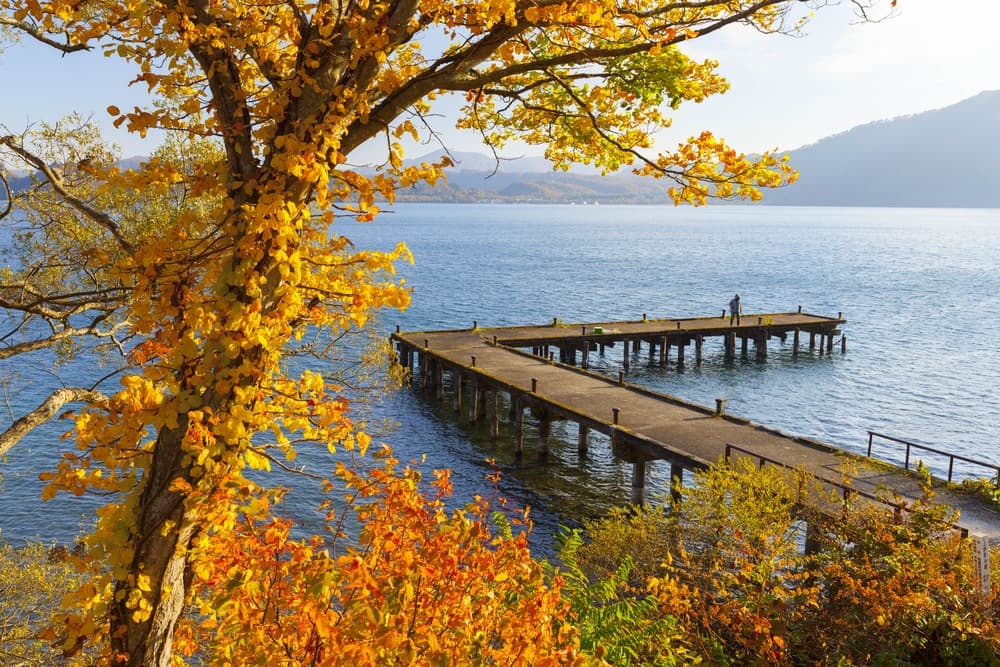
- Autumn (mid-October to early November): the season of kôyô, when the deciduous forests framing the caldera turn brilliant red and gold. This is the peak visitation period.
- Winter (December–March): most transport and boat services cease operations. In February, the Lake Towada Winter Story festival briefly enlivens Yasumiya with an ice village, igloo bar, snow sculptures, light displays on the Otome no Zo statue, and early-evening fireworks.
Practical information
- Access to the lake: open year-round, though tourist services (boats, certain shuttles) operate mainly between April and November.
- Recommended visit duration: one full day to combine Yasumiya, the boat crossing, and the Oirase Gorge trail; two days to include the Towada Art Center.
- Accommodation: ryokans and guesthouses around Yasumiya, plus a few seasonal campgrounds.
- Gear: sturdy hiking boots for the Oirase trail and a windproof jacket, even in summer.
Getting there
From Tokyo, take the Tohoku Shinkansen (Hayabusa) to Hachinohe (approximately 3 hours). From Hachinohe, a JR bus reaches Yasumiya in about 2 hours 15 minutes, with several possible stops along the Oirase River. Bus connections are not available in winter.
The nearest airport is Aomori, served by direct flights from Tokyo, Osaka, Nagoya, and Fukuoka.
Nearby attractions
To extend your stay in the region or complete a Japan itinerary, several mountain sites and cultural destinations merit a visit:
- Mount Tsukuba, an iconic peak in eastern Japan.
- Mount Hiei, sacred mountain overlooking Kyoto.
- Mount Kōya, a major centre of Shingon Buddhism.
- Kinosaki Museums, another cultural stop off the beaten path.
Frequently asked questions
Frequently asked questions
Autumn, from mid-October to early November, for the kôyô. Spring and summer suit hikers who prefer avoiding crowds. Winter is more challenging as most transport services are suspended, except during the February festival.
One full day allows you to combine Yasumiya, the boat crossing to Nenokuchi, and part of the Oirase Gorge trail. Two days are preferable to include the Towada Art Center and fully appreciate the park.
The lake itself remains open, but boats and most seasonal buses do not operate. Access is by car, with winter tyres mandatory. The Lake Towada Winter Story festival in February remains the main event of the season.
During peak season, especially the kôyô, arriving early at Yasumiya or booking in advance is recommended. Outside peak times, purchasing tickets on-site is usually sufficient.
Yes, the lake fits naturally into a Tohoku circuit including Aomori, Hirosaki, or the Shimokita Peninsula. The Oirase Gorge and Towada Art Center are part of the same tourism basin.
Extend your journey
Lake Towada fits naturally into an itinerary exploring northern Japan, blending volcanic landscapes with cultural towns. To tailor a journey that suits you, explore our Japan travel experiences.
Interested in this visit?
We can include it in your personalised itinerary.