Lake Toya
Lake Toya
A caldera lake in southwestern Hokkaido, Lake Toya brings together active volcanoes, thermal springs, central islands and daily fireworks from spring through autumn.
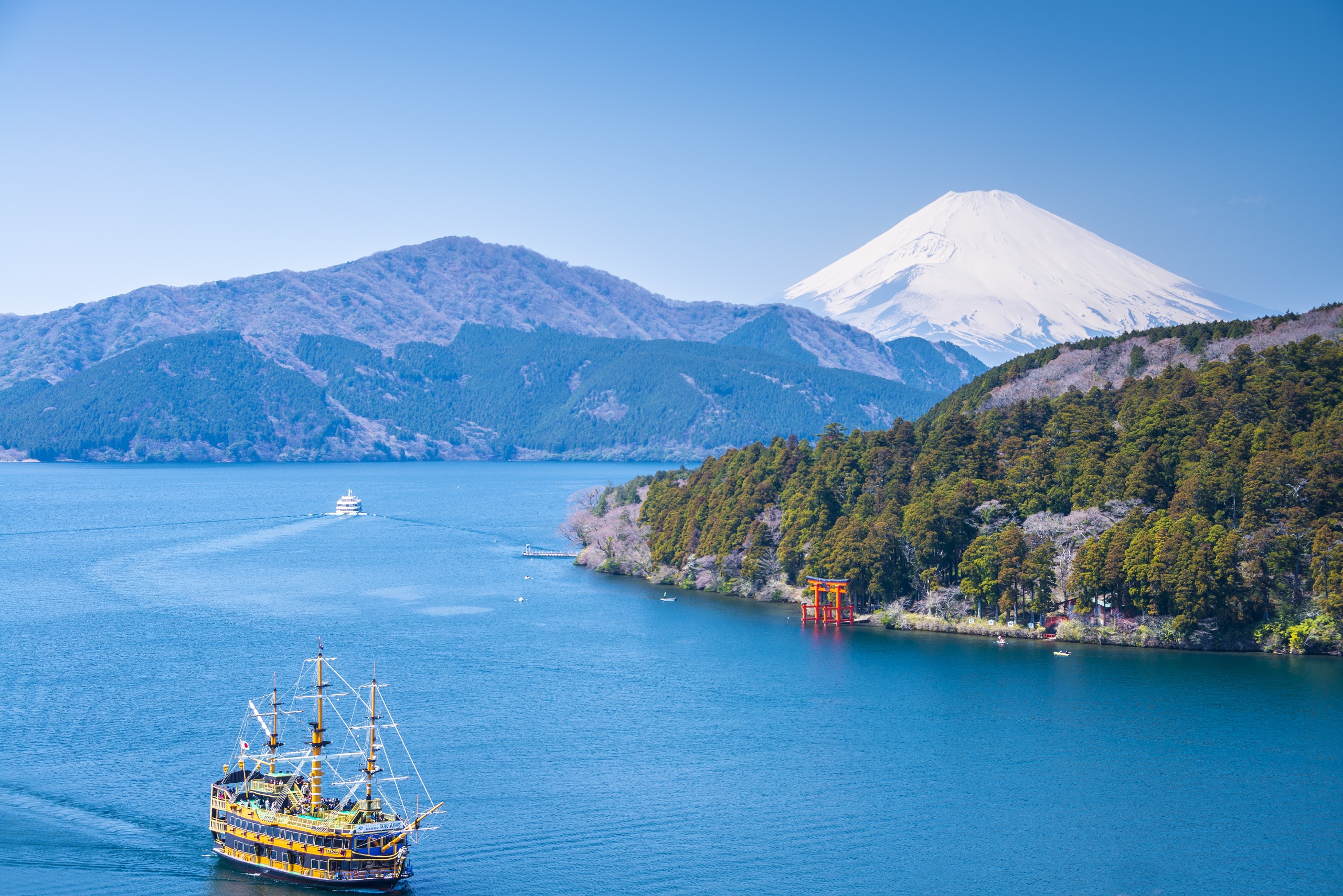
Lake Toya occupies a volcanic caldera in southwestern Hokkaido, within the Shikotsu-Toya National Park. Four islands dot its center, hot springs line its shores, and two active volcanoes, Mount Usu and Mount Showa-Shinzan, watch over the horizon. The hot spring town of Toyako serves as a base for exploring the site, approximately 90 km from Sapporo.
Why visit Lake Toya
The lake ranks among Japan's "100 finest tourist destinations" and combines multiple attractions within a compact area: recent volcanic geology visible on the ground, accessible hot springs, family-friendly hikes, and a daily pyrotechnic show during the pleasant season. The caldera remains navigable, the central islands can be visited by boat, and a network of trails allows you to explore volcanism without special experience.
The site has also left its mark on Japanese popular culture: it appears on the bokuto (wooden sword) of Gintoki Sakata in the manga Gintama, served as inspiration for Lake Kiriya in the anime Sora no Mesoddo, and for Lake Verity in the Sinnoh region in Pokémon Diamond and Pearl.
History and geological formation
Lake Toya was born more than 110,000 years ago, during a major eruption that emptied a magma chamber and triggered surface collapse. The resulting basin filled with water, and subsequent magmatic activity caused four domes of cooled lava to emerge at the caldera's center: Bentenjima, Kannonjima, Oshima, and Nakajima.
Volcanic activity remains vigorous. Mount Usu, on the southern shore, has erupted several times during the twentieth century, including in 2000. That latest eruption damaged roads and buildings, with remnants now preserved and marked as memorial trails. In 2008, the town of Toyako, on the western coast, hosted a G8 summit, which helped bring the region to international attention.
What to see and do
The four islands of the caldera
Boats connect Toyako port to the central islands. Nakajima, the largest, offers easy hiking trails through a forest inhabited by sika deer. Bentenjima, Kannonjima, and Oshima are best enjoyed from the water.
Mount Usu and Mount Showa-Shinzan
Mount Usu rises to 737 m and is reached by cable car from its base. At the summit, well-maintained trails follow the fumaroles and offer sweeping views over the caldera and Uchiura Bay. Mount Showa-Shinzan, more modest at 398 m, is a volcano that emerged between 1943 and 1945 in a former cultivated field — a textbook case for volcanologists.
Traces of the 2000 eruption and Konpira craters
At the foot of Mount Usu, a trail leads to the ruins of buildings struck by lava and mudflows during the 2000 eruption, as well as the young Konpira craters, formed at that time. The Toyako Volcanic Science Museum complements the visit with archival films, seismic simulations, and explanations about regional volcanic hazards.
Hot springs and foot baths
Toyako Onsen lines up thermal hotels and public baths. Several free foot baths are scattered throughout town: the Toyako Visitor Center map lists them all. The waters, recognizable by their brownish tint, are traditionally associated with relief from neuralgia, cold sensitivity, and arthritic pain.
Fireworks and night cruises
From spring through autumn, a pyrotechnic display lasting about thirty minutes (over 450 shots) illuminates the lake each evening from moving barges. The town organizes night cruises to watch the show from the water and offers yukata rental to dress in traditional attire.
When to visit
The region enjoys a humid temperate climate (Cfa according to the Köppen-Geiger classification for the lake area), with annual rainfall of approximately 1,688 mm and an average temperature of 15.7 °C. In practical terms:
- Summer (June to September): busiest season, nightly fireworks, mild temperatures, ideal for hiking and outdoor hot spring bathing.
- Autumn (October-November): foliage colors around the caldera, quieter crowds.
- Winter (December to March): abundant snow typical of Hokkaido, striking landscapes, thermal baths especially welcome.
- Spring (April-May): resumption of lake activities, first cruises.
Practical information
- Toyako Visitor Center: trail maps, foot bath locations and viewpoints, bicycle rental for partial lake tours.
- Rates: moderate for cruises and Mount Usu cable car; numerous free foot baths.
- Recommended visit duration: 1 to 2 days to combine cruise, volcanic hike, museum, and hot spring.
- What to bring: hiking shoes for Mount Usu, towel for hot springs, warm clothing for evenings outside summer.
How to get there
Lake Toya is located approximately 90 km southwest of Sapporo. New Chitose Airport (Shinchitose), which serves Sapporo, receives flights from Tokyo, Nagoya, Osaka, Fukuoka, and Niigata.
From Sapporo, a limited express train reaches Toya Station (Toya Onsen station) in approximately 2 hours. A bus line then connects the station to the lake shore and hot spring district in about twenty minutes. By car, allow roughly 2 hours from Sapporo via expressway.
Nearby
To extend your exploration of Japan's volcanic and thermal landscapes:
- The museums of Kinosaki, in another renowned hot spring town in the country.
- Mount Kōya, a major center of Shingon Buddhism in the Kii Peninsula.
- Mount Hiei, sacred mountain overlooking Kyoto.
- Mount Inasa, famous for its nighttime panorama over Nagasaki.
FAQ
Frequently asked questions
One day allows you to take a cruise to Nakajima island, ride the Mount Usu cable car, and enjoy a hot spring bath. To add the volcanic museum, the 2000 ruins trail, and evening fireworks, plan for 2 days on-site instead.
The pyrotechnic show runs every evening from spring through autumn, roughly April-May to October depending on the year. Summer evenings offer the most stable conditions, but also the largest crowds.
Yes. A cable car reaches the summit (737 m), where short, well-maintained trails let you observe fumaroles and the caldera without strenuous effort.
The simplest way is a Tokyo–New Chitose flight (approximately 1.5 hours), then a limited express train to Toya Station (approximately 2 hours), followed by a bus to the lake shore.
Yes. Most thermal hotels and public baths in Toyako Onsen welcome international visitors. Standard Japanese onsen etiquette applies (shower before bathing, no visible tattoos in some establishments).
Plan your trip
Lake Toya naturally fits into a Hokkaido itinerary combining Sapporo, Noboribetsu, and the Shakotan Peninsula. To build a coherent journey around Japan's volcanic and thermal landscapes, consult our Japan travel guide.
Interested in this visit?
We can include it in your personalised itinerary.