Urakami Cathedral
Urakami Cathedral
In Nagasaki, Urakami Cathedral tells the story of 250 years of Hidden Christians, the 1945 atomic bombing, and the reconstruction of a Japanese Catholic community.
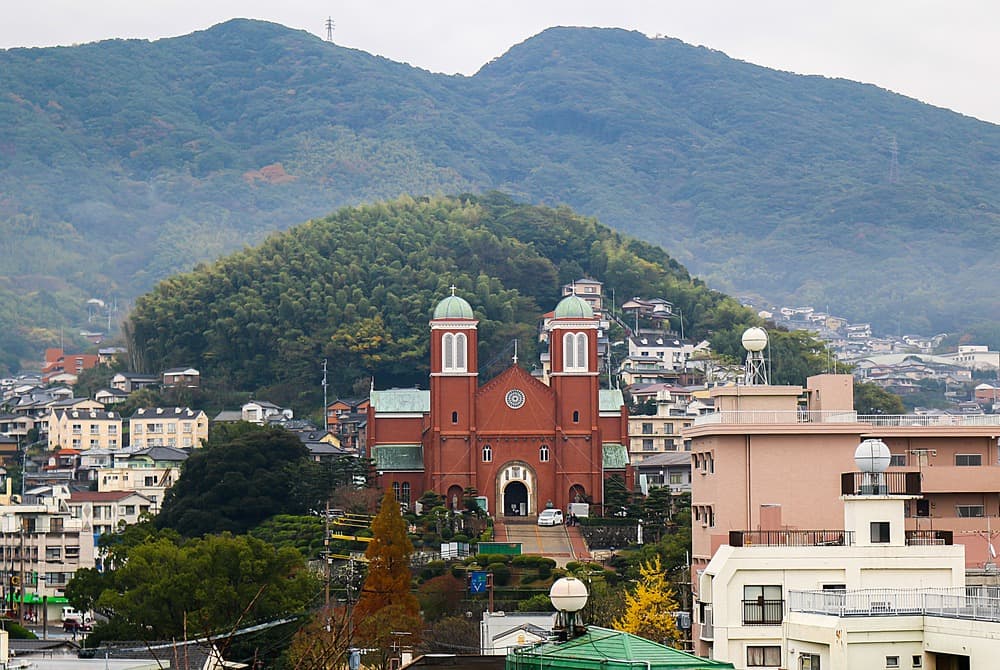
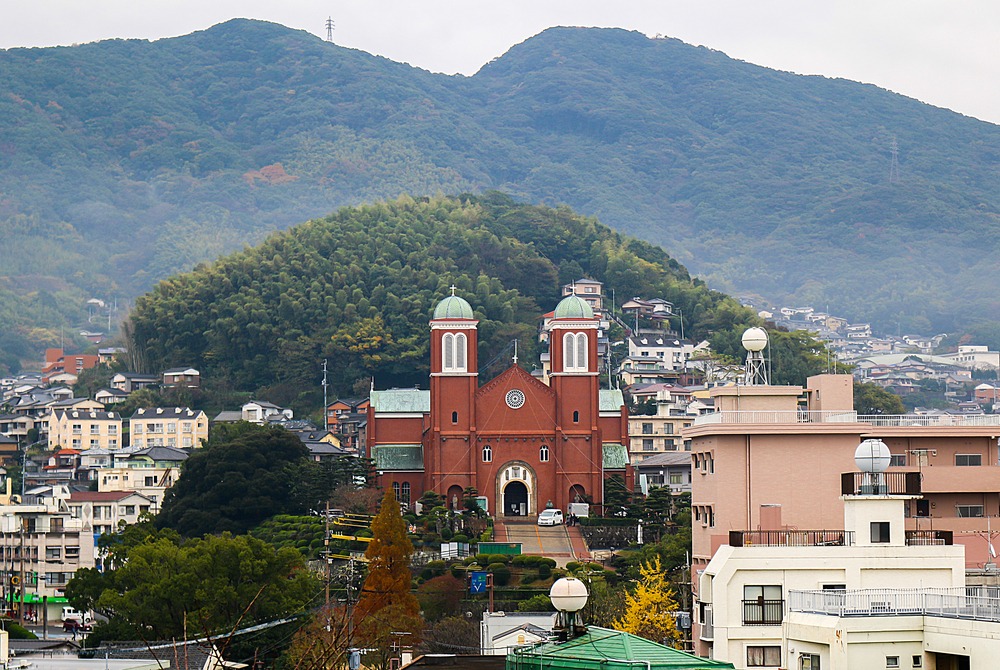
Urakami Cathedral, also known as Urakami Santa Maria Cathedral or Cathedral of the Immaculate Conception, stands in the Urakami district, north of Nagasaki. A neo-Romanesque building with distinctive red brick walls, it bears witness to the history of persecuted Japanese Christians for over 250 years, followed by the atomic destruction of 1945, whose epicenter lay just 500 meters away.
Why visit Urakami Cathedral
The cathedral brings together three inseparable stories of Nagasaki: the silent resistance of the Kakure Kirishitan (Hidden Christians), the rebuilding of a community after exile, and the memory of the August 9, 1945 bombing. The visit appeals especially to travelers interested in religious history, Western architecture in Japan, and World War II memorial sites. It fits naturally into an itinerary combining the Peace Park and the Atomic Bomb Museum, both within a few minutes' walk.
A history marked by faith and resilience
Origins: the Hidden Christians of Urakami
The cathedral's history is inseparable from that of the Kakure Kirishitan, the Hidden Christians. After Christianity was banned in the early 17th century, the faithful practiced their religion in secret for over 250 years, without clergy or visible church.
In 1865, Father Bernard Petitjean discovered that nearly all residents of Urakami were Christian, even though Christianity remained prohibited. The Nagasaki magistrate arrested the entire village and tortured 68 of its inhabitants to force them to renounce their faith. Protests from foreign consuls forced the Tokugawa shogunate to back down, but repression continued.
Under the new Meiji government, nobleman Sawa Nobuyoshi, hostile to any foreign influence, was placed in charge of public order in Kyūshū. With imperial approval, he exiled the villagers of Urakami to different regions of Japan: of more than 3,600 people deported, 650 perished. Survivors did not return until 1873, after the ban was lifted.
Construction and destruction
Upon their return, the faithful decided to build a church on the land where their ancestors had been persecuted. Construction, supervised by French missionary priests, began in 1895 and lasted three decades. With its 64-meter façade, the building was considered the largest Christian structure in East Asia until 1945.
On August 9, 1945, the cathedral was completely destroyed by the atomic bomb dropped on Nagasaki. The epicenter lay 500 meters away. The faithful attending mass at the moment of the explosion were killed instantly. This destruction, experienced as a second catastrophe by the local Catholic community, inspired Japanese dramatist Tanaka Chikao to write his play The Head of Mary, centered on efforts to rebuild the Virgin's statue.
Reconstructions of 1959 and 1980
The fate of the ruins was the subject of long debate. The municipality wanted to preserve the remains as a historical site; the Christians of Urakami wished to rebuild their cathedral on the same spot. The community won: a new reinforced concrete building was completed in 1959. In 1980, a renovation restored its original neo-Romanesque appearance, with its characteristic red brick walls.
What to see on site
Interior of the cathedral
The current building follows neo-Romanesque architectural codes: simple nave, stained glass windows and religious statuary. Services remain open to visitors, provided they observe silence and respect the liturgical character of the place.
The Virgin of Nagasaki
Inside is displayed the wooden bust of an ancient Virgin statue, found almost intact in the rubble after the bombing. Becoming a symbol of the struggle for peace, this fragment was blessed by Pope Benedict XVI in 2010, then by Pope Francis in 2019.
Remains of the first cathedral
Several elements of the original building have been relocated and are visible nearby:
- Damaged walls, columns and statues displayed at the Peace Park.
- The cathedral bell, preserved at the Nagasaki Atomic Bomb Museum.
Practical information
- Duration of visit: allow 30 to 45 minutes for the cathedral alone, more if you include the Peace Park and neighboring museum.
- Dress code: clothing covering shoulders and knees, active place of worship.
- Photography: generally tolerated outside; inside, follow signage and avoid photographing during services.
- Fee: free entry to the cathedral.
How to get there
From Nagasaki Station, the simplest way is by tram number 1, the line serving the city's main points of interest. Get off at the Urakami stop, then walk a few minutes heading north. Taxi remains a convenient alternative in case of reduced mobility or extreme heat. From the Peace Park, the cathedral can be reached on foot in less than ten minutes.
Nearby attractions
- Nagasaki Peace Park: within a few minutes' walk, it houses remains and commemorative monuments.
- Atomic Bomb Museum: preserves the cathedral bell and documents the events of August 9, 1945.
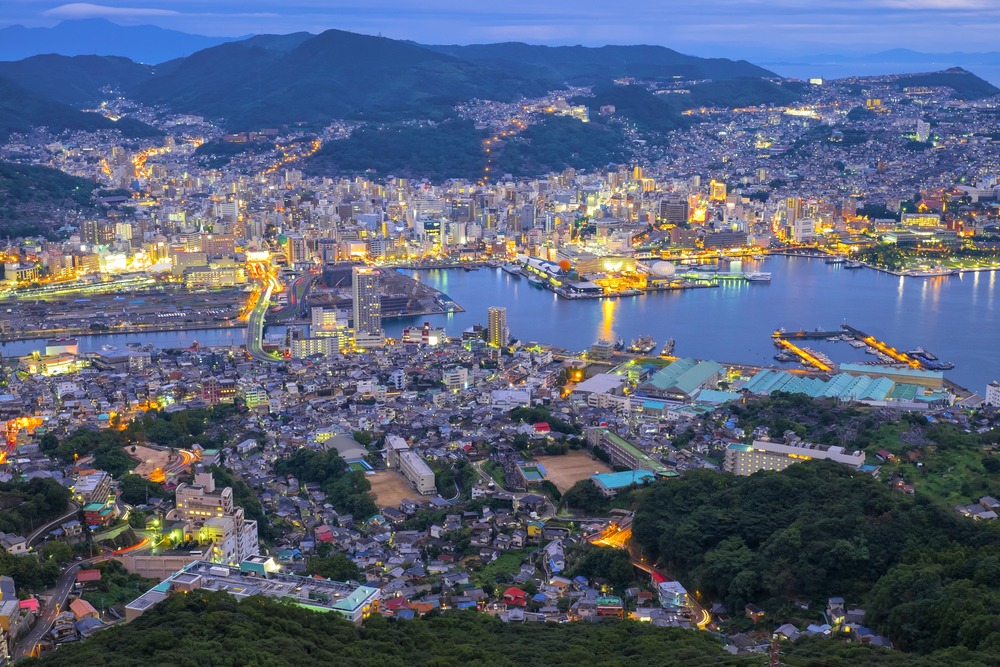
- Mount Inasa: famous panorama over Nagasaki Bay, accessible by cable car.
- Arita: birthplace of Japanese porcelain, about an hour's drive away.
Frequently asked questions
Frequently asked questions
Yes, masses are open to the public. Visitors are invited to observe silence, refrain from photographing during the ceremony, and dress modestly.
No. The cathedral built from 1895 was destroyed by the atomic bomb on August 9, 1945. The current building is a reinforced concrete reconstruction completed in 1959, restored in 1980 in a neo-Romanesque style faithful to the original.
Damaged walls, columns and statues are displayed at the neighboring Peace Park. The Angelus bell is preserved at the Nagasaki Atomic Bomb Museum.
Yes, but the historical context (persecutions, bombing) should be explained to children beforehand. The combined visit with the Peace Park offers a coherent educational itinerary.
Allow 30 to 45 minutes for the cathedral alone. A half-day is reasonable if you combine it with the Peace Park and the Atomic Bomb Museum.
Preparing your trip
Urakami Cathedral has its place in an itinerary exploring the memory of Nagasaki and the heritage of Kyūshū. To plan a custom stay including this stop, consult our tours to Japan.
Interested in this visit?
We can include it in your personalised itinerary.