Japanese Calligraphy
Calligraphy, the art of forming characters with precision, is taught from an early age in Japon.
Calligraphy, the art of forming characters with precision, is taught from an early age in Japon.
Shûji 習字, in Japanese, literally means to practice [forming] characters. While we make do with 26 letters, Japanese speakers will learn thousands throughout their lives. Each kanji expresses a complete idea and forms a whole unto itself. Japanese calligraphy focuses on forming these characters correctly, paying careful attention to the balance of strokes—much like a house of cards that must remain perfectly balanced.
The term shodô (書道) takes this even further: Japanese calligraphy is not merely an art form, but a path, a way of life 道 dô (as in judo, kendo, aikido, and so many others)… Children learn to concentrate before they write, to visualize the character before the brush touches paper. For the way one initiates each stroke, continues it, and concludes it matters greatly. Three types of strokes are distinguished: tomé とめ, hané はね, and haraï はらい—techniques one must master to progress.
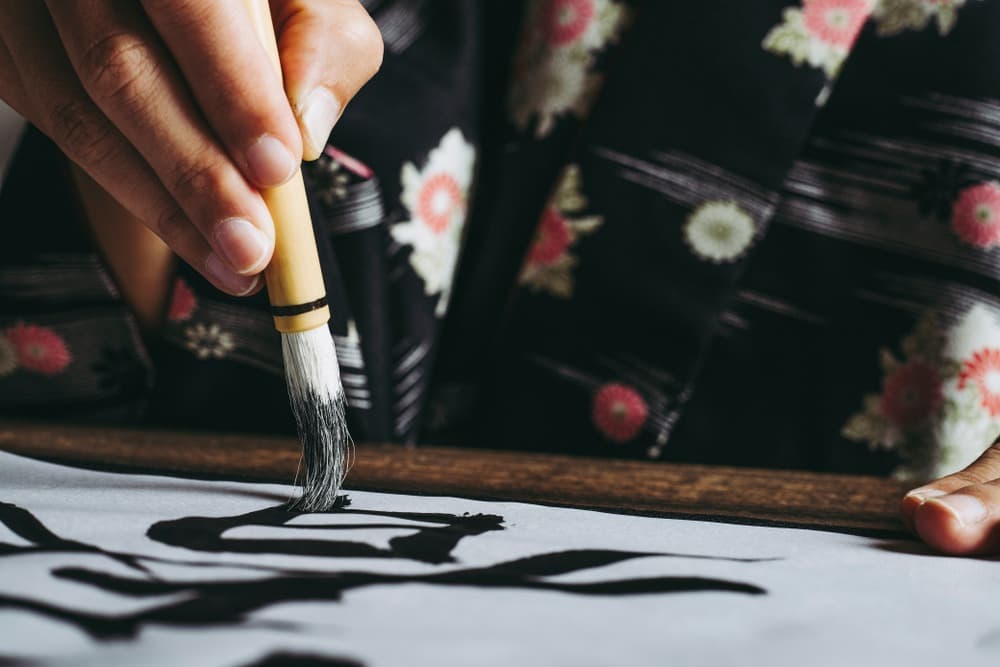
Calligraphy is practiced using a brush, fudé 筆, and black ink, sumi 墨, prepared by rubbing a coal-like block to extract powder, which is then mixed with water. How one prepares the ink and holds the brush matters significantly, as it influences the thickness and tonal variations (nôtan 濃淡) of the strokes.
One of the few occasions when Japanese people write with a brush today is when sending New Year's greeting cards. Often, the fudé pen 筆ペン (flexible-tip marker) is used instead of a traditional brush, as it is more practical.
It is worth noting that several forms of calligraphy exist beyond the kaïsho 楷書 style taught in schools: gyôsho 行書 (semi-cursive), sôsho 草書 (cursive), tensho 篆書, and reisho 隷書.