The Tea Ceremony
Sa-dô 茶道 (literally: the "way of tea"), the tea ceremony is an essential element of Japanese culture.
Sa-dô 茶道 (literally: the "way of tea"), the tea ceremony is an essential element of Japanese culture.
What exactly is it?
An art (of living?), a custom, a philosophy, or simply a pastime? Also called o-cha-kai お茶会, or cha-no-yu 茶の湯 (literally: "the water of tea"), the tea ceremony is one of the great "ways" (paths, dô 道) of traditional Japon, whose principal elements are: the welcoming and respect of the honored guest, beauty in simplicity, attention to detail and perfection… So many aspects that have been studied, but above all practiced day after day by Japanese masters for hundreds of years.
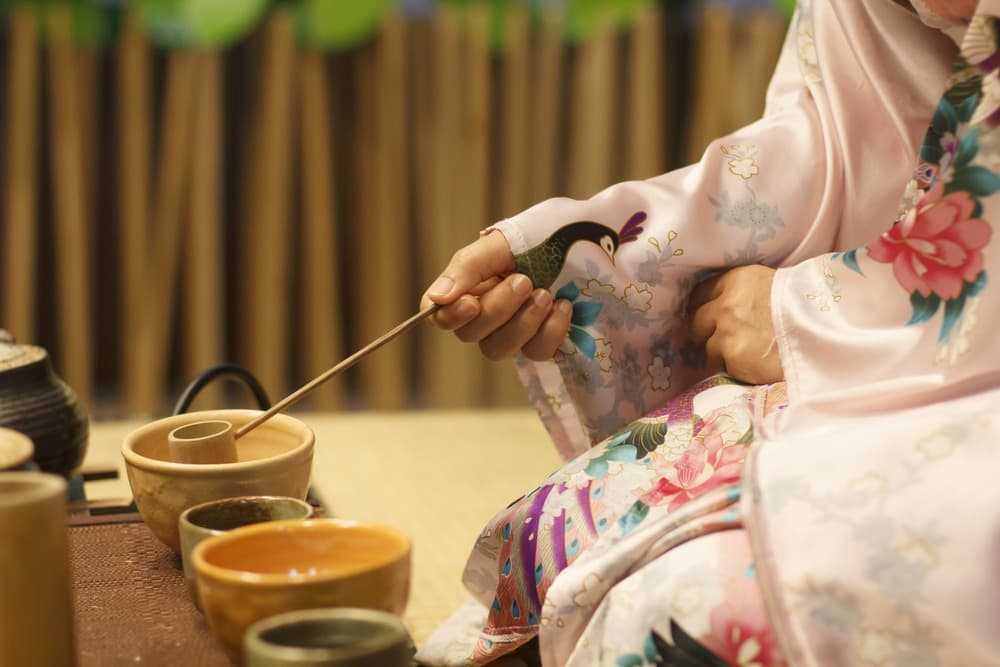
It is often said that the tea ceremony is lengthy, and this is true: one takes time. The time to welcome, or to be welcomed (depending on whether one is host or guest). In silence (save for a few formulas or compliments). The time to admire what is beautiful: the objects (the bowl in which the tea is served, the whisk, the decoration of the room and so forth are works of art to be contemplated with respect). Each gesture is precisely defined and repeated in the same way each time. But, as a tea ceremony instructor once told me, these gestures must become so natural that one no longer needs to think about executing them… in order to be fully present for one's guest.
The tea served during the tea ceremony is matcha 抹茶, a fine powder of green tea, over which hot water is poured, and which is then whisked into a froth with a small whisk. It is drunk in three sips, and the guest will take care to inhale the final sip (with a slight sound) so as not to lose a drop. The guest will then express a compliment such as: kekkô no o-témaé dé-gozaïmashita! 結構のお手前でございました! (note that details differ depending on the schools)
While the tea ceremony is often performed in a closed group setting, it is nonetheless possible to attend one in certain places (certain temples, or for example, the Ura Senke 裏千家 center in Kyoto) but advance reservation is often necessary. In any case, it is a most interesting experience.