Gion Matsuri Festival: Discover Japan's Largest Event
The Gion Matsuri was created in the 9th century, following an epidemic (or devastating floods) to appease the wrath of the God Susanoo-no-mikoto
The Gion Matsuri was created in the 9th century, following an epidemic (or devastating floods) to appease the wrath of the God Susanoo-no-mikoto – at a time when natural disasters were considered divine curses. Today, the Gion Matsuri Festival is Japan's most significant event! Join us and discover this emblematic celebration held every year in July in the historic Gion district of Kyoto.
What is Kyoto's Gion Matsuri Festival?
Originally, the Gion Matsuri was not a festival, but a goryō-e: a Shinto ritual meant to appease spiritual forces. The ceremony took place at the Yasaka Shrine, located in the historic Gion district. The building is dedicated to Susanoo-no-mikoto: the God of storms in the Shinto religion (also known as Yasaka-no-Okami).
Over the centuries, and with the evolution of the world, the ritual became an important cultural event; to the point of becoming Japan's largest festival. In 2016, the Gion Matsuri was inscribed on UNESCO's intangible cultural heritage list, under the title "Yama, Hoko, Yatai, float festivals in Japan" – which includes, in total, "33 representative examples across various regions of Japan, reflecting the diversity of local cultures".
How does the festival unfold (and what are its key dates)?
The Gion Matsuri takes place throughout the month of July in Kyoto, with events of varying importance and two main highlights on July 17 and 24, which correspond to the float parades (Yamaboko Junko).
Omukae Chochin (July 10): Welcoming the Gods
The first major public event takes place on July 10, with the Omukae Chochin. This is a lantern-lit nighttime procession intended to welcome the deities of the Yasaka Shrine. Devotees, musicians, and dancers then traverse the city center. The mikoshis (portable altars designed to receive the deities) are purified by the shrine's high priest.
Yoiyamas (July 14, 15, 16): Street Celebrations
The festival features two float parades. The first on July 17, called Saki Matsuri. The second on July 24, called Ato Matsuri. These two processions are (each) followed by three days of celebration, called Yoiyamas. These festive days occur on July 14, 15, 16, then July 21, 22, and 23, before the second parade.
On this occasion, the streets come alive, adorned with hangings and flowered banners. You can also visit the floats and purchase traditional good-luck charms (chimaki) for a few yen. During the Yoiyamas, the Byōbu Matsuri also takes place…
This is an ancestral tradition in which residents and art galleries display their jewels and valuable objects (such as kimonos, screens, etc.) to festival-goers. Contrary to what one might think, these exhibitions are not intended to please the deities, but rather a way to beautify the festival by showcasing beautiful objects.
Yamaboko Junko (July 17 and 24): Float Parades
The two float parades of the Gion Matsuri are quite similar, but differ in their symbolism and atmosphere.
July 17 (Saki Matsuri): this date marks the highlight of the first half of the festival. It symbolizes the welcome of the deities and comes with heavy crowds. The parade takes place from 9:00 a.m. to 11:30 a.m., and you can see 23 floats.
July 24 (Ato Matsuri), less crowded, this day closes the ritual cycle with a procession of thanksgiving. The atmosphere is calmer. The parade takes place from 9:30 a.m. to 11:50 a.m. and is more modest, with about ten floats.
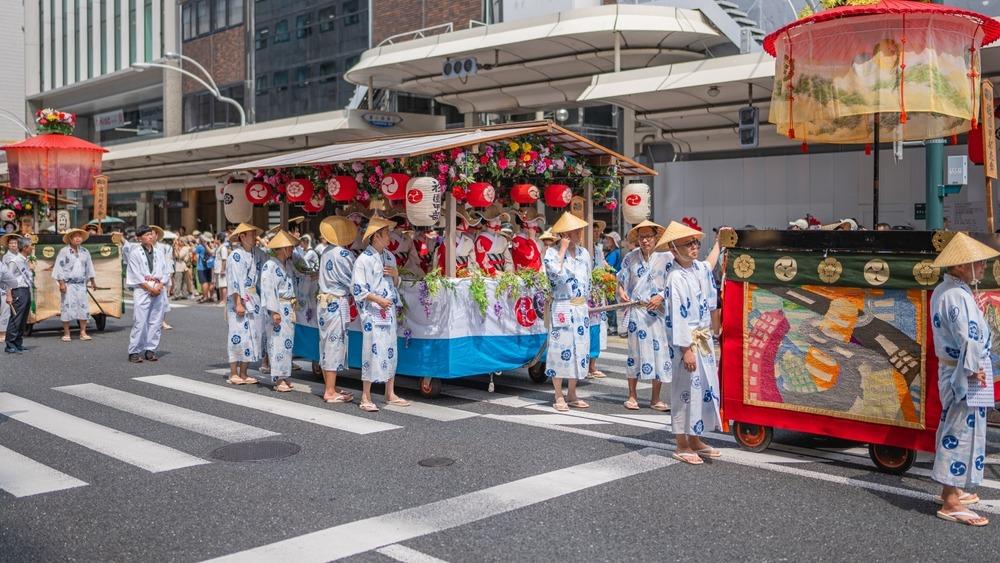
Regardless of the date, you will be able to admire two types of floats. The hokos (the most impressive floats) can weigh up to 12 tons and are occupied by musicians. The yamas, smaller, are occupied by mannequins. Both types of floats showcase mythological tales and legendary figures.
THE highlight of these two parades? The spectacular 90° turns, accomplished using wet bamboo (tsujimawashi) placed under the wheels, which provide thrills and beautiful demonstrations of collective expertise!
Did you know? It is during the Kujitori-shiki on July 2 that the draw takes place which determines the order in which the floats will pass. This ceremony (not open to the public) takes place at Kyoto's city hall. |
Hanagasa Junko (July 24): The Flower Hat Parade
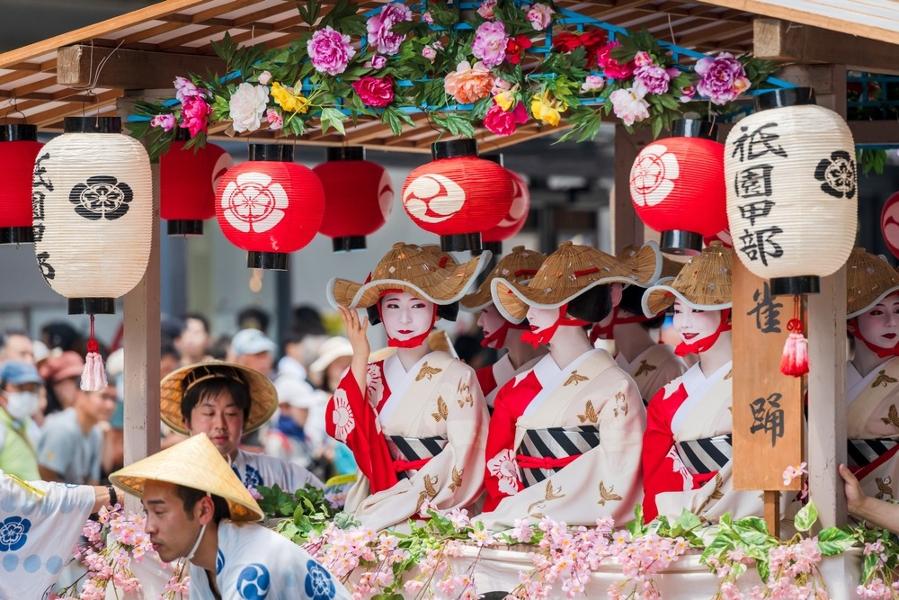
On the same day as the second parade, another procession also animates the city: the Hanagasa Junko. This more family-friendly and intergenerational procession is composed of women dressed in kimonos and lovely flower hats (hanagasa), as well as children in traditional clothes or dressed as warriors (komusha).
Mikoshi Arai (July 28): Purification of the Mikoshis
On July 28, the mikoshis (palanquins) that participated in the processions are transported to the Kamo River and washed in its waters. This nighttime ceremony aims to purify the altars and close the deities' travels with respect.
Eki-jinja Nagoshi-sai (July 31): The Closing Ceremony
The festival officially closes on July 31 at 10:00 a.m. with the Eki-jinja Nagoshi-sai ceremony, which takes place within the grounds of the Yasaka-jinja. For this final major occasion, the faithful gather and leave offerings to the deities.
Why Visit Kyoto During the Gion Matsuri Festival?
During the Gion Matsuri Festival, residents and tourists gather around this great event and share authentic moments together. Moreover, as neighborhoods adorn themselves with a thousand colors and traditional music rises amid the fervor: yatais set up along the streets…
These mobile food stalls (considered Japanese street food) have existed since the Edo period (1603-1868). It's an opportunity to taste local specialties, such as takoyakis (octopus balls), yakisobas (stir-fried noodles), or skewers of dango (a dessert made with mochi).
How to Attend the Kyoto Matsuri Festival? Best Spots and Practical Information
Best Viewing Locations
While the festival parades are free, be aware that there are paid zones offering a more comfortable experience with reserved seats and unobstructed views of iconic parade locations, such as:
Shijo-Karasuma (the official starting point of the parade),
The tsujimawashi street corner,
The Kawaramachi-Oike intersection where you can witness the famous tsuji‑mawashi.
These premium spots are bookable through local agencies or associations. Would you like to discover the festival with a passionate guide? Contact our local agency in Japan, for an immersive experience with an English-speaking guide who has been based in Japan for several years!
Practical Information
When does the festival take place? | This annual event is held every year from July 1 to July 31. The most lively period falls between July 14 and 17 |
Where? | The festival takes over the central streets of Kyoto and the historic Gion district. |
How to get there? | The Gion Matsuri takes place in Kyoto's city center and is easily accessible by subway, bus, taxi, or on foot. |
How much time to plan? | Plan 1/2 day to attend a float parade |
Traffic | The city center becomes strictly pedestrian during yoiyamas processions |
How much do reserved seats cost? | Paid seats cost between 30 € and over 800 € depending on comfort level (with or without backrest, more or less spacious), included services (beverages, bento, etc.), priority access, and of course location. Reserved seats for the float parades (Yamaboko Junko) are particularly in demand. |
What's the weather like during the festival? | In July, temperatures in Kyoto hover around 30°C during the day and 28°C in the evening. Humidity levels are quite high (approximately 75%). Days can be very sultry. |
What should you bring? | ● Light clothing (cotton or linen), ● Comfortable shoes (preferably closed, as it's very crowded), ● Sunscreen, ● Sunglasses, ● A hat or cap, ● A mister or fan, ● Refreshing wipes (as many Japanese people do), ● A camera (with a fairly powerful zoom to capture the floats, which can be quite far from you), ● Yen cash (most food stalls do not accept credit cards). |
Frequently Asked Questions
What is a matsuri festival?
A matsuri is a traditional Japanese festival, organized by a shrine or temple. Some take the form of religious processions where mikoshis (palanquins) are carried through the city, while others feature decorated floats and festive entertainment. These events are an opportunity to gather around games and performances, in a convivial atmosphere. Each matsuri reflects the history and customs of its region.
What is the most famous festival in Japan?
The Gion Matsuri is one of Japan's most important traditional festivals. But other events are also very popular, such as the Tenjin Matsuri in Osaka, the Kanda Matsuri in Tokyo, the Nebuta Matsuri in Aomori, or the Sapporo Snow Festival, created in 1950, which attracts 2 million visitors every year!
Frequently asked questions
Access to the streets and parades of the Gion Matsuri is entirely free. However, reserved spots with seating and premium views are available for a fee, at rates ranging from 30 € to over 800 € depending on comfort and included services. Food stalls (yatais) are accessible to everyone, but it's recommended to have cash in yen as most do not accept credit cards.
The most lively period of the festival is between July 14 and 17. July 17 is the main day: it's the day of the grand float parade (Saki Matsuri) with 23 floats parading from 9:00 a.m. to 11:30 a.m. If you prefer a quieter atmosphere, July 24 (Ato Matsuri) also offers a beautiful procession with about ten floats, in a less crowded setting.
In July, Kyoto records temperatures of around 30°C during the day and 28°C in the evening, with humidity levels around 75%. To enjoy the festival comfortably, it's recommended to wear light clothing in cotton or linen, bring a hat, sunscreen, a fan or mister, and refreshing wipes. Also plan comfortable closed-toe shoes, as the streets are very crowded.
Yes, it is strongly advised to book your accommodation in Kyoto several months in advance for the festival period (especially around July 14-17), as this is one of the year's busiest periods. Reserved seats for the float parades (Yamaboko Junko) also sell out quickly and can be booked through local agencies or associations.
The tsujimawashi is the technique used to rotate the massive floats 90° in Kyoto's narrow streets. Wet bamboo is slid under the wheels to reduce friction and enable rotation. This maneuver, accomplished collectively by dozens of people, is one of the most anticipated moments of the float parades (Yamaboko Junko) on July 17 and 24. Since some hoko floats can weigh up to 12 tons, the technical feat is particularly impressive.