Mount Kōya
Mount Kōya
A UNESCO-listed Shingon monastic city, Mount Kōya offers temples, the forested Okuno-in cemetery and nights in shukubō, 2.5 hours from Osaka.
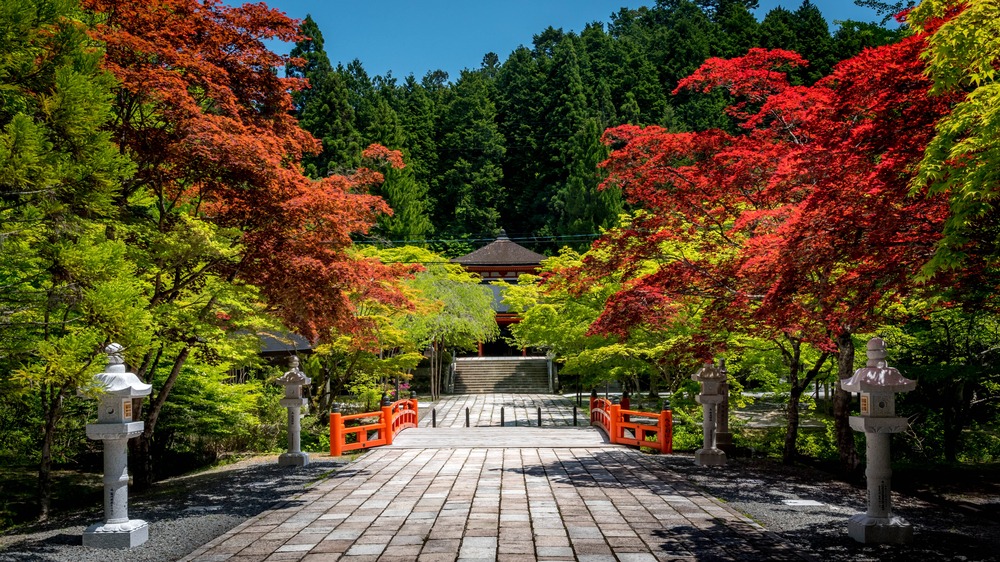
Mount Kōya (Kōya-san) is the capital of Shingon Buddhism and one of Japan's most revered pilgrimage sites. Perched at approximately 800 meters altitude on the Kii Peninsula in Wakayama Prefecture, this monastic city is home to over a hundred temples, a forest cemetery among the country's largest, and the mausoleum of the monk Kōbō Daishi. The site has been inscribed on UNESCO's World Heritage List since 2004.
Why visit Mount Kōya
Few places in Japan condense so much spirituality, history and forest landscape into one setting. Mount Kōya offers three experiences difficult to find elsewhere: a night in a temple (shukubō) alongside monks, a walk through the Okuno-in cemetery beneath century-old cedars and among over 200,000 stone monuments, and visits to the great Shingon halls of Danjo Garan and Kongōbu-ji. The altitude provides welcome coolness in summer, and the plateau's isolation preserves an atmosphere that stands in stark contrast to Osaka, situated just over a hundred kilometers away.
A sacred mountain founded in the 9th century
In 804, the monk Kūkai — posthumously known as Kōbō Daishi — departed for China to study Shingon esoteric Buddhism, then unknown to the Japanese archipelago. He remained there for two years. According to tradition, when he decided to return to Japan in 806, he threw his sankō (a three-pronged ritual instrument) from the coast of Mingzhou, asking that it indicate the place where his monastery should be founded. The object was said to be discovered embedded in a pine tree on Mount Kōya. Kūkai settled there, devoted his life to teaching Shingon, and died in 835. Tradition holds that he still rests in his woodland mausoleum, in eternal meditation.
Along with Kumano Sanzan and Yoshino-Ōmine, Mount Kōya is inscribed on UNESCO's World Heritage List under the title "Sacred Sites and Pilgrimage Routes in the Kii Mountains."
What to see on site
The Daimon Gate
The historic entrance to the site, the Daimon ("great gate") marks the arrival of pilgrims who have walked up the mountain. Its origins date back to the 11th century; the present structure, standing 25 meters high, was rebuilt in 1705. On either side of the gateway, two monumental statues of the Niō, protectors of the Buddha, watch over the entrance.
The Okuno-in Cemetery
This is the spiritual heart of Mount Kōya. Okuno-in gathers over 200,000 Buddhist and Shinto tombs, scattered beneath a grove of cedars, some of which are millennia old. The main path leads, over approximately two kilometers, to the mausoleum of Kōbō Daishi, the ultimate point of pilgrimage. The walk can be done by daylight, but a second visit at dusk, when lanterns are lit, offers a very different experience of the place.
Kongōbu-ji Temple
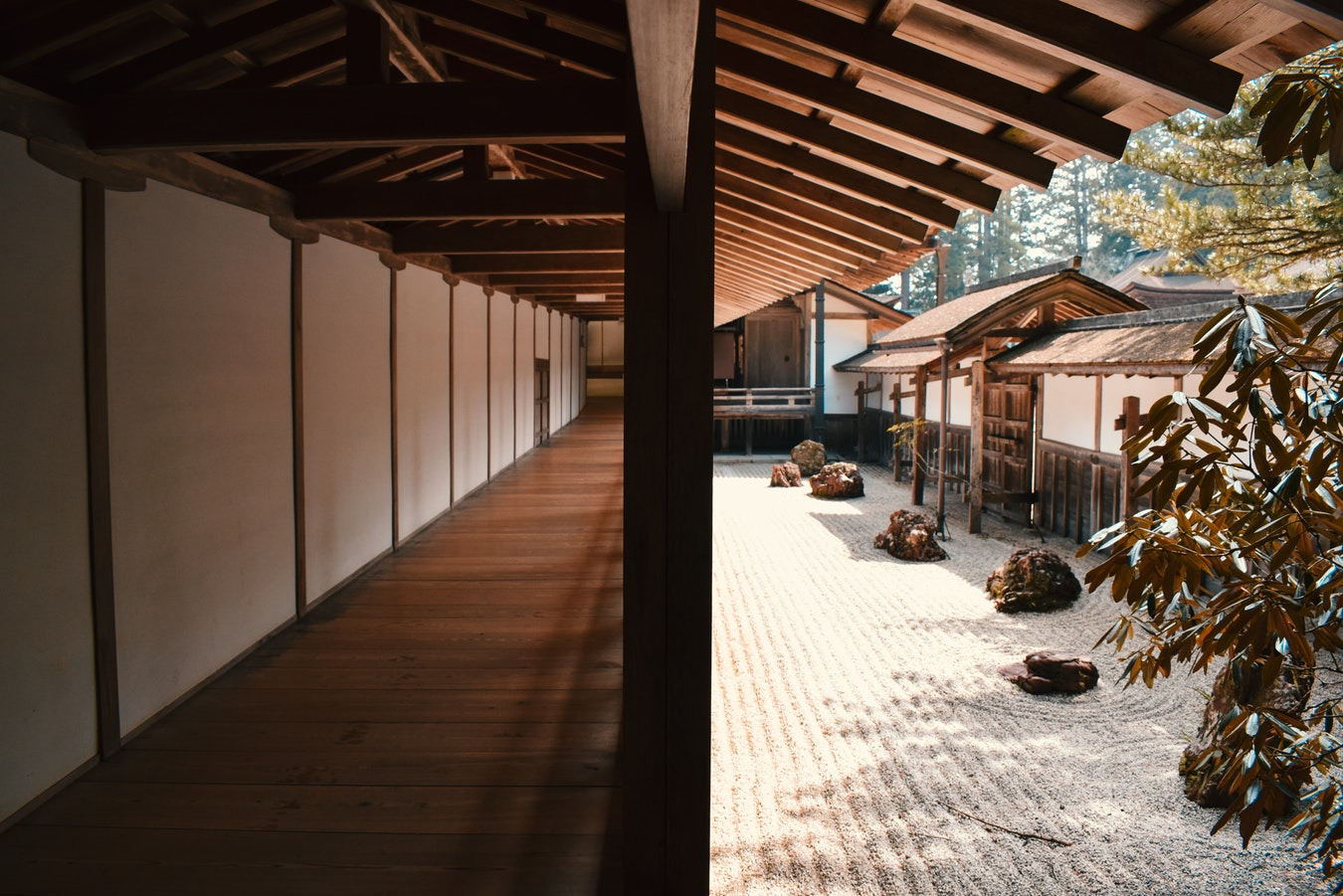
The administrative headquarters of the Shingon school, Kongōbu-ji — "Temple of the Diamond Mountain" — is the principal temple of Mount Kōya. While the main hall is open to the public only during special ceremonies (winter solstice, Sakyamuni's birthday on April 8), the visit gives access to remarkable paintings on fusuma (sliding doors), a botanical garden, and especially the Banryūtei, Japan's largest dry garden with its 2,000 m² of stones and gravel.
The Danjo Garan
This ensemble of temples and pavilions constitutes the original religious core of the monastic city: Kūkai himself participated in its design. The complex today comprises around twenty buildings, including the Konpon Daitō pagoda, which houses a statue of Dainichi Nyorai (the cosmic Buddha), and the Kondō hall, where major ceremonies are held. South of the Garan, the Reihōkan Museum, founded in 1921, preserves the principal Buddhist art treasures of Mount Kōya.
A night in a temple (shukubō)
About fifty temples on Mount Kōya welcome travelers as shukubō guests. The experience typically includes a traditional room with a tatami floor, dinner and breakfast in shōjin ryōri (monastic vegetarian cuisine), and the opportunity to attend morning prayers. Some establishments have an onsen. Rates are higher compared to standard ryokans, with half-board included. Advance reservation is essential, particularly during peak season.
Practical information
- Duration of visit: plan for a full day minimum, ideally two days with a night in shukubō to enjoy Okuno-in lit by lanterns and the morning prayers.
- Clothing: easy walking on sometimes uneven paths, warm clothing in shoulder seasons and winter (altitude lowers temperatures).
- Admission: paid entry to Kongōbu-ji and the Reihōkan Museum is modest. Okuno-in and Danjo Garan are free to access, though some interior halls charge a fee.
- Respect: photography is prohibited beyond the Gobyō-bashi bridge, near Kōbō Daishi's mausoleum.
When to visit
Mount Kōya can be visited year-round, each season with its own character. Spring and late summer offer temperate weather, pleasant for long walks through Okuno-in. Autumn, particularly November, sets maples and ginkgos ablaze. Winter regularly brings snow: preparation is needed, but the snowy landscapes surrounding the cemetery stones are remarkable. Summer remains cooler than Osaka thanks to the altitude.
How to get there
Mount Kōya is reached from Osaka via the Nankai Line. Departing from the stations of Namba, Shin-Imamiya or Tengachaya, take a train to Hashimoto, then transfer to Gokurakubashi, the terminus at the foot of the mountain. From there, a cable car climbs to the plateau, where buses serve the village center (walking the sacred path is not permitted). Journey time is approximately 2.5 hours from Namba.
Nankai offers a two-day round-trip pass covering the train, cable car and local buses: this is the most convenient option for a short visit.
Combining with other stops
Mount Kōya integrates well into an itinerary centered on the Kansai region and ancient capitals:
- Kasuga Taisha in Nara — a grand Shinto sanctuary with thousands of lanterns, accessible from Osaka.
- Himeji Castle — Japan's finest fortress, in western Kansai.
- Kibune — a forest village north of Kyoto, equally conducive to contemplation.
- Hida Takayama — a well-preserved old town in the Japanese Alps, to extend your exploration of sacred mountains.
Frequently asked questions
Frequently asked questions
A full day allows you to see the essentials (Okuno-in, Danjo Garan, Kongōbu-ji, Daimon). A night in shukubō is highly recommended to attend morning prayers and walk through Okuno-in by lantern light.
Yes. Temples often fill up several weeks ahead, especially in spring and autumn. Reservations are made directly with the temple or through specialized platforms.
Yes, transport operates year-round. However, snow is frequent: plan for warm clothing and suitable footwear, and anticipate possible delays.
No. Photography is prohibited beyond the Gobyō-bashi bridge, in the most sacred area of Okuno-in. This rule is strictly observed by visitors.
Autumn (October-November) for the colors, and late spring for mild weather. Summer remains cooler than the lowlands thanks to altitude. Winter attracts travelers seeking snowy landscapes but requires appropriate gear.
Include Mount Kōya in your journey
Mount Kōya naturally fits into an itinerary between Osaka, Nara and Kyoto, as part of a broader exploration of the sacred sites in the Kii Mountains. To build a custom trip including a night in shukubō, consult our Japan journeys.
Nearby
Interested in this visit?
We can include it in your personalised itinerary.