The Museums of Kinosaki
The Museums of Kinosaki
Two museums at Kinosaki Onsen to discover the thermal town beyond its baths: the literary legacy of Naoya Shiga and a singular tradition of straw marquetry.
Known for its seven public baths and its well-preserved hot spring town atmosphere, Kinosaki Onsen also houses two museums that illuminate a less visible heritage: a literary tradition linked to writers who came for cures and a singular craft, straw marquetry. A worthwhile stop to understand the town beyond its baths.
Why Visit the Museums of Kinosaki
- Understand the connection between Kinosaki Onsen and early 20th-century Japanese literature, notably through Naoya Shiga.
- Discover mugiwara zaiku, a straw marquetry technique practiced almost exclusively in Kinosaki today.
- Complement a day of bathing with a short cultural visit, accessible on foot in the town center.
- Take home a local artisanal object (boxes, postcards, spinning tops) directly reflecting a recognized craft tradition.
History and Cultural Context
Kinosaki Onsen is more than the legend of the monk Dochi Shonin and his hot springs. The town has long welcomed writers and artists seeking to benefit from the waters and find an ideal setting for their work. Among them, Naoya Shiga (1883-1971), a major figure in modern Japanese literature, stayed in Kinosaki in 1913 to recover from an accident. He would write the short story "At Cape Kinosaki" (Kinosaki nite), recognized as one of his essential works and associated with the Shirakaba movement, that group of humanist writers and artists who shaped the Taishō era.
This patronage earned the town the nickname "the hot spring town of history and literature." In parallel, another legacy took root: straw marquetry, or mugiwara zaiku. Local tradition tells of an artisan who came for a cure about three centuries ago and introduced the technique to pay for his stay. Passed down and refined by local craftspeople, it became so concentrated in Kinosaki that the majority of active Japanese practitioners today are based here.
What to See
The Toyooka Municipal Kinosaki Bungeikan (Literature Museum)
Opened in 1996 with its exhibition entirely renewed in autumn 2016 for its 20th anniversary, the Toyooka Municipal Kinosaki Bungeikan traces the links between the town and the writers who frequented it. The permanent collection features books, manuscripts, and correspondence, including exchanges between Naoya Shiga and his fellow Shirakaba members.
Other figures associated with the region are also present: Tomioka Tessai (1837-1924), a literati painter and author of Takayuki Naka, and Kogoro Katsura (1833-1877), a key figure in the Meiji Restoration, whose visit to Kinosaki is documented. Two temporary exhibitions per year complement the programming.
The Straw Marquetry Museum
Mugiwara zaiku consists of gluing fine dyed straw stems in geometric patterns onto various surfaces: paper fans, postcards, boxes, spinning tops, colorful flutes, and decorative boxes. The museum presents the evolution of the technique over three centuries and offers introductory workshops. It's an opportunity to observe a craft whose practice remains highly localized.
Practical Information
- Bungeikan: open during the day (generally 9am-5pm), closed Wednesdays and December 31 and January 1; temporary closures during exhibition changes. Check before your visit.
- Straw Marquetry Museum: open during the day (generally 10am-4pm), closed Wednesdays, December 31, and January 1.
- Moderate admission fee for each museum. Allow 45 minutes to 1 hour per site.
- Location: the Bungeikan is located in the center, a few dozen meters from the main street running along the Otani River; the marquetry museum is situated near the parking for Ichi no Yu onsen, behind the stream.
How to Get There
Kinosaki Onsen is accessible by train from major cities in the Kansai region. With a JR Pass, expect approximately 2 hours 40 minutes from Kyoto or Osaka, 2 hours 40 minutes from Kobe, and about 1 hour 50 minutes from Himeji. Most connections are direct; some require a transfer at Fukuchiyama station. Bus services also connect Kinosaki to several cities in Hyogo Prefecture. Once there, both museums can be reached on foot from the station in less than fifteen minutes.
What to Combine Nearby
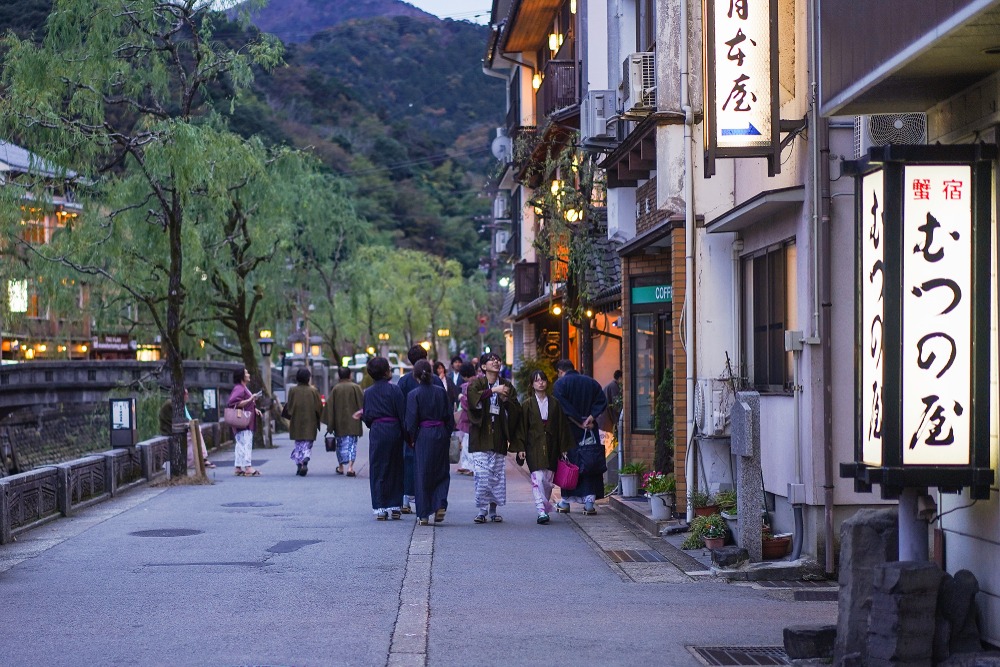
After your visit, the town's seven public onsens offer a natural continuation, moving from bath to bath in your yukata. To extend a cultural itinerary through Japan, several complementary stops are worth the detour: the samurai district of Nagamachi in Kanazawa, the historic Nakasendo route between Kyoto and Tokyo, or the Nanzen-ji temple in Kyoto, a convenient starting point for Kinosaki.
Frequently Asked Questions
Frequently asked questions
Planning Your Stay in Kinosaki
To incorporate Kinosaki Onsen and its museums into a broader itinerary, consult our suggestions for trips to Japan: cultural circuits, stays combining Kansai and the Japan Sea coast, or customizable thermal stops.
Interested in this visit?
We can include it in your personalised itinerary.