Ritsurin Garden
Ritsurin Garden
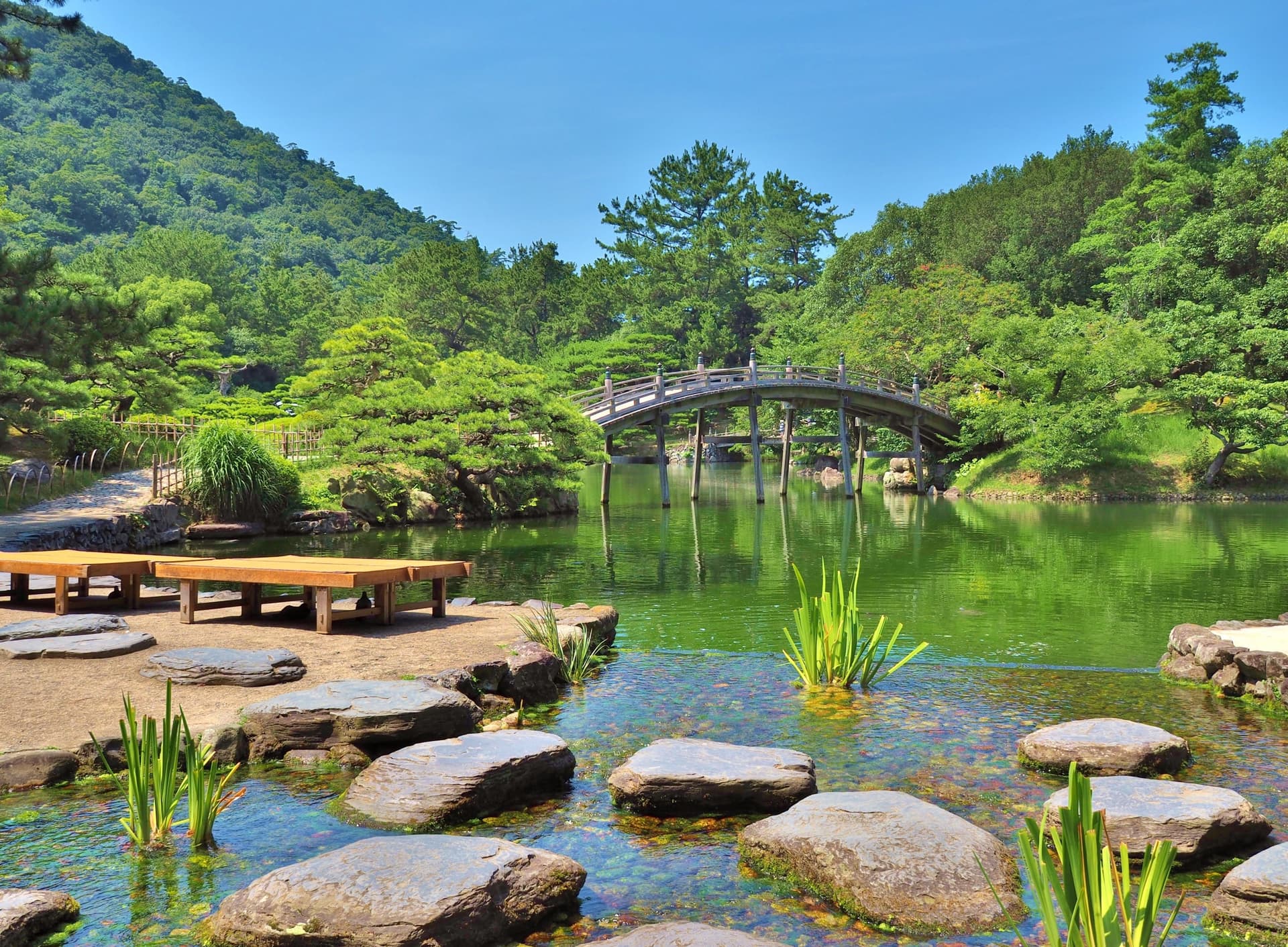
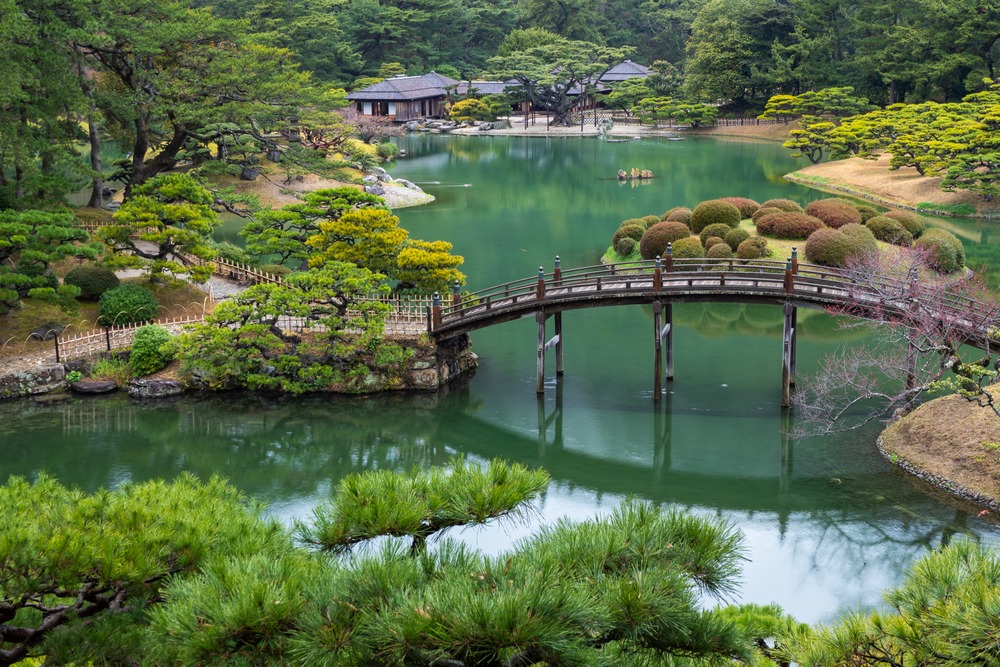
In Takamatsu, Ritsurin Garden unfolds 16 hectares of Edo landscape between ponds, sculpted pines and tea pavilions, set against Mount Shiun.
In the heart of Takamatsu, on the island of Shikoku, Ritsurin Garden ranks among Japan's most extensive preserved landscape ensembles from the Edo period. Spread across 16 hectares, it combines ponds, artificial hills, century-old pines and tea pavilions, all framed by Mount Shiun according to the principle of shakkei (borrowed scenery). Listed three stars in the Michelin Green Guide, it is also designated an Exceptional Landscape by Japanese authorities.
Why visit Ritsurin Garden?
- A 16-hectare Tsukiyama-niwa stroll garden, one of the country's most extensive.
- A living reading of four centuries of Japanese landscape art, from the Edo period to today.
- Mount Shiun in the background, exemplifying the shakkei school.
- Some thirty master gardeners who trim pines and bonsai daily.
- A tea pavilion over water, Kikugetsu-tei, for a matcha pause.
- A less crowded stop than Kyoto, ideal for those wishing to explore Shikoku.
Garden history
Ritsurin was created in 1625 around the residence of the local daimyo. In 1645, the Matsudaira clan came to power in the region and took over the estate, which they developed for over two centuries. Two distinct spaces emerged: a stroll garden to the south and a duck-hunting ground to the north.
With the Meiji Restoration, the site was taken over by the government and opened to the public from 1875 onwards. Since then, the original layout has been preserved, with the exception of a few modifications to the northern section in the 20th century. The garden thus maintains the coherence of a landscape project developed over more than 200 years.
What to see in the park
The south, a classical Japanese garden
The southern half concentrates the most emblematic elements. The artificial Hiraiho hill, modeled on Mount Fuji, offers one of the best viewpoints over the ponds and their bridges. Further on, the Hanashobuen garden brings together thousands of irises and finely sculpted pines. Near the main path stands the Neagari Goyomatsu, a Japanese white pine gifted by Shogun Tokugawa in 1833, whose aerial roots make it a remarkable specimen.
The Kikugetsu-tei tea pavilion
Southwest of the park, this wooden pavilion opens its veranda directly above the pond. You can settle in to sip matcha tea accompanied by a wagashi (modest supplement on top of admission). It is one of the rare spots in the garden where you observe the landscape seated, from inside a historic structure.
The north and Sanuki Museum
The more wooded northern section houses the Sanuki folk crafts museum (Sanuki Mingeikan), devoted to ceramics, lacquerware and wooden objects from the Kagawa region. Allow 30 to 45 minutes to explore it.
Traditional wasen boat tour
A guided tour in a traditional wasen boat allows you to cross the central pond from the water, from another angle. The tour lasts around thirty minutes and is subject to a supplement beyond the entry ticket.
When to visit Ritsurin Garden
- Late March – early April: cherry blossom bloom, one of the most sought-after periods.
- May – June: iris bloom at Hanashobuen.
- November – early December: kôyô, red and orange maples around the ponds.
- Spring and autumn: occasional evening illuminations, check the official calendar before visiting.
- Winter: low attendance, refined atmosphere, pines wrapped against the snow.
To enjoy the garden without crowds, arrive at opening time. Allow 2 to 3 hours for a complete visit, longer if you combine the tea pavilion, museum and boat tour.
Practical information
- Hours: open year-round, with variable hours depending on season (from sunrise to late afternoon in winter, until early evening in summer). Check hours on the official website before visiting.
- Admission: moderate entry for adults, half-price for children; group discounts available from 20 people.
- Free admission: January 1st and March 16th (the garden's anniversary).
- Accessibility: main paths are passable, but some pavilions and gravel paths remain difficult.
How to get there
The garden is located in Takamatsu, capital of Kagawa Prefecture, on the island of Shikoku. JR Takamatsu Station, the arrival point for trains and ferries from Honshū, is situated about 2 km north of the park.
- By Kotoden train: Kotohira line departing from Takamatsu-Chikko, to Ritsurin-Koen station, followed by a ten-minute walk. Journey of around 10 minutes, frequent departures.
- By JR train: from Takamatsu, take a train toward Tokushima and get off at Ritsurin-Koen-Kitaguchi station, a 5-minute walk from the park.
- On foot or by bicycle: from central Takamatsu, allow 25 to 30 minutes on foot or about ten minutes by bicycle.
Combine with nearby attractions
Ritsurin lends itself to a stop on the route to several major sites in western Japan. Before or after Takamatsu, you can extend your itinerary toward Himeji Castle, accessible by train from Okayama, then to the Hiroshima Peace Memorial. Further south, Mount Kōya and its Shingon temples offer striking contrast with Ritsurin's landscape aesthetic. To stay within the world of gardens and shrines, Kasuga Taisha in Nara and the village of Kibune, north of Kyoto, pleasantly complement your visit.
Frequently asked questions
Include Ritsurin Garden in your journey
A natural stop on an itinerary that ventures off the beaten path of Honshū, Ritsurin combines easily with the Shikoku pilgrimage, the Setouchi region and its art islands, or a broader arc toward Kyoto and Hiroshima. To build a custom itinerary blending gardens, temples and local heritage, consult our Japan travel experiences.
Interested in this visit?
We can include it in your personalised itinerary.