Eihei-ji Temple
Eihei-ji Temple
30 minutes from Fukui, Eihei-ji is one of two seats of Japanese Soto Zen: 70 buildings nestled in an ancient cedar forest with zazen initiation programs.
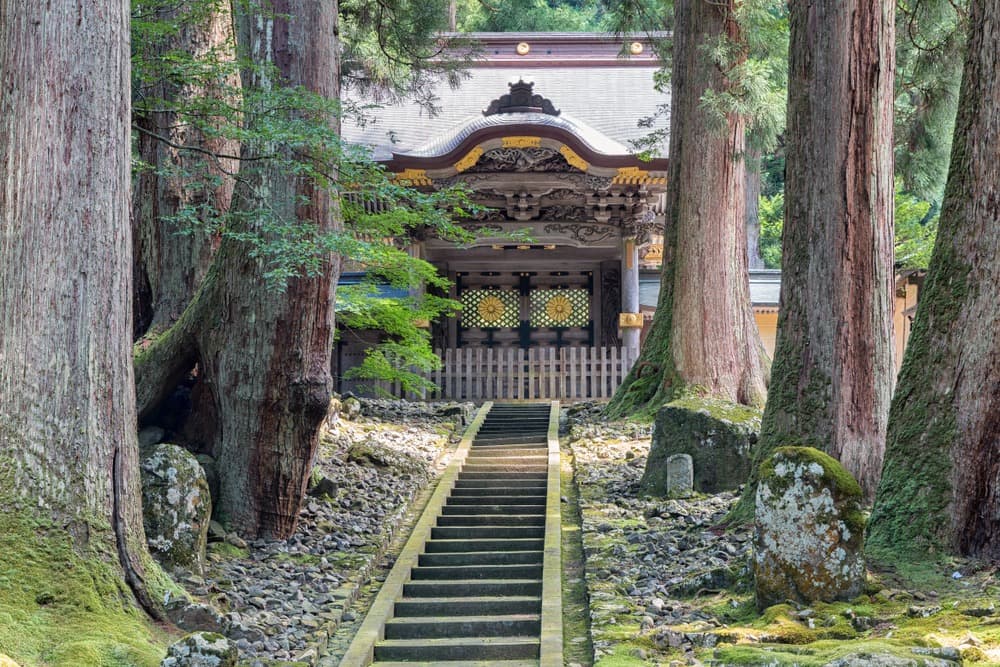
Nestled on a mountainside in a forest of centuries-old cedars, some thirty minutes from the city of Fukui, Eihei-ji Temple is one of the two principal seats of the Soto branch of Japanese Zen Buddhism. Founded in 1244 by master Dogen Zenji, it continues to function today as an active monastery where over a hundred monks follow an uninterrupted discipline spanning nearly eight centuries. Several biographies of Steve Jobs report that Apple's founder considered entering here as a novice in his youth—a testament to the site's international resonance.
Why visit Eihei-ji
Eihei-ji is not a temple-museum. It is an active Zen training center, which fundamentally changes the visiting experience: you encounter monks in practice, walk through corridors where silence is the norm, and observe architecture designed for spiritual discipline rather than tourism. Three elements justify the detour from the Kyoto-Kanazawa route:
- Its status as one of two daihonzan (principal seats) of the Soto Zen sect, the other being Soji-ji Temple in Yokohama.
- A complex of 70 buildings connected by covered walkways, spread across 300,000 m² of parkland dotted with ancient cedars.
- The opportunity to share a few hours or several days of monastic life through zazen initiation programs.
Temple history
Dogen Zenji (1200-1253) founded the "Temple of Eternal Peace" in 1244 on lands granted by samurai Yoshishige Hatano. Returning from China, where he trained in Chan Buddhism, Dogen sought a secluded place to transmit his vision of Soto Zen, centered on shikantaza, sitting meditation without an object of focus. His successors maintained this practice without interruption.
Repeated fires have marked the site's history: most current buildings are reconstructions, and the oldest structure in the complex dates to 1794. Many original relics were lost to flames. However, the most precious artifacts were transferred by Chinese monk Jakuen, at Dogen's request, to Hokyo-ji Temple located some thirty kilometers to the southeast, where they have been preserved.
What to see on the complex
The visiting route begins at the Kichijokaku Hall, where a monk introduces the temple and reminds visitors of the rules to observe (silence, prohibition of photographing monks in meditation, appropriate dress). From there, you access the Sanshokaku Hall, whose ceiling is adorned with 230 circular paintings depicting flowers, birds, and landscapes.
Buildings not to miss:
- Butsuden (Buddha Hall): houses statues of Amida Butsu (past), Shakyamuni Butsu (present), and Miroku Bosatsu (future).
- Hatto: the great lecture hall at the hilltop, where teachings are delivered.
- Joyoden: mausoleum housing Dogen's ashes, a particularly revered site.
- Sanmon: the main gate, guarded by statues of the Four Heavenly Kings.
Other buildings can only be viewed from outside as they remain reserved for the monastic community: the monks' quarters, the kitchen Daikuin, as well as the baths Yokushitsu and toilets Tosu—these latter two considered in the Soto tradition as meditation spaces in their own right. A hiking trail departs from the gardens, offering a sweeping view over the entire complex.
Monastic stays and practical information
The temple is open year-round except on January 1st, with continuous daytime hours. Reception times may vary according to the monastic calendar: check on-site or via the Fukui tourism office before visiting.
To go beyond a simple visit, Eihei-ji offers several formulas for initiation into monastic life in shukubo (temple lodging):
- Sanzen: intensive short stay, with four to five zazen sessions, participation in morning services, Buddhist meals shared with monks, and nights in a dormitory.
- Sanro: more accessible option, with two 40-minute zazen periods.
- International Zen Workshop: four-day program with eight to ten 40-minute zazen periods daily, lectures, and maintenance tasks. Prior daily zazen experience is required.
Registration takes place approximately one month in advance via the official website. Rates are moderate but vary by program. Given limited capacity, Fukui Prefecture constructed nearby the Hakujukan Hotel, part of whose structure uses cedar from the surrounding forest. Its restaurant, supervised by monks, also serves as a meditation hall.
When to visit
Eihei-ji can be visited year-round, with each season offering a distinct atmosphere:
- Autumn (October-November): maples turn brilliant red and orange, contrasting sharply with the deep green of the cedars. Most photogenic period but also the busiest.
- Winter (December-March): snow blankets roofs and walkways. The site's silence and austerity reach their peak, though access may be slowed.
- Spring and summer: mild temperatures, moderate crowds, ideal for combining with a monastic stay.
Allow two to three hours for a simple visit, a full day if you include the hiking trail and surrounding grounds.
How to get there
Access is from Fukui Station, served by the Thunderbird Limited Express and covered by the JR Pass. Reference travel times from major cities:
- From Osaka: approximately 2 hours.
- From Kyoto: approximately 1.5 hours.
- From Kanazawa: approximately 45 minutes.
From Fukui Station, direct buses reach the temple in about thirty minutes. Departures are scheduled throughout the morning and early afternoon; check the tourism office near the station for current schedules. The stop is within walking distance of the complex entrance, and return tickets can be purchased on-site.
Nearby attractions to combine
Eihei-ji fits naturally into an itinerary centered on the Sea of Japan coast and the Japanese Alps:
- Fukui: access city, noteworthy for its dinosaur museum and castle ruins.
- Nagamachi in Kanazawa: a former samurai quarter with well-preserved alleyways.
- Hida Takayama: a mountain town renowned for its wooden historic center.
- Kamikochi: alpine valley for hiking enthusiasts.
Frequently asked questions
Frequently asked questions
No, a simple visit requires no reservation. However, any monastic stay in shukubo (Sanzen, Sanro, IZW) must be requested approximately one month in advance via the temple's official website.
Yes, in most buildings, but it is strictly forbidden to photograph monks in meditation or practice. Guidelines are reminded upon arrival at Kichijokaku Hall.
Sanro and Sanzen programs are open to those without prior experience. The International Zen Workshop (IZW), however, requires regular zazen practice.
Allow 2 hours to walk through the accessible buildings, 3 to 4 hours if you add the hiking trail and surrounding grounds.
Yes, for those interested in Zen Buddhism or seeking an authentic monastic experience. The journey from Kyoto takes approximately 1.5 hours by train plus 30 minutes by bus, allowing for a same-day round trip.
Include Eihei-ji in your journey
The temple fits naturally into an itinerary combining the west coast, Japanese Alps, and spiritual heritage. Our English-speaking advisors design bespoke itineraries across Japan incorporating Eihei-ji with Kanazawa, Takayama, or an extended monastic stay according to your interests.
Interested in this visit?
We can include it in your personalised itinerary.