Tōdai-ji Temple
Tōdai-ji Temple
A UNESCO World Heritage site, Tōdai-ji in Nara houses the Daibutsu-den, the world's largest wooden structure, and a monumental bronze statue of Buddha Vairocana.
Tōdai-ji is a vast Buddhist complex located north of Nara park, inscribed as a UNESCO World Heritage site in 1998 for its historic monuments of ancient Nara. Seat of the Kegon school of Buddhism, it houses the Daibutsu-den, considered the world's largest wooden structure, and a monumental bronze statue of Buddha Vairocana.
Why visit Tōdai-ji
The temple concentrates several records and masterpieces within a single precinct: Japan's largest temple gate, two wooden guardian statues over eight meters tall signed by Unkei and Kaikei, and a bronze Buddha statue fourteen meters high. Beyond sheer dimensions, the site illuminates Buddhism's role in Japan's political foundation in the 8th century, when Emperor Shomu established Tōdai-ji as the spiritual center of an entire network of provincial temples.
History of Tōdai-ji
Construction of the complex was ordered by Emperor Shomu in 735 to protect the people from the major epidemics then ravaging the archipelago. The name literally means "Great Temple of the East." The ambitious project mobilized thousands of workers and resulted in the erection of monasteries and Buddhist temples in each province of ancient Japan.
The site experienced multiple destructions: it was devastated by fires during the clan wars in 1180, then again in 1567. Shogun Minamoto no Yoritomo commissioned the first major restoration at the end of the 12th century, entrusted to the monk Chōgen, who introduced Song Chinese architectural influences. The buildings visible today largely date from this campaign, with further reconstruction during the Edo period.
What to see at Tōdai-ji
The Nandaimon, Great South Gate
The Nandaimon marks the main entrance to the complex. Completed in 1203 during the Kamakura period, it draws inspiration from Song Chinese architecture. Standing 25.46 meters high with its double roof and 18 pillars, it is Japan's largest temple entrance. Within its niches sit two monumental wooden statues of the Niō kings, guardians of the sanctuary. Created by sculptors Unkei and Kaikei in 1203, standing over 8 meters tall, they constitute Japan's largest wooden statues of these deities.
The Daibutsu-den
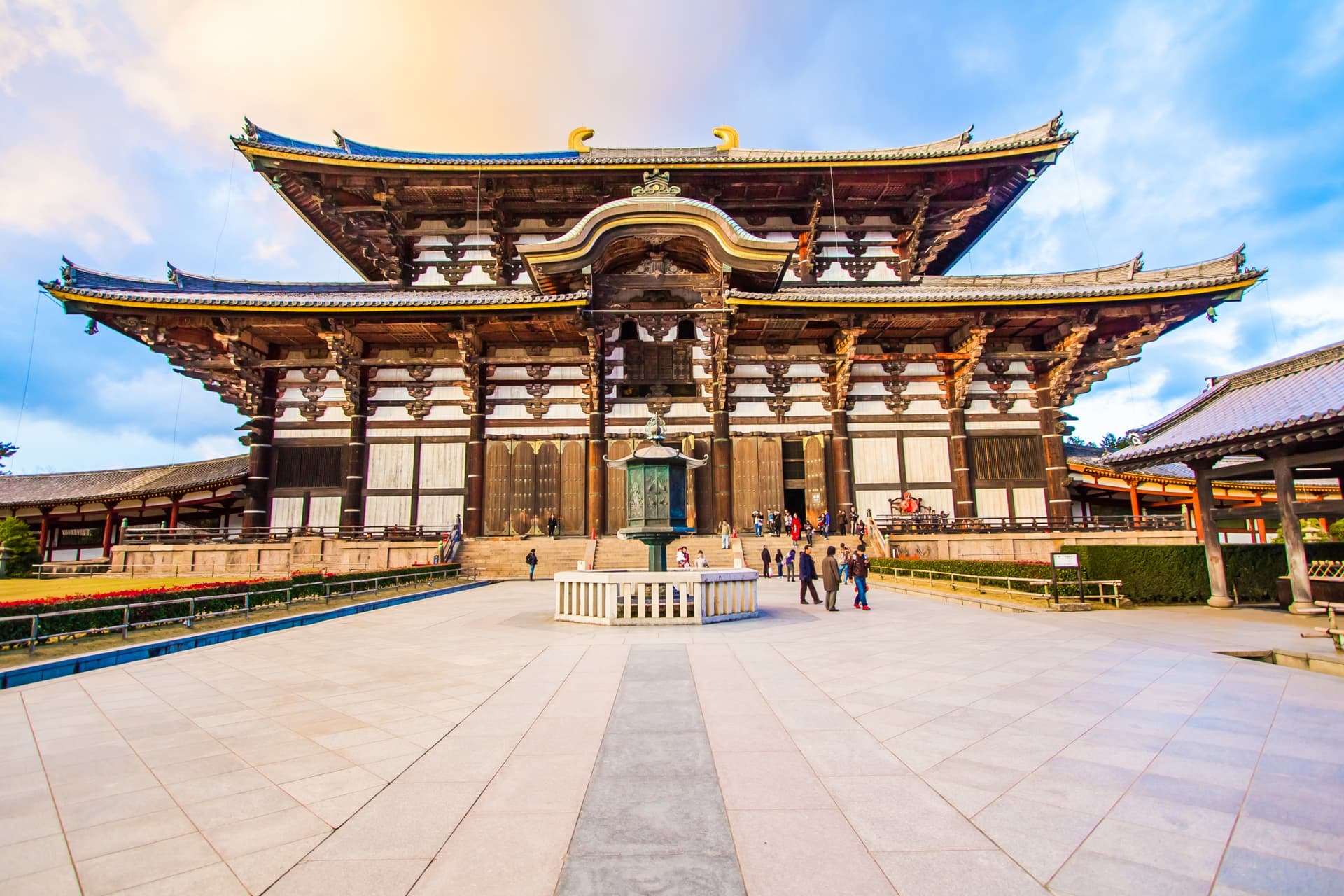
The main building measures 57 meters long by 50 meters wide and approximately 49 meters high. It is nonetheless 30 percent smaller than the original structure, giving a sense of the scale of medieval Tōdai-ji. The wooden framework, visible from the nave, remains one of the great testimonies to traditional Japanese carpentry.
Buddha Vairocana
The statue housed in the Daibutsu-den is the world's largest bronze Buddha. It stands approximately 14 meters tall and weighs several hundred tons (estimates vary by source). The Buddha is depicted seated on a lotus flower with 48 petals, the right hand forming the gesture of fearlessness (abhaya-mudra) and the left hand that of generosity (varada-mudra). The current version results from a recast in the 13th century, following the destructions of 1180. On either side stand two Bodhisattvas, enlightened beings who renounced Nirvana to guide mankind.
Secondary pavilions
The Nigatsudō, to the east, features an open balcony overlooking Nara city. It is the birthplace of the Omizutori (Shuni-e) festivities, held annually in the first half of March. The Shosoin, to the northwest, is an imperial storehouse that preserves the possessions of the imperial family and Emperor Shomu. The Kaidanin, to the west, houses four clay statues of the Four Divine Kings, guardians of the cardinal points. Finally, the Hokke-dō, east of the Daibutsu-den, is the temple's oldest building; Hokke ceremonies are held there in March. A museum near the Nandaimon presents part of the complex's cultural and religious treasures.
Practical information
Tōdai-ji is open daily, with visiting hours varying by season (later opening in winter, extended hours from April through September). Admission is moderate and differentiated by visitor category; a combined ticket provides access to the Daibutsu-den and museum. Allow 1.5 to 2.5 hours to explore the complex at a leisurely pace, longer if you include Nigatsudō and Hokke-dō.
When to visit
The site can be visited year-round. Spring (cherry blossoms in April) and autumn (maples in November) offer the most photogenic settings, but also the heaviest crowds. The first half of March features the spectacular Omizutori ceremonies at Nigatsudō, particularly striking in the evening. Summer is warm and humid, winter mild but cool; early morning brings fewer visitors and less pressure on the park's free-roaming deer.
How to get there
The temple is accessible on foot in approximately 30 minutes from Kintetsu Nara Station, and about 45 minutes from JR Nara Station. By bus, alight at the Tōdai-ji Daibutsuden stop: 5 to 10 minutes' walk will then get you to the Nandaimon.
Nearby attractions
Tōdai-ji is part of a collection of Nara sites easily combined into a single day: Nara park and its free-roaming deer, Kasuga Taisha shrine and its lanterns, Kōfuku-ji temple and its five-story pagoda. Expanding to the Kansai region, several stops complement a cultural itinerary: the Higashiyama district in Kyoto, Mount Arashiyama and its bamboo grove, or the Himeji Castle.
Frequently asked questions
Frequently asked questions
Plan 1.5 to 2.5 hours for the Nandaimon, Daibutsu-den and Buddha statue. Add 1 hour if you climb to Nigatsudō and visit Hokke-dō and the museum.
Yes, the sika deer of Nara park roam freely around Tōdai-ji. Biscuits (shika senbei) are sold on site, but these remain wild animals: avoid sudden movements.
Yes, a combined ticket provides access to the Daibutsu-den and Tōdai-ji museum. It can be purchased directly at the entrance.
Early morning at opening, crowds are lighter and the light on the Daibutsu-den is softer. Late afternoon during off-season is equally pleasant.
The Daibutsu-den is accessible at ground level. However, Nigatsudō and Hokke-dō require stairs. The park around the temple features wide paths but sometimes graveled surfaces.
To incorporate Tōdai-ji into a broader cultural itinerary, consult our suggestions for travel to Japan.
Interested in this visit?
We can include it in your personalised itinerary.