Ine
Ine
Two hours north of Kyoto, Ine lines its stilt-house funayas along a pristine bay. A practical guide to visiting this classified village.
Ine is among Japan's Most Beautiful Villages. In this small, isolated town about two hours from Kyoto, local fishermen welcome tourists into their funaya homes to share the spirit of camaraderie in the Japanese maritime world. Stories and fresh seafood await!
History
Legend has it that fishermen settled in Ine roughly 1,500 years ago. They adapted their village to the region's natural constraints, building across a narrow strip of land barely 20 meters wide, hemmed in by sea and mountains. Long ago, the commercial route linking Kyoto to China ran near Ine, which was renowned for its whaling industry. When younger generations began migrating to cities, time seemed to stand still in this town. Ine remains as it is—rural, peaceful, and preserved. For its authenticity, it earned classification among Japan's Most Beautiful Villages.
Discovering Ine
Ine maintains a traditional way of life in harmony with the sea, called "Sato-umi." Fishing and agriculture remain the foundation of local life. Here, you'll find few modern technologies. Leave the neon behind and embrace the soothing colors of nature. Between water, earth, and lush vegetation, Ine's charm is irresistible.
Admire the Funayas, Ine's Traditional Fishermen's Houses
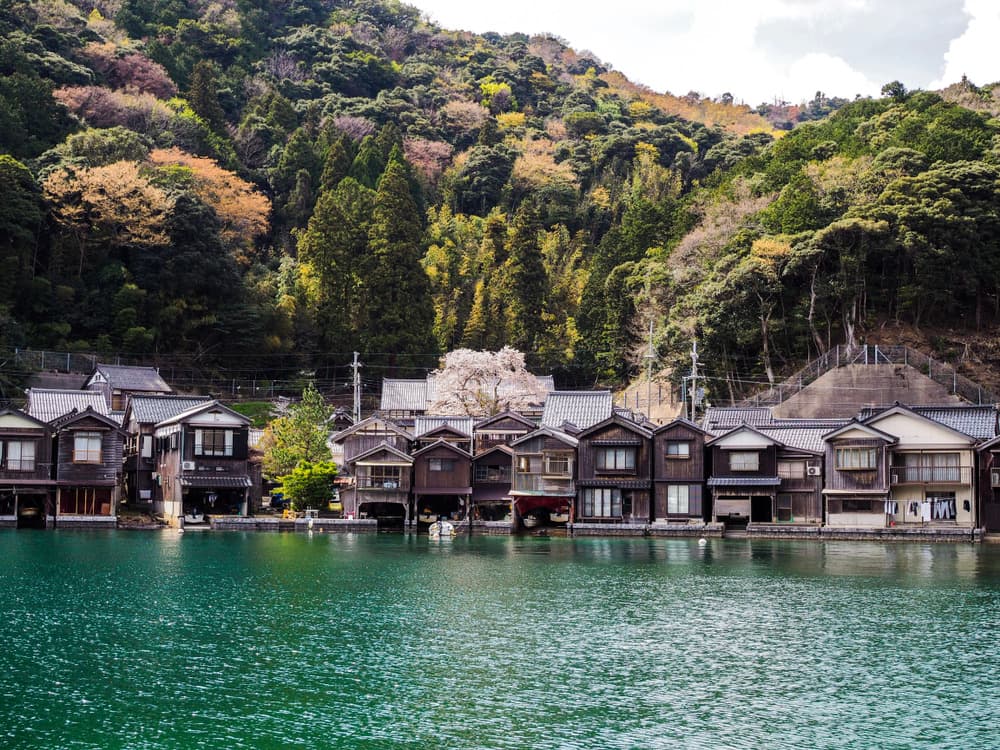
Few Japanese fishing villages have remained intact; urbanization has transformed most. Ine is among the rare places where you'll still find authentic atmosphere. The local traditional houses are called funayas. Inspired by the white warehouses of the Edo period, they stand out for their waterfront locations and unique design: a boat garage on the ground floor and living quarters on the upper stories. Many funayas have preserved their original purpose. Others have been converted into izakayas (Japanese taverns) or restaurants where you can relax while gazing across Ine's clear bay waters. Atop the hill overlooking the village, Funaya no Sato Park offers a panoramic view of the bay. The site hosts various establishments, including the tourist office and the Mukai sake distillery, which is absolutely worth a visit. It's run by a woman—a rare occurrence in Japan. Here, you'll discover the secrets of nihonshu production.
Go Fishing!
It would be a shame not to try your hand at fishing when you visit Ine. The bay's waters teem with treasures! Whether you're a beginner or seasoned angler, fish alongside a local guide. You'll find all necessary equipment on site: fishing rods, bait, coolers, and more. The best fishing season runs from November to March, when fish reach peak condition. This is when you'll find fugu pufferfish, yellow-tail flounder (buri), and giant Taiza crabs. In May, dolphins appear in the bay during the day, while the dinoflagellate plankton Noctiluca scintillans illuminates the sea with a dazzling blue glow at night. In late August, Ine hosts a fireworks festival where fishermen hang paper lanterns on their funayas to light up the shoreline.
Explore the Tango Peninsula
Ine lies within the Tango Peninsula, which juts into the Sea of Japan roughly two hours' drive north of Kyoto. The jagged coastline creates a spectacular natural backdrop. Marvel at forested mountains rising above blue ocean, sheer cliffs, and rocky islets piercing the horizon. The sea itself harbors a wealth of delicacies prized by gourmands worldwide.
Climate in Ine
Ine receives substantial rainfall. Showers persist in the bay even during months typically considered dry. Annual precipitation averages 2,045 mm. Temperature-wise, the yearly average sits around 13.8 °C. The Köppen-Geiger climate classification places Ine in the Cfa category.
April is the driest month, with just 118 mm of rain. September sees the highest precipitation, averaging 238 mm.
Situated along Ine Bay in the north of Kyoto Prefecture, the fishing village is relatively isolated, accessible only by car or bus from Amanohashidate Station.
If you're in Kyoto, board the limited express JR Hashidate train and get off at Amanohashidate Station. From there, catch a bus to Ine—they run roughly every hour. The journey to the village (about fifteen kilometers) takes roughly an hour.
To explore Ine, if you'd rather not walk the village, consider biking. A rental service operates at the local bus stop. Ine Bay's shoreline stretches roughly 5 kilometers. Roads are quite narrow, so driving isn't particularly practical. Plus, on a bicycle, you'll have more opportunities to connect with locals.
Boat cruises are available in various formats. You can choose between large tour boats or Ine water taxis for your adventure. No reservation is needed for the larger vessels, and the crossing takes about 25 minutes. For water taxis, reservations are required and the cost is higher. Their advantage is offering a more personalized experience.
What to Do in Ine?
- Experience life inside a fisherman's home by staying in a funaya
- Taste local sake in an izakaya
- Try your hand at fishing in Ine Bay
- Take a water taxi excursion
- Sample seafood specialties, and much more
Want to discover this destination?
Our local advisors design your tailor-made trip.