Kurokawa Onsen
Kurokawa Onsen
Thirty ryokans, smoking open-air baths dotting the valley, and a village frozen in time: here's your complete guide to Kurokawa Onsen.
Discover the Japanese art of relaxation by visiting Kurokawa Onsen. Among the hot spring resorts on the island of Kyushu, this small mountain village stands out not only for the abundance and diversity of its thermal springs, but also for its picturesque natural setting and traditional atmosphere, transporting you to the nostalgic ambiance of the Edo era.
History
In this small hamlet nestled in the heart of the Kumamoto Prefecture mountains, hot springs flow from every direction. The Japanese call them Kizuyu, or "baths of wounds," thanks to their exceptional healing properties for treating injuries.
Kurokawa Onsen became popular during the Edo period (1603–1868). It was a haven of relaxation for the feudal lords of Kumamoto. The thermal baths and ryokans continued to attract visitors through the end of the Meiji era (1868–1912). The great transformation occurred in the 1960s, when Kurokawa Onsen was recognized among the finest onsen destinations in Japon.
From there, the resort entered a new phase of development. A highway was built near the village. Young entrepreneurs, returning home after the oil shock of the 1970s, proposed the brilliant idea of designing Kurokawa as "one great unified ryokan." Since then, the inns have been considered as rooms, the streets form the corridors, and the lush landscape represents a vast open-air garden.
Visiting Kurokawa Onsen
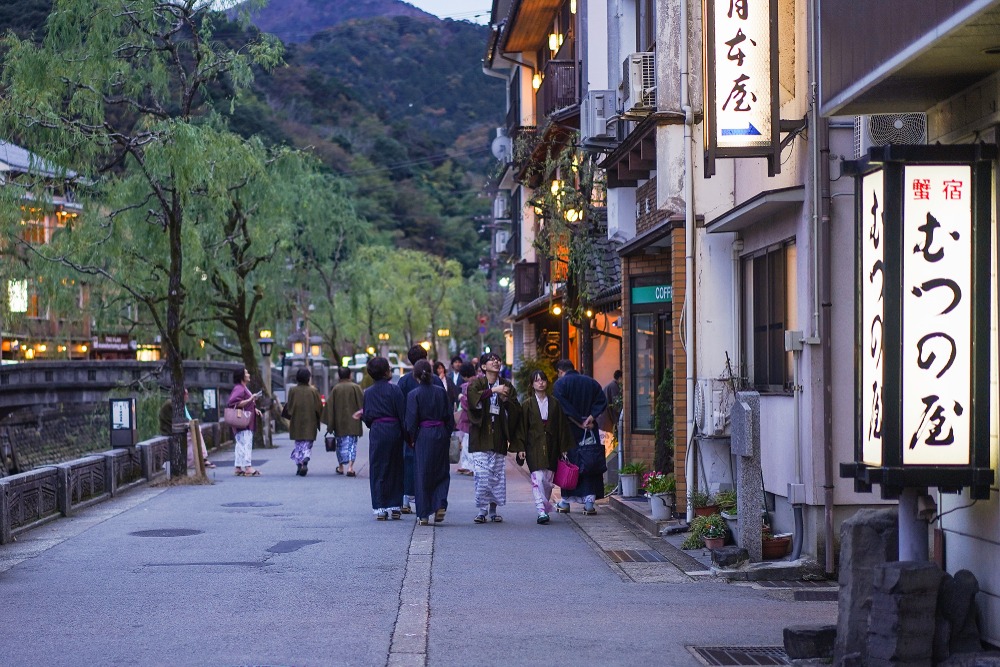
Charming and nostalgic, Kurokawa Onsen soothes the spirit at first glance. The resort is surrounded by lush vegetation, approximately 20 km from Mount Aso, Japon's largest active volcano. In harmony with nature, the village's setting remains deeply traditional. Here, neon signs and large concrete structures are replaced by natural materials. Wood reigns supreme, alongside earthen walls and stone staircases.
To complete the picture, the Tanoharu River winds gently through the landscape. From the everyday setting to its overall ambiance, everything at Kurokawa evokes Japon of yesteryear. Upon arrival, acquire a yukata and geta sandals to align yourself with the local way of life.
Tour the Stunning Thermal Baths of Kurokawa Onsen
Kurokawa Onsen currently has around thirty inns situated on either side of the Tanoharu River. The options are thus numerous and diverse for enjoying the pleasures and benefits of the onsen. Faced with such abundance of choice, residents came up with a clever idea: creating a special pass called "Nyuto tegata," allowing for a "rotemburo meguri" or "bath tour."
With the small wooden plaque, sold at the visitor center, you can sample three onsen of your choice. After each visit, reception stamps your pass, which you can then keep as a memento or donate to a temple.
Each Onsen Has Its Own Character
Beyond their sheer number, each of Kurokawa's onsen has its own style and unique features. Public or private baths, mixed or gender-separated, nestled in a cave or set in the open air—there's something for every preference!
To give you a taste of this diversity, the Yamamizuki ryokan boasts its rotemburo (outdoor bath) with a picturesque view over the river and mountains. Iyashi no Sato Kiyashiki offers an experience blending relaxation and culture, with wooden tubs, an elevated bath, an indoor bath, and a spacious rotemburo surrounded by lush greenery.
After regaining energy and serenity, savor a traditional Japanese meal at one of Kurokawa Onsen's restaurants. Massage options are also available for optimal wellness!
There is no train service to Kurokawa Onsen. To reach it, the simplest option is to take a direct bus from the city of Fukuoka. You can board at Hakata Station, which is connected by the Shinkansen to Tokyo and Osaka.
From Kumamoto, the closest station to Kurokawa Onsen is Aso Station. From there, you'll need to take a local bus or taxi to reach the thermal resort.
If you plan to travel with your own car, be aware that the route to Kurokawa Onsen is quite challenging. You'll navigate narrow, winding roads. Moreover, parking is limited.
For those traveling by plane from distant destinations, the nearest airport is located in Kumamoto.
Opening Hours and Rates
Accessible year-round, Kurokawa Onsen experiences peak visitation during high season, particularly during year-end holidays and vacation periods. That said, autumn with its stunning scarlet foliage and spring, when the cherry blossoms bloom, are particularly privileged times to immerse yourself in the resort's natural beauty. In winter, the thermal baths offer pleasant warmth.
With the Nyuto tegata pass, you can enjoy three onsen for 1,300 yen, compared to 500 yen for each separate visit.
Want to discover this destination?
Our local advisors design your tailor-made trip.