Soba
Soba そば (or 蕎麦) is a type of noodle that's distinctly Japanese in character.
Soba そば (or 蕎麦) is a type of noodle that's distinctly Japanese in character.
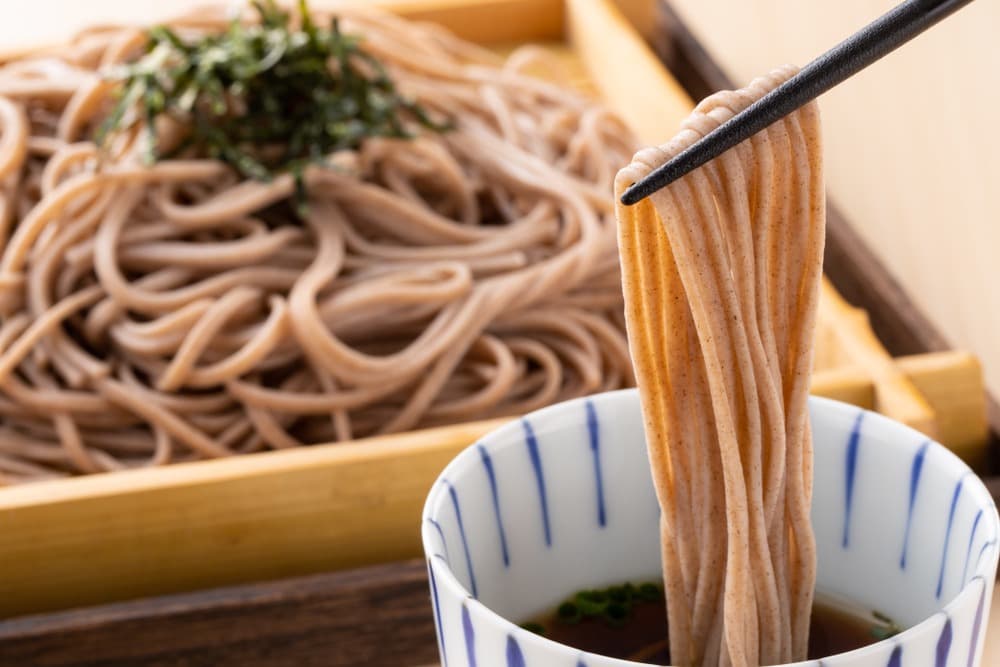
Made from a paste derived from a grain called "soba" (buckwheat), these grayish noodles are found everywhere across Japon, but particularly in the North, where buckwheat thrives despite the cold. Soba is eaten either chilled or hot (in both cases, the noodles are boiled first).
When chilled, soba (known as "zaru soba" ざるそば) is served on a kind of bamboo sieve, accompanied by dried seaweed and a dipping sauce (typically soy-based) garnished with finely sliced spring onions and wasabi. In authentic soba restaurants, you'll even be brought the cooking water from the noodles (soba-yu, in the red pot shown in the photo), which you can drink to finish your meal (admittedly, it resembles spaghetti cooking water, but if it's good, why not?).
When hot, soba floats in a broth (usually with vegetables). Soba can be eaten at any time of day: as a meal, or between meals as a snack. Symbolizing longevity through its elongated form, soba is eaten on New Year's Eve (ômisoka): it's then called toshi-koshi soba (年越しそば), or "year-passing soba." I've also heard it's customary to eat soba when moving house: hikkoshi soba (引越しそば). Could soba thus symbolize a "passage" (koshi 越し)?
There are naturally many varieties of soba available, but in my view, the finest is fresh soba (nama soba 生そば), handmade (te-uchi soba 手打そば). The best soba-ya (soba restaurants) I've encountered were often tucked away in the depths of the Japanese countryside.