kamishikimi
kamishikimi
Shinto sanctuary nestled in a cedar forest at Takamori, near Mount Aso: 270 steps, moss-covered torii and legendary Ugeto Iwa cave.
Kamishikimi Kumanoimasu is a Shinto sanctuary established within a cedar forest at Takamori, in Kumamoto Prefecture, near Mount Aso. The site combines a 270-step staircase lined with lanterns, a moss-covered torii, and a sacred cave associated with a founding legend of the Aso region.
Why visit Kamishikimi Kumanoimasu
- A forest sanctuary whose earliest ritual services date back to the 14th century.
- A photogenic setting: 270 steps, 50 pairs of lanterns, a verdant moss-covered torii two-thirds of the way up the climb.
- The backdrop for the 2011 animated short film Hotarubi no Mori e, adapted from the manga of the same name by Yuki Midorikawa published in 2002.
- The Ugeto Iwa cave and its legend tied to Tateiwatatsu no Mikoto.
- Easy access from Takamori, a village ranked among Japan's Most Beautiful Villages in 2013.
Sanctuary history
The precise origins of Kamishikimi remain poorly documented. The sanctuary's earliest ritual services are believed to date back to the 14th century. The site is dedicated to Izanagi and Izanami, the founding deities of Japan in Shinto cosmology. Kamishikimi belongs to the network of Kumano sanctuaries, whose headquarters is located in the Kii Mountains region and which is said to have several thousand branch temples throughout the archipelago.
The original building was destroyed by fire in the 16th century during the feudal wars. The present honden is a reconstruction from the early 18th century (around 1722 according to local sources).
Long remaining little-known, the sanctuary gained prominence in the 2010s following the release of the animated short film Hotarubi no Mori e, whose setting was directly inspired by the moss-covered staircase and torii. Fan accounts published online gradually attracted international visitors, leading to the development of a parking area and the paving of certain sections of the path.
What to see on site
The staircase and moss-covered torii
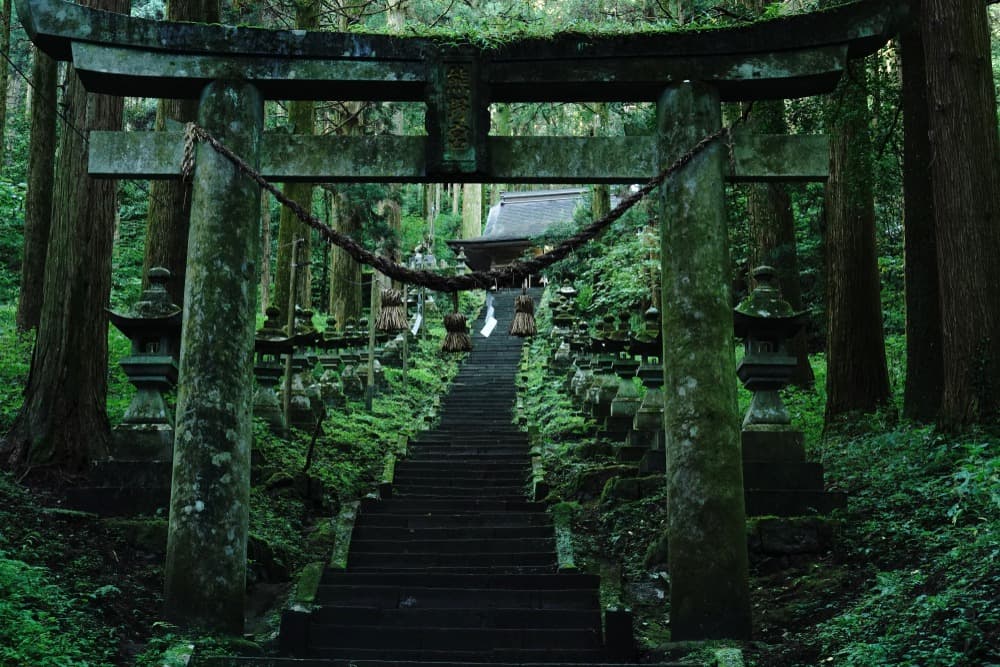
From the road, the first torii marks the entrance to the sanctuary grounds. The 270 steps climb through an ancient cedar forest, punctuated by 50 pairs of stone lanterns. Two-thirds of the way up stands a second torii, blanketed with moss, which has become the most recognizable image of the site.
Before approaching the honden, it is customary to purify your hands and mouth at the temizuya located at the entrance, in accordance with Shinto ritual.
The honden and sacred Nagi trees
On either side of the honden grow two Nagi trees, considered sacred. Their leaves are traditionally used during wedding ceremonies. In Kumano sanctuaries, pilgrims would once carry a sprig of Nagi as protection for their journey.
The Ugeto Iwa cave
Above the sanctuary lies a rock arch known as Ugeto Iwa, associated with local legend. Tateiwatatsu no Mikoto, grandson of Emperor Jinmu, would practice archery from an Aso summit, aiming at a boulder on the opposite side of the caldera. With only a single arrow, he would task his servant Kihachi with retrieving it after each shot. On the hundredth attempt, an exhausted Kihachi trampled the arrow. Enraged, his master pursued him across the caldera. Kihachi transformed into a demon and attempted to escape by piercing the crater's edges; the hole he supposedly carved while crossing Mount Tsukigata would become Ugeto Iwa. He was ultimately caught and executed in the cave.
This legend gave rise to a pilgrimage tradition to the cavity. Ugeto Iwa is reputed to bring good fortune for academic success and the realization of personal projects. A paved path allows you to reach the arch in roughly ten minutes from the sanctuary. Walking sticks are available on the right side of the honden.
Practical information
- Sanctuary access is free, open year-round.
- Respectful dress recommended. Closed-toe shoes are essential for the staircase and the path leading to Ugeto Iwa.
- The ground can be slippery after rain, particularly on the moss-covered steps.
- Allow 1 to 2 hours for your visit, longer if you venture up to the cave.
When to visit
The sanctuary can be visited year-round. Rainy season (June–July) enhances the moss and fog within the cedar forest: damp conditions but particularly atmospheric forest setting. In early summer, light filtered through the cedars highlights the lanterns. Autumn offers striking contrasts between foliage and stone. Winter is serene, sometimes snow-covered at higher elevations.
How to get there
Access is more straightforward by car. From the Fukuoka region or from Kumamoto, expect a mountain road crossing the Aso caldera.
By public transport, from Kumamoto, the Takamori-Go bus connects the station and airport to the town of Takamori, with several daily departures and a journey of approximately two hours. The sanctuary is located about 6 km from the terminal: taxi, bicycle rental at the station, or walking at your own pace. The Minamiaso line train from Tateno is also an option depending on network status (disruptions possible since the 2016 earthquake).
What to see nearby
Takamori, nicknamed the "village of the wind," was ranked among Japan's Most Beautiful Villages in 2013. At the foot of the Aso caldera, it serves as a practical base for exploring the region.
- Takamori Torokko Train: operates with open roof on weekends and holidays from March to November.
- Fûchin-sai Festival: celebrated each August for over three centuries, featuring a parade of floats built by residents from household objects.
- Mount Aso and its caldera: Nakadake crater, Kusasenri grasslands, panoramic road.
- Takachiho: gorge and sanctuaries linked to Shinto myths, approximately one hour's drive away.
To expand your exploration of Kyushu and southern Japan, you can combine this visit with Dazaifu Temmangu sanctuary, Urakami Cathedral in Nagasaki, or the porcelain city of Arita.
Frequently asked questions
Frequently asked questions
In Takamori, in Kumamoto Prefecture, on the island of Kyushu, near Mount Aso. The sanctuary is approximately 6 km from Takamori Station.
The staircase consists of 270 steps, lined with 50 pairs of stone lanterns within a cedar forest.
The sanctuary inspired the setting of the 2011 animated short film adapted from the manga published in 2002 by Yuki Midorikawa. It has become a pilgrimage site for fans of the work.
A rock arch located above the sanctuary, associated with the legend of Tateiwatatsu no Mikoto and his servant Kihachi. It is reputed to bring good fortune for academic success. It is reached in about ten minutes via a paved path, from the right side of the sanctuary.
The Takamori-Go bus connects Kumamoto and its airport to Takamori in approximately two hours, with several departures daily. From the terminal, plan for a taxi, bicycle rental, or walking to reach the sanctuary.
Access to the sanctuary is free. A donation in the offering box (saisen) remains customary before prayer.
Plan your trip
Kamishikimi Kumanoimasu naturally integrates into a Kyushu itinerary blending volcanic nature, Shinto traditions, and historic villages. To design a custom trip including the Aso region and Takamori, consult our Japan voyages.
Interested in this visit?
We can include it in your personalised itinerary.