Matsuyama Castle
Matsuyama Castle
Perched atop Mount Katsuyama, Matsuyama Castle is one of twelve original Japanese keeps. History, visiting information and practical access.
Matsuyama Castle ranks among the twelve Japanese castles that have preserved their original Edo-era keep. Positioned at the summit of Mount Katsuyama, it has dominated the city for four centuries and offers, from its upper floors, panoramic views of the Seto Inland Sea and the mountains of Shikoku. Its cable car or chairlift access, roughly twenty defensive structures still standing, and collections of feudal artifacts make it one of the region's best-preserved historical sites.
Why Visit Matsuyama Castle
Unlike many Japanese castles reconstructed in concrete after World War II, Matsuyama Castle belongs to the select circle of fortresses whose main keep dates from the Edo era. This architectural authenticity, combined with the richness of its fortifications—gates, turrets, stone walls—allows visitors to grasp concretely how a Japanese castle's defensive systems were organized.
The site lends itself to multiple perspectives: a historical visit for military architecture enthusiasts, a scenic route for walkers, and a photographic stop during cherry blossom season. Evening illumination extends the site's visibility well after sunset.
Castle History
The castle's history begins with the daimyo Kato Yoshiaki, rewarded for his victory alongside the Tokugawa at the Battle of Sekigahara in 1600. With the funds received, he launched construction of a fortress at the summit of Mount Katsuyama in 1602. The work would span nearly a quarter century. A fire ravaged the site in 1624, but the first section of the domain was completed in 1628.
In 1635, the Matsudaira clan took possession of the castle and would occupy it until the end of the feudal era. In 1642, the main keep was raised to five stories. The castle then underwent nearly a century and a half without major modification, until lightning struck the structure in 1784. Reconstruction, spread from 1820 to 1854, restored the site to its current appearance.
Matsuyama Castle then escaped two trials that caused the disappearance of most Japanese fortresses: the Meiji Restoration, which saw the demolition of hundreds of feudal structures, and American air raids during World War II, which damaged only some of the buildings. Since 1966, the municipality has conducted an ongoing restoration program for the affected structures.
What to See On-Site
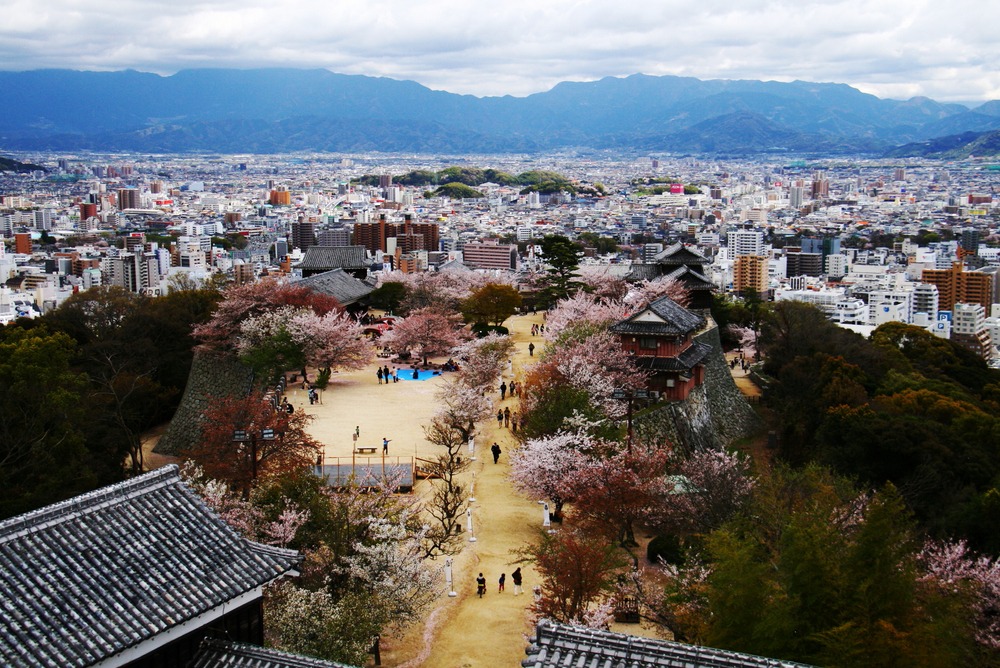
The castle is of the hirayama type—that is, a flatland castle built at the summit of a hill. Once past the defensive systems, visitors reach a large esplanade overlooking the city.
Gates and Defenses
- The Tonashi Mon Gate, designated as an Important Cultural Property of Japan, illustrates Japanese defensive design.
- The hidden Kakure Mon gates, equipped with rifle and crossbow emplacements, completed the system by trapping assailants once they entered the outer enclosure.
- The opening ceremony of the Ichino Mon gate takes place early in the day on weekends and holidays. Visitors present can don samurai armor for the sequence.
The Keep (tenshu)
Before entering, it's worthwhile to observe the gray-tiled roofs and wooden ornaments that harmonize with the white walls. Inside, the rooms display weapons, objects related to haiku poetry (Matsuyama is the birthplace of poet Masaoka Shiki), and explanations of traditional construction methods. Wooden staircases lead to the topmost level, perched at approximately 161 meters in elevation, from which one can distinguish the Seto Inland Sea to the west and Mount Ishizuchi to the south.
Exterior Viewpoints
To photograph the castle as a whole, two spaces stand out: Honmaru Park, immediately adjacent to the fortifications, and Horinouchi Park, below. In the evening, the keep's illumination remains active until 11 p.m.
Practical Information
The site is open year-round, with one day of annual closure in December. Entry fees and cable car fares remain modest (budget a few hundred yen per person for each service). Allow 1.5 to 2.5 hours for a visit if you ascend to the tenshu and explore the exhibition halls. Wearing shoes that are easy to remove is recommended: access to the keep is barefoot or in socks, as is the case in most Japanese historic buildings.
When to Visit
Spring, particularly the cherry blossom season (typically late March to early April depending on the year), offers the most photogenic window: the park's sakuras frame the keep. Autumn provides another quality of light, with maples coloring the surroundings. Summer is hot and humid in Matsuyama but allows visitors to enjoy night illumination after a late-day visit. Winter remains feasible, with reduced crowds.
How to Get There
The castle is located in central Matsuyama, at the summit of Mount Katsuyama. Three access options:
- On foot: several trails climb to the esplanade (15 to 25 minutes depending on the route).
- By cable car: quick ascent from the lower station.
- By chairlift: open-air alternative on the same route.
To reach the lower station, the reference tram stop is Okaido, served by Line 5 from JR Matsuyama Station and by Lines 2 and 3 from Matsuyama-shi Station. Allow approximately five minutes' walk from Okaido to the cable car entrance.
Nearby Attractions
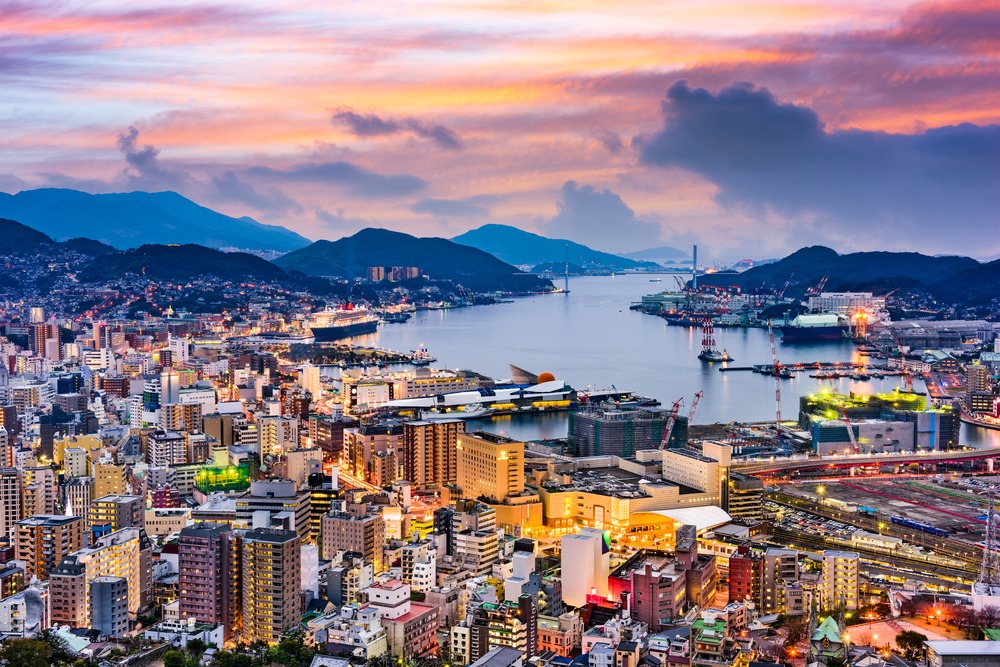
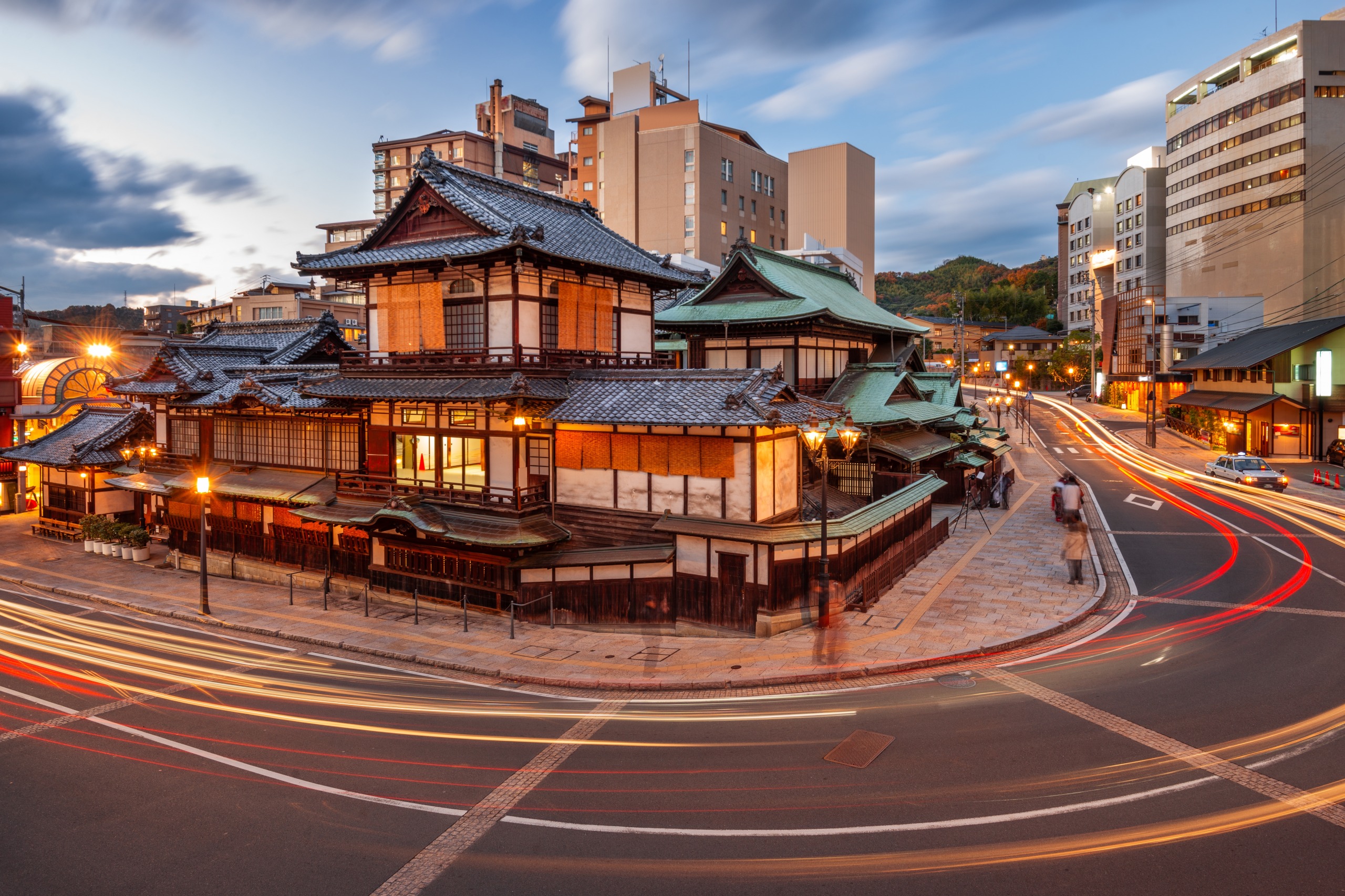
The castle is part of a broader stay in Matsuyama, a city renowned for its thermal springs (notably Dogo Onsen) and literary heritage. To extend the theme of panoramas and sacred landscapes, you can explore our pages on Mount Hiei near Kyoto, Mount Inasa in Nagasaki, or Nachi Taisha in the Kii Peninsula.
Frequently Asked Questions
Frequently asked questions
The bloom typically occurs between late March and early April. Exact dates vary each year depending on weather: it is useful to consult bloom forecasts (sakura zensen) a few weeks before departure.
Allow 1.5 to 2.5 hours if you explore the fortifications, ascend the keep, and enjoy the views. A faster tour of the esplanade and panorama is possible in under an hour.
Both follow the same route and cost the same fare. The cable car is covered and suited for rainy days; the chairlift, in the open air, offers unobstructed views during ascent. You can typically choose at the time of ticket purchase.
Access to the esplanade is facilitated by the cable car. However, the interior of the keep features narrow, steep wooden staircases without an elevator, which limits its accessibility.
Yes, night illumination is in service until 11 p.m. The best exterior viewpoints are Honmaru Park and Horinouchi Park.
Plan Your Journey
Matsuyama Castle naturally integrates into an itinerary across Shikoku island, often paired with a visit to Dogo Onsen and the pilgrimage of the 88 temples. To build a tailor-made trip incorporating this stop, consult our Japan travel itineraries.
Interested in this visit?
We can include it in your personalised itinerary.