Nachi Taisha
Nachi Taisha
On the slopes of Mount Nachi, the Shinto shrine Nachi Taisha and the temple Seiganto-ji stand facing a sacred waterfall of 130 meters, a station on the Kumano Kodo.
Atop Mount Nachi in Wakayama Prefecture, the Shinto shrine Nachi Taisha shares its grounds with the Buddhist temple Seiganto-ji. Both face the Nachi-no-taki waterfall, venerated as a divine entity for centuries. This unique complex illustrates the coexistence of Shintoism and Buddhism in Japan, and represents one of the major stages of the Kumano Kodo pilgrimage, inscribed on the UNESCO World Heritage list.
Why visit Nachi Taisha
The site combines three rare elements together: a Shinto shrine, a Buddhist temple, and a sacred waterfall over 130 meters high. It is one of the Three Grand Shrines of Kumano Sanzan and a historic entry point to the Saigoku pilgrimage, which connects 33 temples dedicated to Kannon throughout the Kansai region. The forest of centuries-old cedar trees lining the approach path reinforces the solemn character of the place.
History
According to tradition, Emperor Jinmu discovered the Nachi Falls during his journey westward and founded the original shrine approximately 2,700 years ago. This legendary origin remains inseparable from the site. The shrine is dedicated to the kami Okuninushi, god of Medicine and Magic. The Kumano region on the island of Honshu is also considered in Shinto mythology as the resting place of Izanami, goddess of Creation and Death.
The meeting of two religions
When Buddhism was introduced to Japan in the 6th century, it did not replace local Shintoism but rather overlaid it. The temple Seiganto-ji was erected in the immediate vicinity of the shrine, and the two institutions long formed a unified religious complex. This cohabitation lasted until the end of the 19th century, when the Meiji government imposed administrative separation between Shinto and Buddhism.
A major pilgrimage stop
Nachi Taisha is among the Three Grand Shrines of Kumano Sanzan, alongside Hongū Taisha and Hayatama Taisha. The complex is inscribed with UNESCO under the designation "Sacred Sites and Pilgrimage Routes in the Kii Mountain Range". On the Buddhist side, Seiganto-ji marks the departure point of the Saigoku pilgrimage, which visits 33 temples dedicated to Kannon, the goddess of Mercy.
What to see
The Daimonzaka trail
Access to the shrine traditionally follows the stone-paved Daimonzaka trail, approximately 1 km of stairs winding through a cedar forest, some of whose trees exceed 800 years in age. A shop located at the base offers rental of traditional pilgrim attire for those wishing to ascend in the manner of pilgrims past. The trail leads to the entrance of the grand shrine.
The Shinto shrine Nachi Taisha
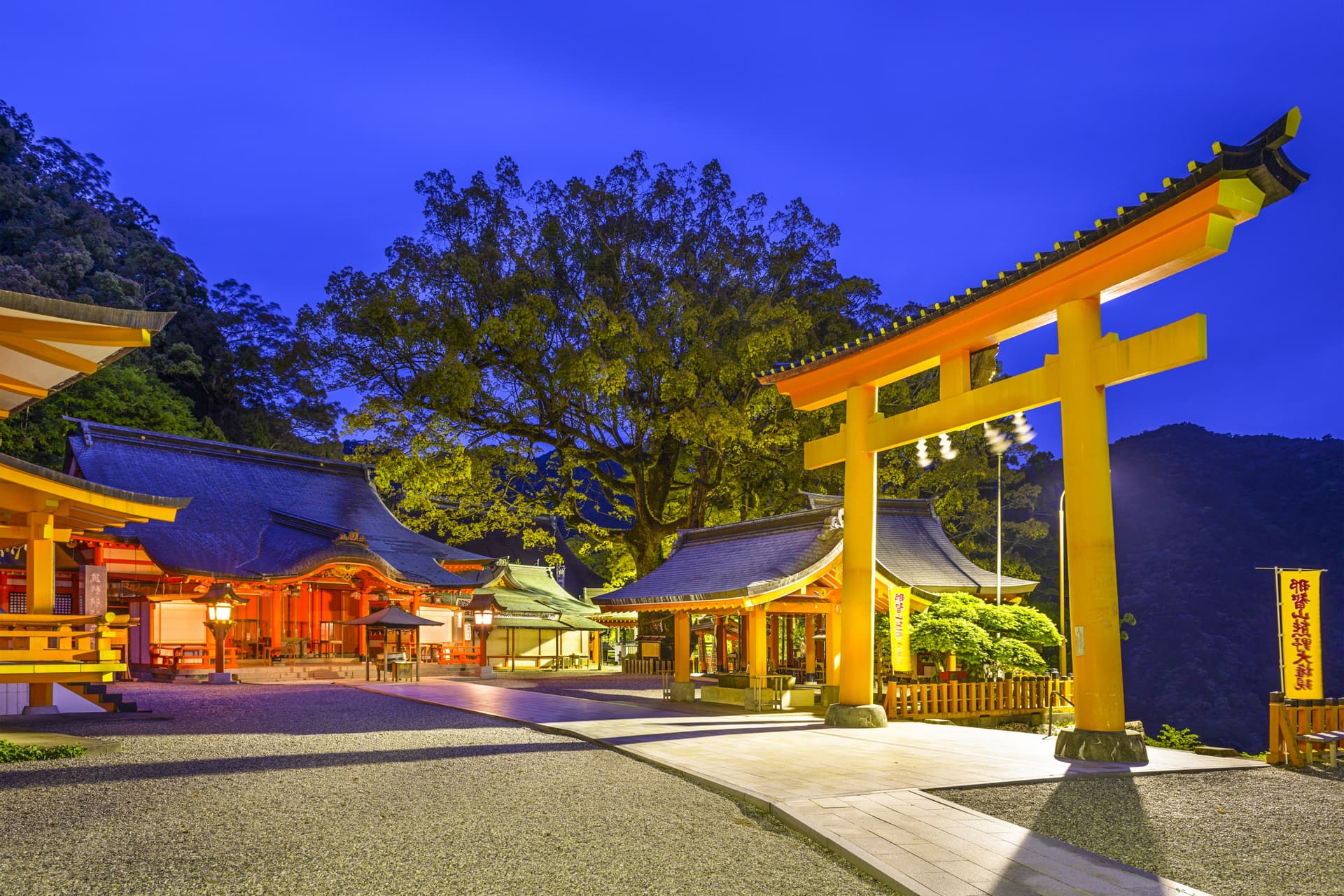
The main complex comprises six traditional buildings with vermillion facades, positioned on the slopes of Mount Nachi. In the immediate vicinity stands a sacred camphor tree approximately 850 years old, its hollow trunk used for the Tainai Kuguri ceremony: passing through the tree symbolizes spiritual rebirth. In July, the Nachi Fan Festival draws devotees dressed in white who carry enormous flaming torches along the Daimonzaka to purify the grounds.
The temple Seiganto-ji
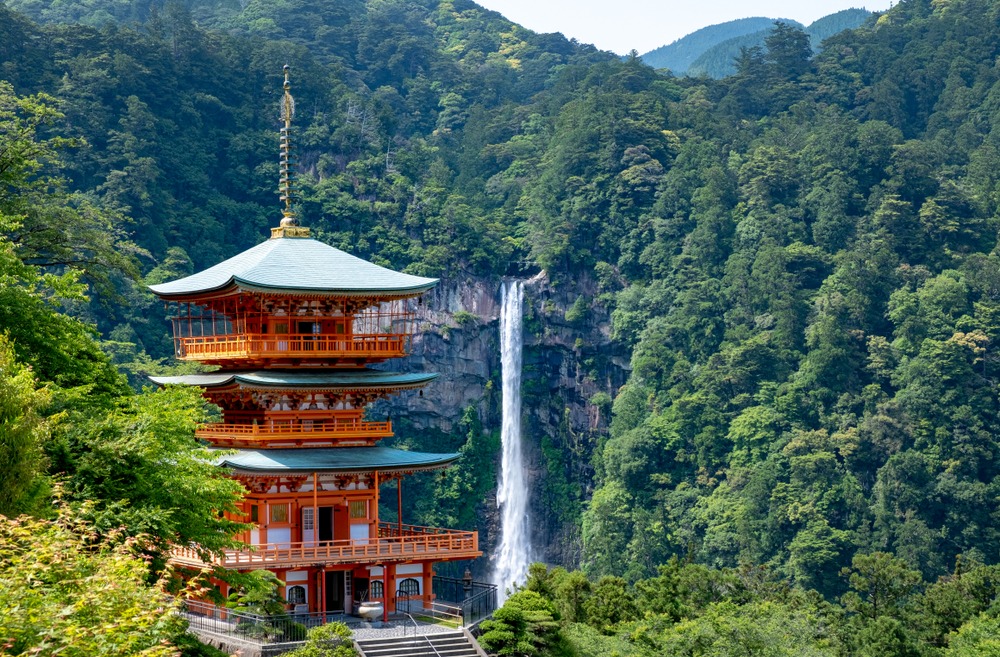
Just meters from the shrine, the temple Seiganto-ji preserves its three-tiered vermillion pagoda, whose silhouette stands out against the waterfall. The pagoda includes an observation platform that frames the cascade and, on clear days, offers a glimpse of the Pacific Ocean in the background. It is one of the most reproduced views in documentation on Kumano.
The Nachi Otaki waterfall
At more than 130 meters high and 13 meters wide, Nachi Otaki is one of Japan's most impressive waterfalls. In Shinto tradition, it is the place where Okuninushi manifested, making it a divine entity in its own right. The secondary shrine Hiro-Jinja is situated at the base of the fall. On site, the dragon fountain dispenses water reputed to confer health and longevity, to drink or to take away in a small bottle.
Practical information
- Site access: open year-round during daytime hours. Access to the shrine grounds is generally free; certain interior areas, the pagoda platform, and guided tours may be ticketed (moderate fee).
- Duration of visit: allow 2 to 4 hours to combine the Daimonzaka trail, the shrine, the temple, and the waterfall.
- Attire: proper footwear is essential due to stone stairs, often damp.
- Photography: permitted outdoors; certain interior buildings may prohibit it.
When to visit
The site can be visited year-round, but each season offers a different atmosphere. Spring (April–May) and autumn (October–November) are the most pleasant periods, with mild temperatures and, in autumn, the colors of maple leaves on the Kii mountains. Summer is hot and humid, but it is also the season of the Nachi Fan Festival in July, which alone justifies a visit for those interested in Shinto rituals. Winter remains accessible, sometimes with light snow at higher elevations that contrasts with the red of the pagoda.
How to get there
The site is served by bus from several points:
- From Kii-Katsuura or Nachi Station: alight at Nachi-san stop to access the shrine directly, or at Nachi-no-Taki-mae to start with the waterfall.
- From Shingu Station: alight at Jinja Otera-mae stop.
Kii-Katsuura and Shingu are connected to the rest of the Kansai region by the JR Kisei Line, accessible notably from Osaka and Nagoya.
Nearby
A stay at Nachi naturally extends to other sites in the Kii range and Kansai region:
- Mount Kōya, center of Shingon Buddhism and another spiritual pinnacle of Wakayama.
- Kasuga Taisha in Nara, a Shinto shrine renowned for its thousands of lanterns.
- Kibune, a mountain village north of Kyoto.
- Himeji Castle, the finest feudal fortress in the country.
- Hida Takayama, in the Japanese Alps, for its preserved historic district.
Frequently asked questions
Frequently asked questions
Prepare your journey
Nachi Taisha naturally fits into an itinerary combining the Kii Peninsula, the Kansai region, and the imperial cities. To build a bespoke trip including this site and other stages of the Kumano Kodo, consult our suggestions for travel to Japan.
Interested in this visit?
We can include it in your personalised itinerary.