Hiroshima Peace Memorial
Hiroshima Peace Memorial
A UNESCO World Heritage site, the Genbaku Dome is the only building that remained standing after the atomic bomb of 1945. Visit the memorial, museum and Hiroshima park.
The Hiroshima Peace Memorial, commonly known as the Genbaku Dome, is the sole structure in the city center that remained standing after the explosion of the world's first atomic bomb on August 6, 1945. Inscribed as a UNESCO World Heritage site in 1996, it serves as the essential starting point for any memorial visit to Hiroshima.
Why visit the Peace Memorial
The site brings together the Genbaku Dome, the Peace Memorial Museum and the commemorative park within a single perimeter. It is one of the rare places in the world where the history of nuclear weapons is told on a human scale, through objects, testimonies and architecture deliberately preserved in its original state. The visit is emotionally and intellectually demanding, and it naturally complements a stop in Hiroshima before continuing to Miyajima Island or further east toward Himeji.
History of the Genbaku Dome
The building was designed in 1915 by Czech architect Jan Letzel to house the Industrial Promotion Hall of the prefecture. Standing approximately 25 meters high, crowned with an oval dome and constructed of brick, it stood out sharply from Japanese buildings of the era, which were predominantly wooden.
On August 6, 1945, at 8:15 a.m., the atomic bomb detonated just a few hundred meters above the structure. The blast killed roughly 70,000 people instantly; the total toll from immediate and delayed effects—burns, radiation exposure, radioactive fallout—is estimated at nearly 140,000 deaths by the end of 1945. Due to the nearly vertical force of the blast, the Industrial Promotion Hall's framework remained partially intact. Local authorities chose to preserve it as a ruin and regularly reinforce it to prevent collapse, as a memorial to the victims.
The first commemoration ceremony was held in 1947 under the direction of Shinzo Hamai, then mayor of Hiroshima. The site was designated a UNESCO World Heritage site in 1996.
What to see on the site
The Genbaku Dome
Located on the bank of the Motoyasu River, the dome is freely visible day and night. There is no interior access: you walk around it in a few minutes, reading the multilingual panels that recount the building's history.
The Peace Memorial Museum
The museum, situated across the park, preserves objects recovered after the explosion. You will see schoolchildren's clothing, locks of hair, a watch stopped at 8:15, and a stone slab bearing the trace of a body swept away by the blast. An entire wall is dedicated to letters of compassion sent by foreign nations and heads of state over the decades. The museum's path is documentary and emotionally intense, and is generally not recommended for young children.
The park and its monuments
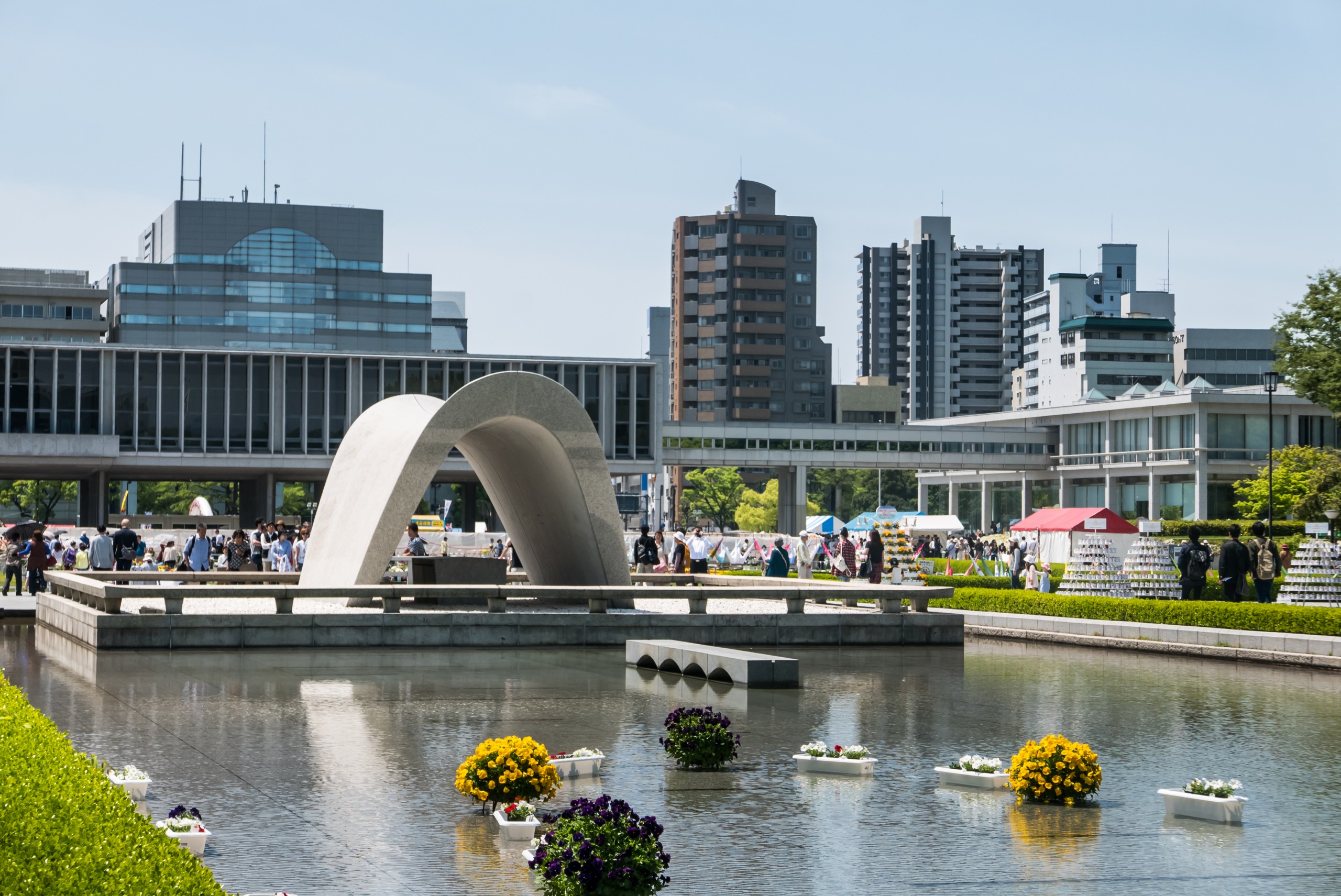
The cenotaph of the memorial and the Monument to the Peace of the Children punctuate the park. Before the latter, water bottles are regularly left as offerings: they echo the severely burned survivors who, in the hours following the explosion, could not drink due to the "black rain" and clouds of ash. The peace bell may be freely rung by visitors.
When to go
The Dome and park are accessible year-round. Two moments stand out:
- August 6th, the day of the Commemoration Ceremony. The gathering begins around 8 a.m. at the cenotaph, followed by a moment of silence at 8:15 a.m., then speeches and, as evening falls, the release of paper lanterns on the Motoyasu River. Attendance is considerable, so arrive well in advance.
- Autumn (kôyô) and spring (cherry blossoms) offer the most pleasant visiting conditions. Summer is hot and humid, winter is cool but dry.
Practical information
- Genbaku Dome and park: free access and open to all hours.
- Peace Memorial Museum: open daily, with annual closure for a few days at the end of December / beginning of January. Hours vary by season (longer hours in summer, shorter in winter); check the official website the day before.
- Museum admission: moderate fee, free for younger visitors.
- Duration of visit: allow 2 to 3 hours to combine the dome, park and museum.
- Accessibility: the park and museum are adapted for people with reduced mobility.
How to get there
The site is located at the Genbaku Dome-Mae tram stop, served from Hiroshima JR Station by lines 2 and 6 (approximately 15 minutes journey time).
To reach Hiroshima from Tokyo, the easiest option is the Shinkansen (Tōkaidō-Sanyō line), which connects the two cities in approximately 4 hours. Hiroshima also has an airport served by connections to several major Japanese cities, including Sapporo and Okinawa, with limousine bus service to the central station.
Nearby attractions
Once you have completed the memorial visit, Hiroshima offers several extensions within walking distance or by tram: Hiroshima Castle, rebuilt to its original specifications, the Shukkei-en Garden, a compact landscape garden, and slightly further afield, Mitaki-dera Temple, crossed by three waterfalls and particularly striking during the kôyô season. The Hondori district (shopping) and Okonomimura (okonomiyaki specialties) offer a chance to unwind in the late afternoon. Further along the road back toward Osaka, Himeji Castle makes an excellent complementary cultural stop.
Frequently asked questions
Frequently asked questions
Allow 2 to 3 hours to visit the Genbaku Dome, the park and the Peace Memorial Museum in succession. A half-day is comfortable if you wish to take time to read the testimonies.
The park and Genbaku Dome are free and open to the public. Only the museum charges admission, at a moderate rate, with free entry for younger visitors.
The park and Dome can be visited as a family without difficulty. The museum, however, displays very distressing objects and images; it is generally not recommended for children under 10 years old.
Yes, the Commemoration Ceremony is open to the public at the cenotaph from 8 a.m., with a moment of silence at 8:15 a.m. Attendance is very large: arrive early and book your accommodation several months in advance.
The tram is the simplest way: take line 2 or 6 to the Genbaku Dome-Mae stop, approximately 15 minutes from JR Station.
Organize your trip
The Peace Memorial fits naturally into an itinerary combining Tokyo, Kyoto and western Honshū. To plan a structured visit including Hiroshima and Miyajima, consult our journeys in Japan.
Interested in this visit?
We can include it in your personalised itinerary.