The Golden Pavilion Kinkaku-ji
The Golden Pavilion Kinkaku-ji
A Zen temple covered in gold leaf in north-west Kyoto, Kinkaku-ji combines unique architecture, strolling gardens and a turbulent history.
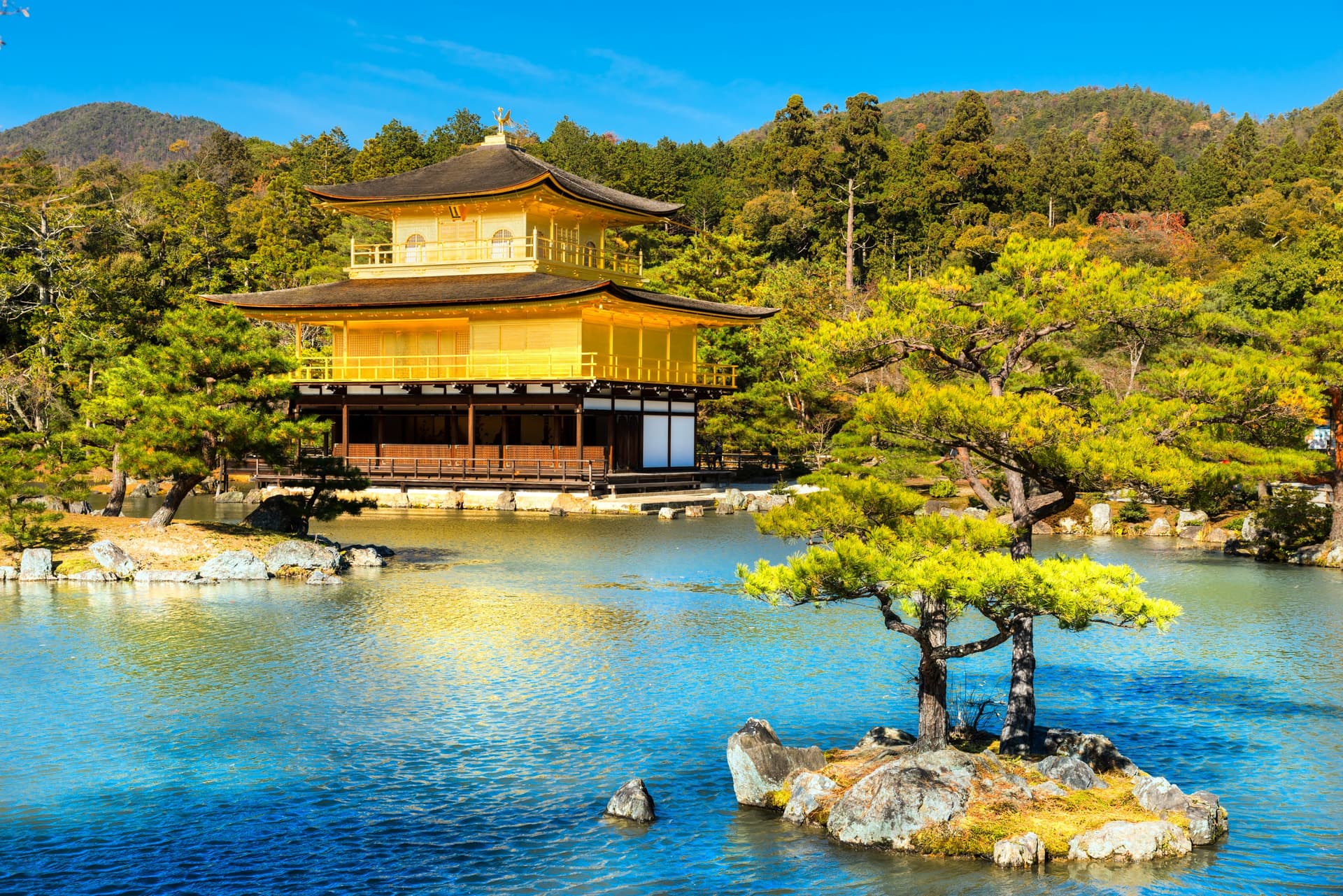
Officially named Rokuon-ji, the "temple of the deer garden," Kinkaku-ji or the Golden Pavilion stands in north-west Kyoto. Its two upper storeys covered in gold leaf are reflected in the Kyōko-chi pond, forming one of the most recognizable images of Japan. A Zen Buddhist temple of the Rinzai school, it is inscribed on the UNESCO World Heritage list.
Why visit the Golden Pavilion
Kinkaku-ji combines several attractions on a single site: unique architecture blending three Japanese styles across three storeys, a traditional Muromachi-period strolling garden, and a turbulent history that includes an arson fire that became a literary subject. The visit is relatively brief (allow 45 minutes to 1 hour) and fits easily into a day devoted to north-west Kyoto.
Temple History
An aristocratic villa from the 13th century
The site was originally the private villa Kitayama-dai, constructed around 1220 by Saionji Kintsune, an influential statesman at the imperial court. In 1397, shogun Ashikaga Yoshimitsu purchased the property and transformed it into a temple-residence. Upon his death, in accordance with his wishes, the building became a Zen temple of the Rinzai school under the direction of his son.
The 1950 fire
The pavilion survived the Ōnin War (second half of the 15th century) without major damage, while many Kyoto buildings were destroyed. However, it fell victim to the actions of a young monk, Shoken Hayashi, who set it ablaze on 2 July 1950 at 2:30 a.m. The monk claimed he acted out of "envy of the building's beauty" and "resentment against the upper class." The original statue of Ashikaga Yoshimitsu perished in the flames. The event inspired Yukio Mishima to write his novel The Temple of the Golden Pavilion (1956).
Successive reconstructions
The pavilion was rebuilt identically in 1955. In 1984, the gold leaf on the two upper storeys was entirely replaced with thicker sheets than the original. The restoration of interior paintings and the statue was completed in 1987. The shingled roof was remade in 2003. Symbolically, the gold is meant to purify pollutions and negative thoughts associated with death.
What to see on site
Three superimposed architectural styles
The pavilion brings together three Japanese architectural traditions across three levels:
- Ground floor: shinden style, inherited from Heian-period aristocratic residences, without gilding.
- First floor: buke style, typical of samurai dwellings, covered in gold leaf.
- Second floor: zenshū-butsuden style, that of Zen temples, also gilded, housing relics of the Buddha.
Atop the pyramidal roof sits a bronze Chinese phoenix. The interior of the pavilion is strictly off-limits to the public; visits are made solely from outside, following a designated circulation path.
The pond and gardens
The Kyōko-chi pond ("water mirror") reflects the pavilion from the main viewpoint, the most photographed spot on the site. The path then leads to the rear of the temple, through gardens dotted with cloud-pruned pines, stone lanterns and a small moss-covered bridge. Higher up, a tea house offers a matcha break with views over the entire composition. The site exemplifies the kaiyū-shiki-teien, or strolling garden, tradition.
Practical Information
- Visit duration: 45 minutes to 1 hour is sufficient for the entire route.
- Admission: paid entry, modest fee (check on-site or the official website for current rates).
- Hours: open daily during daytime hours, no significant closures. Verify exact hours before your visit.
- Tickets: no advance booking available; purchase on-site. An ofuda (paper charm) is issued as your ticket.
- Accessibility: partially accessible route; some sections feature stairs and gravel paths.
When to visit
Kinkaku-ji suits all seasons, each bringing its own atmosphere to the site:
- Spring (late March–early April): cherry blossoms bloom around the pond.
- Autumn (mid-November to early December): red maples (momiji) are particularly photogenic.
- Winter: rare but spectacular snow episodes on the gilded roof; visitor numbers drop significantly.
- Summer: dense vegetation and powerful reflections, but high crowds and heat.
To minimize crowds, arrive early at opening or visit during the last hour before closing. The site is one of Kyoto's most visited attractions.
How to get there
The pavilion is not served by the subway; bus remains the simplest means from central Kyoto.
- Buses 12 and 59: Kinkakuji-mae stop, closest to the entrance.
- Buses 101, 102, 204 and 205: Kinkakuji-michi stop, followed by a short walk.
- Taxi: convenient option for groups, approximately 20 to 30 minutes from Kyoto Station depending on traffic.
- Bicycle: possible from the city centre; allow 30 to 45 minutes.
What to combine in the area
North-west Kyoto concentrates several major sites accessible within the same day:
- Ryōan-ji temple and its famous dry garden, 15 minutes' walk away.
- The Ninna-ji complex, a former imperial palace converted into a temple.
- Kitano Tenmangū shrine, dedicated to scholarship.
- The Arashiyama district and its bamboo grove, accessible by bus.
- Nanzen-ji temple, on the east side of the city, to extend your Zen temple route.
Frequently Asked Questions
Frequently asked questions
Planning the rest of your journey
Kinkaku-ji fits naturally into an itinerary spanning several days in Kyoto, or into a wider circuit combining temples, castles and nature. To plan your programme, explore our selection of Japan tours.
Interested in this visit?
We can include it in your personalised itinerary.