Urakami
Urakami
North of Nagasaki, Urakami holds two distinct memories: that of persecuted hidden Christians from 1614 to 1873, and that of Ground Zero on August 9, 1945.
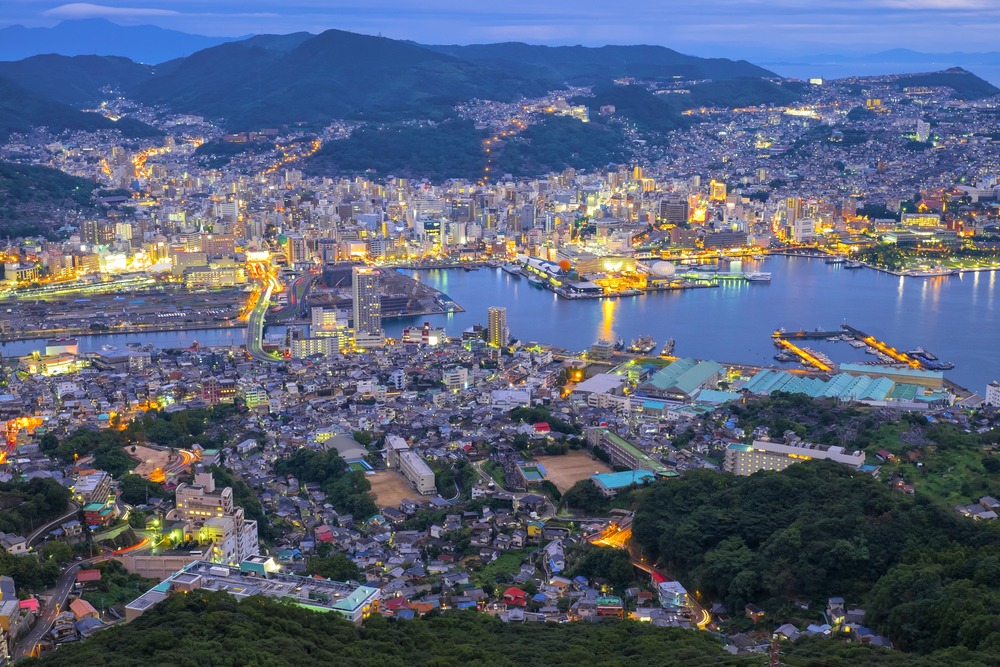
North of Nagasaki, the Urakami district encompasses two chapters of Japanese history: the resistance of hidden Christians over more than two centuries, and Ground Zero on August 9, 1945. Its rebuilt cathedral, the nearby Peace Park, and the Atomic Bomb Museum make it a memorial site in its own right, complementing Hiroshima.
Why visit Urakami
Urakami lacks the international prominence of Hiroshima's Genbaku Dome — the site is not inscribed on the UNESCO World Heritage List, unlike the latter — but it tells a longer and denser story. The district long stood as a bastion of persecuted Japanese Christians from the 17th century onward, before becoming, nearly four centuries later, the epicenter of the 1945 nuclear explosion. To visit Urakami is to walk through both these memories within a few hundred meters.
The district lends itself to a 2 to 3-hour walking tour centered on the cathedral, Peace Park, and museum. It fits naturally into a day trip to Nagasaki, complementing the harbor-side sites to the south such as Oura Cathedral or Glover Garden.
History of Urakami
The persecution of Christians (1614-1873)
In 1614, Shogun Tokugawa Ieyasu banned Christianity in Japan, fearing European influence would weaken the empire. Believers faced torture or execution. Urakami became a haven for hidden Christians, who continued practicing their faith in secret for more than two centuries, spiritually supported by the community linked to Oura Cathedral.
Four waves of repression, called kuzure ("disintegration"), struck the community:
- The first persecution in Urakami began in 1790: hidden Christians were captured, but none were executed.
- The persecution resumed in 1839, without casualties.
- In 1859, the empire ordered the third kuzure; more than a dozen people died under torture.
- The final persecution, known as "Urakami Yoban Kuzure," took place between 1867 and 1873.
At the start of this final wave, 68 Urakami Christians were captured and forced to renounce their religion. In 1868, the Meiji government entrusted the administration of the Kyushu region to Sawa Nobuyoshi, known for his hostility toward foreigners. An imperial council on April 25 validated a two-stage exile plan: first isolate the leaders in Tsuwano, Hagi, and Fukuyama, then relocate the rest of the village. More than 3,400 Christians fell victim.
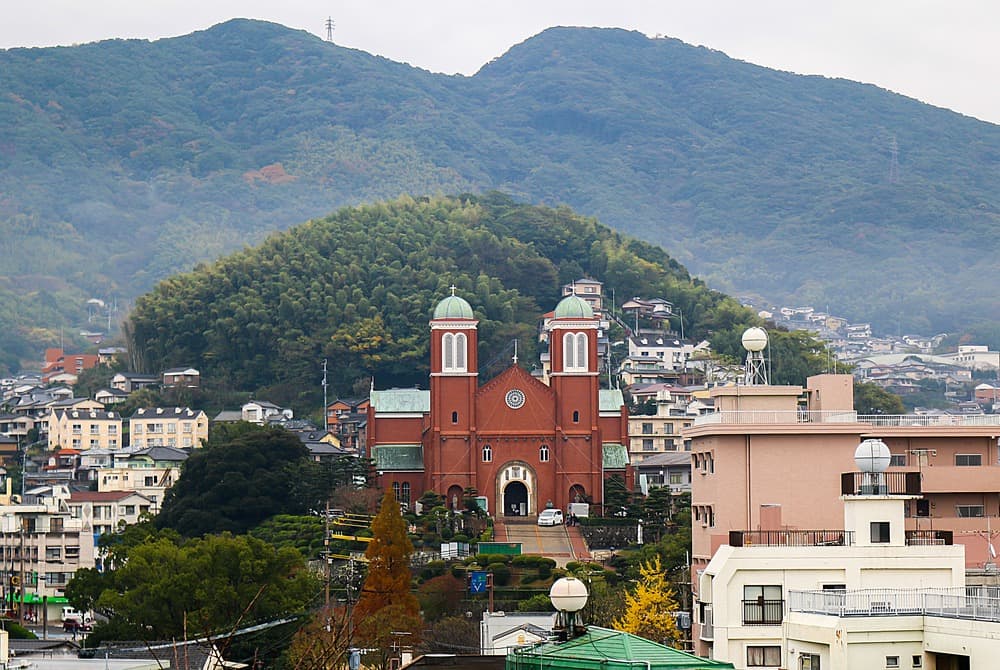
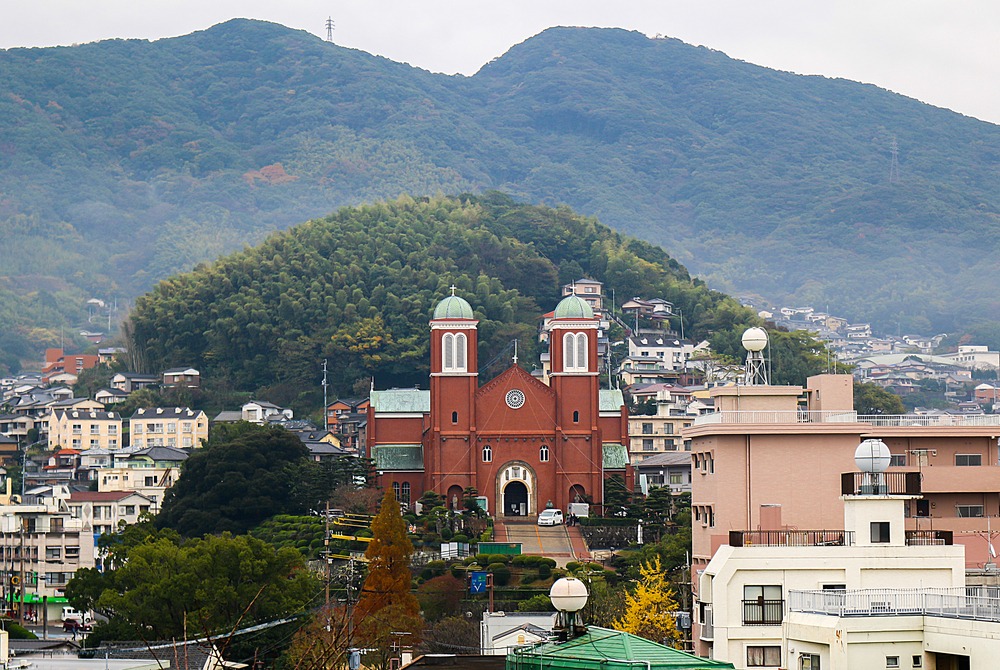
In 1873, pressure from the United States and European nations forced Japan to lift the Christian ban. Believers returned to Urakami and began constructing a cathedral in 1895, completed in 1925.
Ground Zero on August 9, 1945
On August 9, 1945 at 11:02 AM, Urakami became Ground Zero in Nagasaki. The nuclear bomb detonated at roughly 500 meters altitude and devastated 80% of the city's infrastructure, including the cathedral. Over 74,000 people died. The building was restored in 1959 by municipal authorities — a choice that partly explains its non-inclusion on the UNESCO World Heritage List, unlike the Genbaku Dome left standing at Hiroshima.
What to see in Urakami
Urakami Cathedral
The current structure is a faithful reconstruction of the original building. Inside and around it, several artifacts rescued from the explosion are on display, including wall fragments and charred statues. The Madonna of Nagasaki with a burnt face, found in the rubble, receives particular veneration. Allow about thirty minutes for the visit. For more information, consult the dedicated page on Urakami Cathedral.
Peace Park and the Peace Statue
A few hundred meters from the cathedral, Peace Park spreads across the hill that overlooked the hypocenter. Its central statue, nearly 10 meters tall, points with its right arm to the nuclear threat and with its left hand toward a peaceful horizon. The park hosts the commemorative ceremony each August 9.
Atomic Bomb Museum
The museum presents objects, photographs, and testimonies from survivors. The most striking piece remains a wall clock whose hands froze at 11:02 AM, the exact moment of the explosion. The dense exhibition requires 1 to 1.5 hours to view.
Nearby
- Nagasaki Atomic Bomb Hospital — a specialized facility for follow-up care of survivors (hibakusha).
- Mirai Nagasaki Coco Walk — shopping complex near Urakami Station, useful for a meal break.
- Nagasaki Brick Hall — concert and international conference venue, in immediate proximity to the station.
- Peace Garden — from which the silhouette of the cathedral can be seen.
To extend your exploration of the region, the Dazaifu Temmangu shrine in Fukuoka and the porcelain village of Arita are accessible the same day by train from Nagasaki.
Practical information
- Recommended visit duration: half a day to combine the cathedral, Peace Park, and museum.
- Admission: free entry to the cathedral and Peace Park; moderate fee for the Atomic Bomb Museum.
- Best time: early morning to avoid school groups, particularly numerous at the museum.
- Dress code: the cathedral remains an active place of worship; modest attire is appreciated.
How to get there
From central Nagasaki, the streetcar is the simplest option. Take lines 1 or 3 to the Heiwa Koen (Peace Park) stop: the cathedral is about a 10-minute walk away. A day pass, sold at major stations and tourist offices, provides free access to the entire network.
To reach Nagasaki from abroad, the fastest option is a domestic flight from Tokyo Haneda (approximately 2 hours). By Shinkansen from Kyoto, Shin-Osaka, or Hiroshima, expect a transfer in Hakata (Fukuoka), then the JR Kamome train to Nagasaki.
Frequently asked questions
Frequently asked questions
No. Unlike Hiroshima's Genbaku Dome, which was preserved in ruins, Urakami Cathedral was rebuilt in 1959 by municipal authorities. This restoration partly explains why it does not appear on the World Heritage List.
Allow half a day (3 to 4 hours) to cover the cathedral, Peace Park, and Atomic Bomb Museum. The district is entirely walkable.
Yes, outside of religious services. The cathedral remains an active place of worship: silence and modest dress are requested. Several statues and objects rescued from the 1945 explosion are on display.
Hiroshima has preserved its landmark building (the Genbaku Dome) in ruins as direct testimony, and holds a UNESCO designation. Urakami offers a longer narrative, spanning both the persecution of hidden Christians (1614-1873) and the 1945 bombing, but features a rebuilt cathedral.
Take the streetcar lines 1 or 3 to the Heiwa Koen stop. The cathedral is about a 10-minute walk away. A day pass is available at stations.
To incorporate Urakami into a comprehensive itinerary across Japan, explore our tailor-made Japan tours.
Interested in this visit?
We can include it in your personalised itinerary.