Hiraizumi
Hiraizumi
Once Kyoto's rival in the 12th century, Hiraizumi preserves a Buddhist heritage listed as UNESCO World Heritage. Temples, Pure Land gardens and golden treasures await discovery.
Hiraizumi is a charming rural town situated in the southern part of Iwate Prefecture. It stands as a window into historic Japan. Hiraizumi is home to numerous sites recognized as UNESCO World Heritage.
History
Nestled between rivers and small mountains, Hiraizumi benefited from a strategic position along the Oku Taido route. The city emerged during the second half of the Heian period (794–1185), thanks to the powerful rulers of the Fujiwara clan of Mutsu. In turn, Kiyohira, Motohira, and Hidehira enriched the city's architectural and cultural heritage, eventually rivaling Kyoto itself in the 12th century.
In 1189, Minamoto Yoritomo, who would become Japan's first shogun, destroyed Hiraizumi on the pretext that the Fujiwara clan leader had harbored his rival Yoshitsune. While the city certainly lost prominence after this attack, it retained remarkable historical and cultural treasures that are today inscribed on the UNESCO World Heritage list. Among them are the temples Chusonji and Motsuji, the ruins of Muryoko-in temple, the former garden of Kanjizaio-in temple, and Mount Kinkei.
Hiraizumi Today
Hiraizumi has left its rivalry with Kyoto behind, transforming into a charming countryside town. Yet it loses none of its appeal. Head to the tourist center near the station to pick up a map of local attractions.
Chusonji Temple
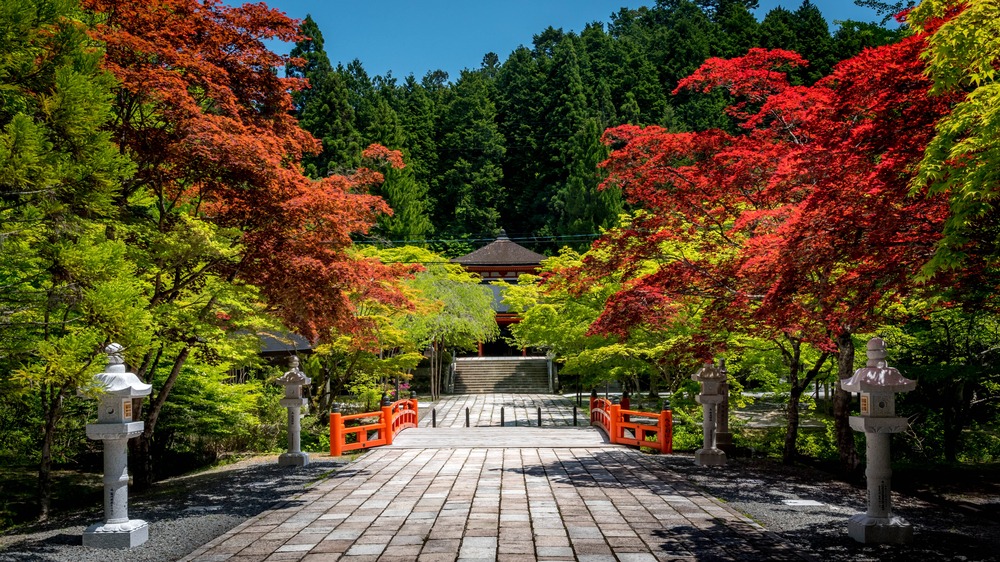
The Chusonji temple complex tops the list of must-see sites in Hiraizumi. The current building dates from 1909, though its original structure was designed during the Heian period. It was founded by the priest Ennin in 850. Fujiwara Kiyohira expanded it in the early 12th century. At its peak, the complex comprised some forty buildings. You must walk through a forest with glimpses of the Kitakami River and Mount Kotagatamine to reach the temples. Upon arrival, notice the small wooden shrine positioned to the left of the temple's main hall; it is dedicated to Benkei, the god of war. You will find a representation of Buddha Amida in the main hall.
Sankozo Museum
Next, visit the Sankozo Museum, perched on a hillside. This institution displays over 3,000 authentic pieces. Imposing wooden statues of Buddha grace the building's entrance. Another museum highlight: seek out the image of Kannon, the goddess of mercy, which stands over 1.74 meters tall. Do not miss the exhibitions of swords and kimonos, as well as videos documenting the restoration of the Chusonji complex.
With your Sankozo entrance ticket, you can access the Konjikido or Golden Hall of Chusonji. This Buddhist altar erected in 1124 covers 5.5 m² and features four pillars. The structure is enveloped in black lacquer embellished with gold leaf. Its interior walls display gilded images of Buddha Amida, guardian kings, and various bodhisattvas. Beneath the altar rest the mummified remains of three great leaders of the Fujiwara clan: Kiyohira, Motohira, and Hidehira. The Konjikido opens onto the Sutra Hall or Kyozo, which once contained over 5,000 sutra scrolls written in gold and silver ink. Some manuscripts are visible at the Sankozo Museum and on Mount Koya.
Motsuji Temple
Continue your journey at Motsuji Temple, renowned for its beautiful gardens and the Jodo teien Heian pond. Like Chusonji, this complex was also founded by the priest Ennin in the 9th century. Several of its buildings lie in ruins, though some foundations remain.
In the temple's main hall, restored in 1989 in keeping with Heian-period architectural principles, stands a representation of Buddha Yakushi Nyorai. Near the domain's parking area, discover the Yumeyakata Museum, which houses wax statues, holograms, and numerous images reconstructing the history of the Fujiwara clan. Browse the gift shop for local crafts such as noren curtains and lacquerware.
Traditional Events
Each May, Hiraizumi celebrates a poetry festival called "Gokusui no En" at Motsuji Temple. During this event, participants sit along the stream that feeds the Jodo teien Heian garden pond and compose a poem before a floating sake cup reaches them. For this occasion, women don kimonos, while men wear hunting or court garments. Before the challenge, the Jakudo movement performs the Ennen no Mai, a longevity rite. At the event's end, the texts are read aloud by the master of ceremonies.
Climate
The town of Hiraizumi enjoys a warm, temperate climate, pleasant to experience, though rainfall is relatively significant. The city receives an average of 1,265 mm of rain annually. Temperatures average around 11 °C.
Train travel proves the most convenient way to reach Hiraizumi. From Tokyo, take the JR Tohoku Shinkansen and get off at Ichinoseki. This first leg of your journey to Hiraizumi takes approximately 2 hours and 10 minutes.
Once in Ichinoseki, board a local JR Tohoku line train to reach Hiraizumi in under 10 minutes.
At Hiraizumi Station, numerous local buses are available to reach major attractions, though some sites are within walking distance. Bicycle rental services are also available near the station.
What to Do in Hiraizumi?
- Pay respects to Benkei, the god of war, at his shrine within the Chusonji temple complex
- Honour the powerful leaders of the Fujiwara clan at the Konjikido of Chusonji Temple
- Discover the precious sutras at the Sankozo Museum
- Stroll through the Jodo teien Heian garden at Motsuji Temple
- Participate in the "Gokusui no En" poetry festival in May, and much more
Want to discover this destination?
Our local advisors design your tailor-made trip.