Japon: The Atmosphere of a Ski Resort
Japan's northernmost island is called Hokkaido. Its latitude places it at the level of the French Alps, and yet… it is far colder there and receives much more snow.
Japan's northernmost island is called Hokkaido. Its latitude places it at the level of the French Alps, and yet… it is far colder there and receives much more snow. The reason is that Siberia and its cold currents are not far away.
Upon arrival at Sapporo Airport, the "capital" of Hokkaido, you immediately notice the athletes—ski bags and snowboards slung over their shoulders, cutting-edge Gore-Tex jackets, impeccably well-equipped. The departure organization is distinctly Japanese: group leaders wielding flags gather individuals wanting to board one of the dozens of shuttles heading to the resorts. Maximum wait time: 10 minutes. The bus practically comes to collect you from the airport hall itself. Before all passengers have boarded the shuttle, the driver has already loaded every single bag into the hold. An hour later, you've forgotten the very name of the country you're in: skirting lakes, penetrating dense forests, you're convinced you're in Sweden…
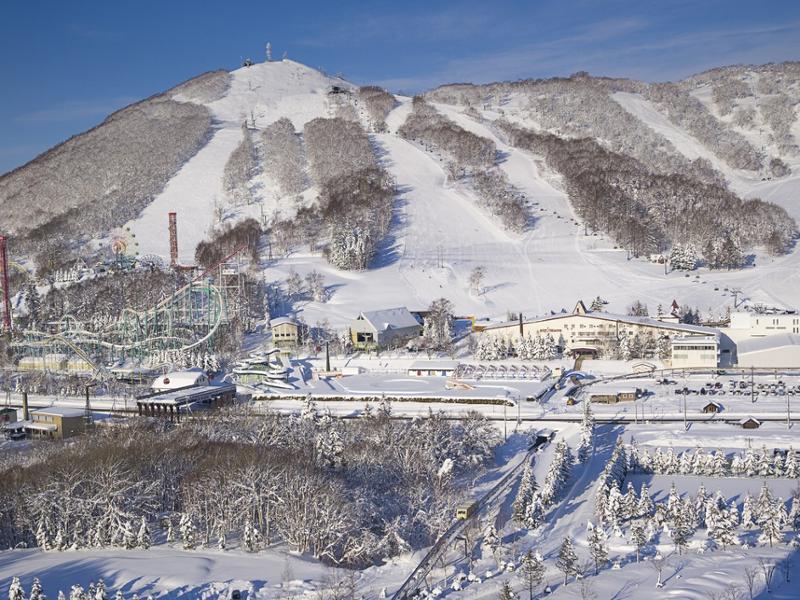
Suddenly, an immense structure emerges, barely visible through the falling snow. We're only 100 meters above sea level, and yet not a blade of grass is visible—the ground is blanketed in a thick layer of white powder. This structure is a hotel, the resort's only one, but what a hotel! Worthy of the kitsch and gigantic constructions of Las Vegas, it nonetheless exudes a serene atmosphere. The welcome is, of course, impeccable, and the cleanliness of the vast marble halls seems surreal. The rooms are very spacious, and the suites comfortable without being ostentatiously luxurious: perfect for a resort hotel. The array of services offered by the hotel is impressive: 10 restaurants to choose from, 2 equipment rental shops, a game room, a dozen various boutiques, changing rooms providing direct access to the slopes, and more.
The ski domain is large enough to satisfy any skilled skier for several days. The number of snowboarders is striking: the proportion approaches 50%. Given the amount of snow that falls at Rusutsu, they'd be foolish not to make the most of it. Hokkaido Island sits in the path of atmospheric currents coming straight from Siberia. This is why you'll always be assured of finding abundant, high-quality snow. And this is why the lack of mountains isn't a problem: the slopes you descend here are nothing other than the flanks of volcanoes! Even more remarkable: these volcanoes peak at no more than 1,000 meters! As for the vertical drop, it too is 1,000 meters, since the slopes finish at sea level. This is equivalent to a resort spanning from 2,500 to 1,500 meters in our regions—something hardly uncommon at all…
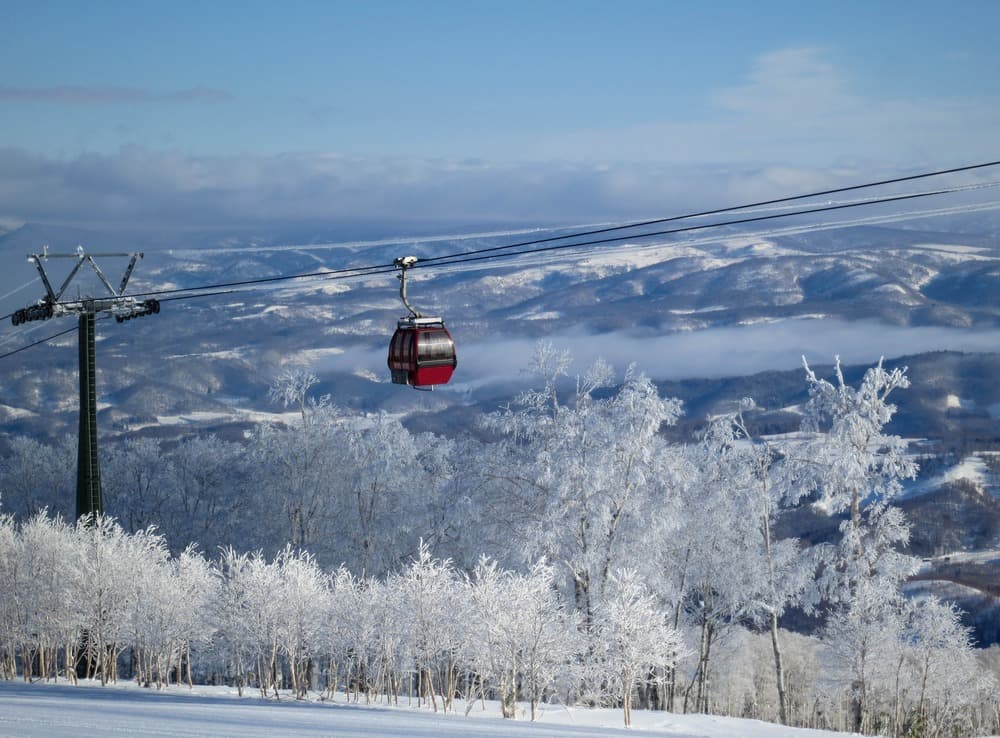
Add to this the possibility of skiing until 9 p.m. every day on a quarter of the domain, virtually no queues at the chairlifts, and the fact that certain slopes are intentionally left ungroomed for snowboards, and you'll begin to see French ski resorts in a different light. Moreover, innovations abound here—after all, this is Japon. All chairlifts, in addition to never breaking down, feature benches for 4 to 6 people under a transparent plastic dome for protection from the cold—it regularly drops to -10°C. Each chairlift is individually swept by a smiling employee just before you sit down. At the top, you'll be greeted by another employee, thoroughly honored by your presence at the resort. Regarding off-piste options, they are somewhat limited in number but not in quality. The depth of snow in the forests separating the slopes is simply incredible. The only recurring issue is a general lack of steepness, but there are still ways to enjoy yourself in gorgeous powder fields, especially for snowboarders.
In the evening, you leave the outside world behind and remain inside. Indeed, everything you need can be found in the corridors and halls of this gigantic resort. An indoor pool, Onsens—the famous Japanese hot baths—, tea lounges, a cyber cafe, a pub, and much more await you while snow falls outside. The restaurants feature décor oscillating between bad taste and naïve art, between Soviet ambiance, rococo salons, and sometimes refined design. The service and quality of the food served are impeccable, and the choice is wide: Italian, Japanese, American cuisine, and more. All restaurants are near the guest rooms, within the maze of this uniquely particular hotel complex. And even if you're staying in the 20-story tower belonging to the complex, you won't have to walk: a monorail is there to take you there!
Ultimately, this place with such a strange name, in which every employee, from the lift operator to the server, belongs to the same group, whose slopes are operated by the company that owns the hotel complex and the outrageous amusement park next door, bears an uncanny resemblance to a caricature of the entire country in which it sits—a country operating in a closed loop, a country regulated like clockwork: Japon.
Frequently asked questions
Rusutsu is a ski resort located on Hokkaido Island, Japon's northernmost island. It is approximately one hour's drive from Sapporo Airport, the capital of Hokkaido. Direct shuttles connect the airport to the resort with wait times of less than 10 minutes.
Hokkaido sits in the path of cold atmospheric currents coming from Siberia. These moisture-laden winds dump abundant, light snow on the island, guaranteeing exceptional powder snow quality throughout the winter season.
Rusutsu's slopes are located on volcanic flanks peaking at approximately 1,000 meters in elevation. The vertical drop is 1,000 meters, with slopes descending to sea level. Despite this modest altitude, the quality and quantity of snow are remarkable thanks to Siberian climate conditions.
Yes, it is possible to ski until 9 p.m. daily at Rusutsu on a portion of the ski domain. This is one of the resort's appreciated features, ideal for extending slopes sessions after sunset.
Onsens are the famous Japanese hot springs, fed by naturally heated waters. The Rusutsu resort features Onsens directly within its hotel complex, allowing skiers to relax after a day on the slopes—an experience that is both relaxing and culturally authentic.
Absolutely. Rusutsu is a highly sought-after destination for snowboarders, who make up approximately 50% of the resort's users. Certain slopes are intentionally left ungroomed for snowboarding, and the powder snow in the forests offers ideal off-piste conditions.