Where to See the Hachikō Dog Statue in Tokyo?
Hachikō is the name of a dog whose story touched the world. Known for waiting for his master at the station for 10 years after his death
Hachikō is the name of a dog whose story touched the world. Known for waiting for his master at the station for 10 years after his death, the dog has his own statue in his honor in Tokyo. What is the story of Hachikō? How did it all end? Where is his statue located? Discover the complete story of Japan's most famous dog and everything you need to know to see the Hachikō statue during your stay in Tokyo.
What is the Story of the Famous Dog Hachikō?
A Faithful Dog Who Waited for His Deceased Master at the Station for 10 Years
Hachikō is the name of a Japanese dog whose story touched people around the world. It all began in 1924 when Ueno Hidesaburō, a professor in the agriculture department at the Imperial University of Tokyo, decided to acquire a Japanese breed dog.
He chose an Akita dog, a breed registered as part of Japan's national heritage, and named him Hachikō. "Hachi" means "eight" in Japanese, referring to the fact that the puppy was the eighth in the litter, while the suffix "Kō" can be defined as "child" or "little" and is used to make the term affectionate.
From that moment on, his dog became his most faithful companion. He accompanied his master every morning from home to Shibuya Station in Tokyo and waited for him at the same spot every evening when he returned from work. A little over a year later, a tragic event would end this beautiful friendship: on May 21, 1925, Hidesaburō Ueno died suddenly at the age of 53 from a cerebral hemorrhage.
Though the dog had accompanied him that morning, he waited for him that evening, never to see him again. He was subsequently placed in the care of several of the professor's friends and his wife. No matter which households Hachikō stayed in, the dog continued to go to the station every day, hoping to see his master again, despite distances and bad weather. In total, the faithful companion made the trips to and from the station for 10 years.
A Symbol of Loyalty That Resonates with Japanese Values:
Hachikō's story perfectly represents Japanese values, as explained by the Japan National Tourism Organization: "Immortalized in the form of a bronze statue, this humble Akita dog is a symbol of loyalty and perseverance, two qualities essential to Japanese culture."
A Story So Moving That It Led to the Erection of a Statue in His Honor
As Hachikō's story of waiting for his master at the station moved people throughout the neighborhood, it gained popularity across the country when articles about him were published in the media. He was given the nickname Chūken ("faithful dog") and became a true national symbol.
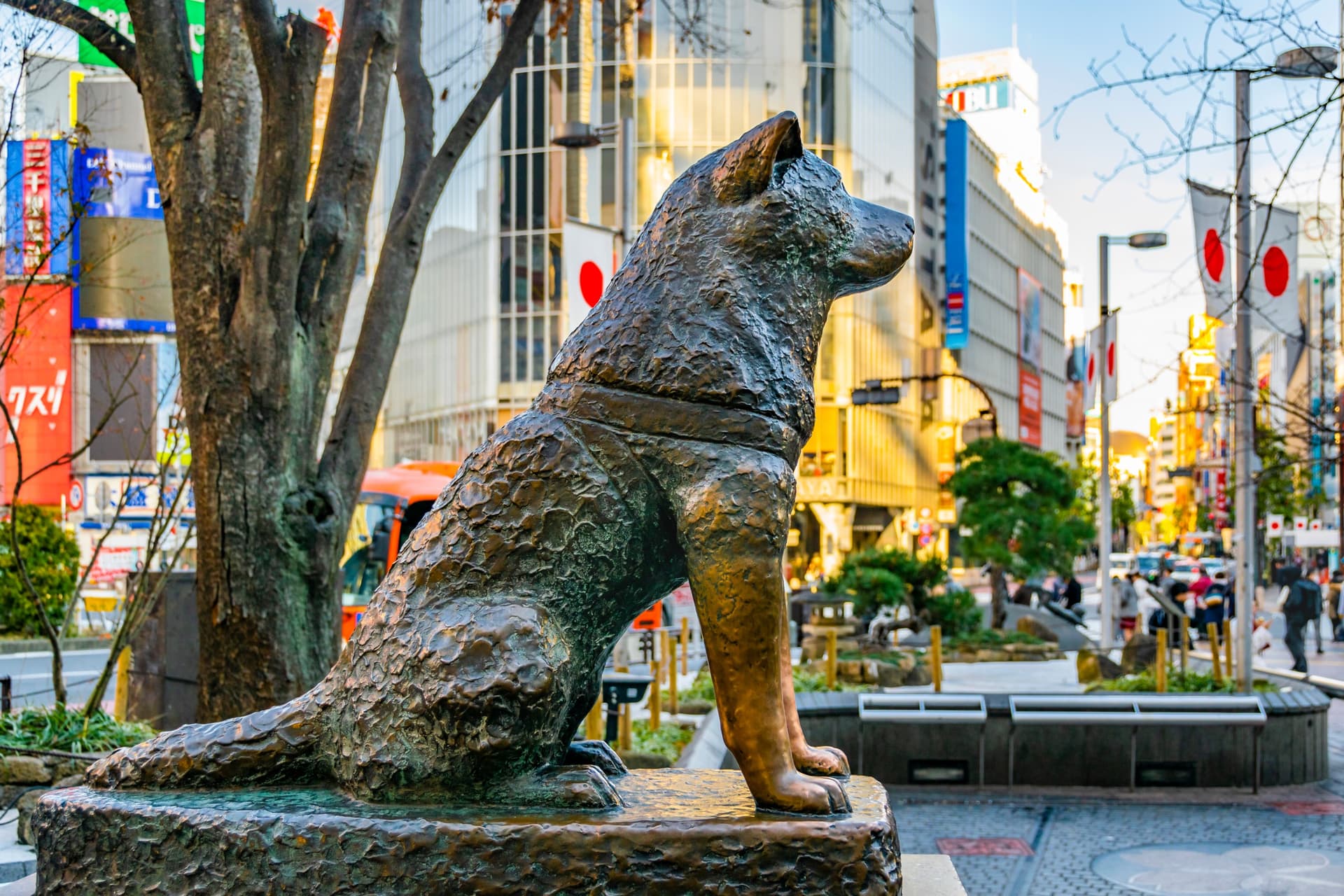
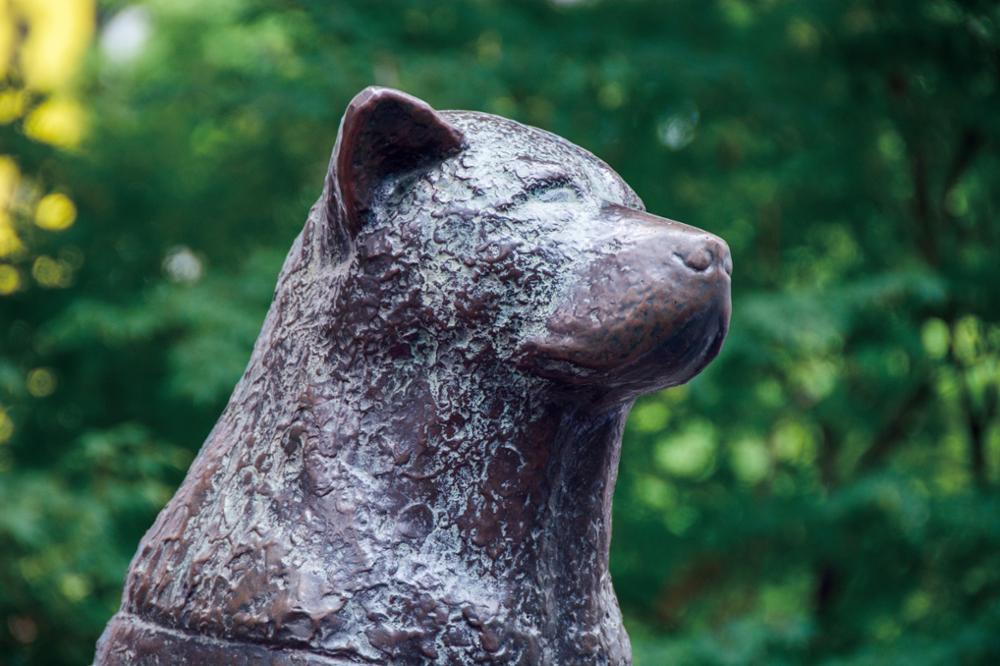
Neighborhood residents came to leave him water and food and grew affectionate toward the animal. In 1934, fundraising efforts were undertaken to erect a statue in his likeness. The project came to fruition when a bronze statue was unveiled outside the station entrance. The statue, created by Teru Ando, stands 1.62 meters tall and sits on a pedestal 1.80 meters high. At its inauguration, Hachikō the dog was himself present.
Unfortunately, he died a year later, at the age of 11. A funeral service was held, his body was preserved and displayed at the National Museum of Nature and Science, and the rest of his remains were buried at Aoyama Cemetery, alongside the gravestone of his master. The dog would have celebrated his 100th birthday in 2023.
The Hachikō statue has undergone several transformations since its creation. In 1944, it was melted down due to a metal shortage and to support the war effort during World War II. It would not be erected again until 1948, this time by Takeshi Ando, the son of its original creator.
In May 1989, the statue was slightly relocated due to renovation work at the station. It was turned eastward so that the dog's gaze would be directed toward the station exit. Every year in April, a ceremony is held in tribute to Hachikō around the statue.
Did You Know?
In addition to the statue at Shibuya Station, there has been another Hachikō statue since 2004 at Ōdate Station, in the city of Akita, where this dog breed originated. In 2015, on the occasion of the 80th anniversary of the professor's death, a statue of him and his dog was erected on the campus of Tōdai, the University of Tokyo where he worked.
A Touching Tale That Inspired Cinema
Due to his story, he became Japan's most famous dog and one of the most famous in the world. He frequently appears in literature, Japanese manga, and dramas. He was also the subject of a Japanese film in 1987, Hachiko Monogatari, which itself was remade as an American film in 2009 called A Dog's Tale (Hachi in the English-language version) starring Richard Gere.
Where to See the Hachikō Statue in Tokyo?
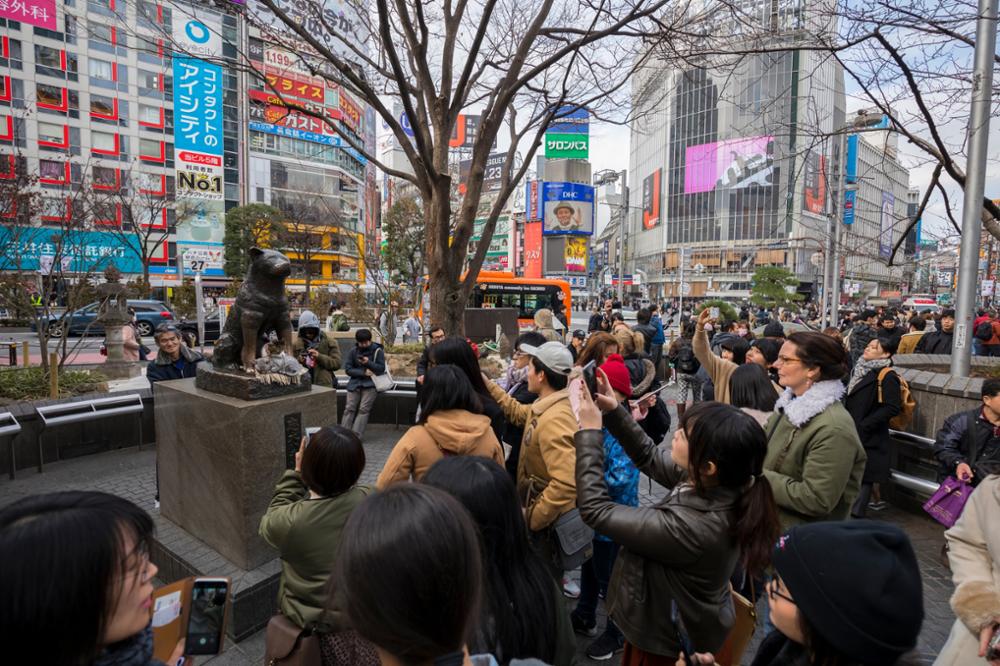
The famous Hachikō statue is located at one of the exits of Shibuya Station: the Hachikō Exit. This exit on the west side of the station serves as a meeting point for many locals and travelers.
A Closer Look at the Shibuya District
Shibuya is one of the must-see districts of Tokyo. Indeed, the area is home to one of the world's most popular crosswalks: Shibuya Crossing, sometimes called "Shibuya Scramble." It is a crosswalk known throughout the world, crossed by thousands of people every day. It is said that between 1,000 and 2,500 people cross it every two minutes, creating the impression of a genuine human tidal wave. Its fame is such that it is often compared to Times Square in New York.
The district is also very popular with young people and stands out as the "youth capital" of Japan. Nightlife there is particularly vibrant. It is also a major shopping and business hub: you'll find impressive shopping centers including Parco and Marui as well as the famous 109 building.
How to Get to the Hachikō Statue in Tokyo?
To reach the Hachikō statue, simply take public transportation and get off at Shibuya Station. Among the various forms of transport that serve Shibuya Station, you can use:
The Saikyō train line,
The Shōnan-Shinjuku train line,
The Keiō Inokashira train line,
The Tōkyū Den-en-toshi train line,
The Tōkyū Tōyoko train line,
The Ginza subway line,
The Hanzōmon subway line,
The Fukutoshin subway line.
Beyond train and subway lines, you can also reach the Hachikō statue by taking the Hachikō bus. This community minibus service, which also pays tribute to the famous dog as evidenced by its decorations, travels throughout the Shibuya district and provides access to all the main points of interest in the area for just 100 yen.
Frequently asked questions
The Hachikō statue is located outside the Hachikō Exit (west side) of Shibuya Station in Tokyo. Once you exit through this entrance, the bronze statue is visible within seconds on the plaza just in front of the station. It is also a very popular meeting point for both locals and tourists.
Yes, the Hachikō statue is accessible free of charge and at any time. It is located on public land outside the west exit of Shibuya Station. There is no entrance fee or closing hours to observe.
Shibuya Station is one of the busiest in the world. To enjoy the statue without too much crowd and take good photos, it is recommended to visit early in the morning, before 8 a.m., or on weekdays outside peak hours. In the evening, the statue is illuminated and the atmosphere is different, but visitor numbers remain high.
Hachikō is famous for his exceptional loyalty: after his master's death in 1925, he continued to go to Shibuya Station every day for 10 years to wait for him. This story moved all of Japan and symbolizes values deeply rooted in Japanese culture, such as faithfulness and perseverance.
Yes, every year in April, a tribute ceremony is held around the Hachikō statue in front of Shibuya Station. It is a solemn and moving occasion that brings together neighborhood residents and enthusiasts of the story of the famous Akita dog.