First Birthday Celebrations
When a baby celebrates their first birthday in Japan, a curious custom comes into play in Japanese families.
When a baby celebrates their first birthday in Japan, a curious custom comes into play in Japanese families.
In Japan, tradition dictates that the child be made to carry a package of mochi. And not just a few grams, but a full 10 gô (the gô 合 is a volumetric unit of measurement used for rice, equivalent to 0.18 liters, or roughly one cup; 10 gô amount to approximately 3.3 kilograms of rice!).
The mochi wrapped in lovely Japanese paper is often in two colors: pink and white, as these two colors (actually red and white) symbolize celebration in Japan, as illustrated by the character 寿 kotobuki on the packaging. Red and white are also the traditional colors of the Japanese New Year.
If some think: "Making a baby carry 3 kilos of mochi, what a torture!", I have nonetheless heard several explanations for this rather unusual custom
If the child walks at one year old, they risk getting into all sorts of mischief by wandering left and right. The weight of the mochi would therefore be intended to prevent the child from roaming everywhere and making life impossible for their parents.
The quantity of mochi of 10 gô corresponds to 1 shô (一升 isshô, or approximately 1800cc). This quantity isshô, which echoes the expression "for all of life" (pronounced the same way, but written 一生), would symbolize that the child will have enough to eat for their entire life.
An explanation that came to me from someone originally from Hokkaido (北海道): when the child is a girl, this practice would be intended to prevent her from finding a husband who lives far from her parents' home, by influencing her destiny.
Although these explanations apparently date back to a bygone era (except for mischief—children still get into that, but parents need something to keep them occupied), this custom is nonetheless still observed today.
One begins by wrapping the mochi in a fabric, called a furoshiki 風呂敷. The furoshiki, which originally was a "bath towel" (furo 風呂 = bath, and shiki 敷 = to spread [a fabric, etc.]), can serve many purposes: to dry off of course, but also to wrap up a bundle and so on.
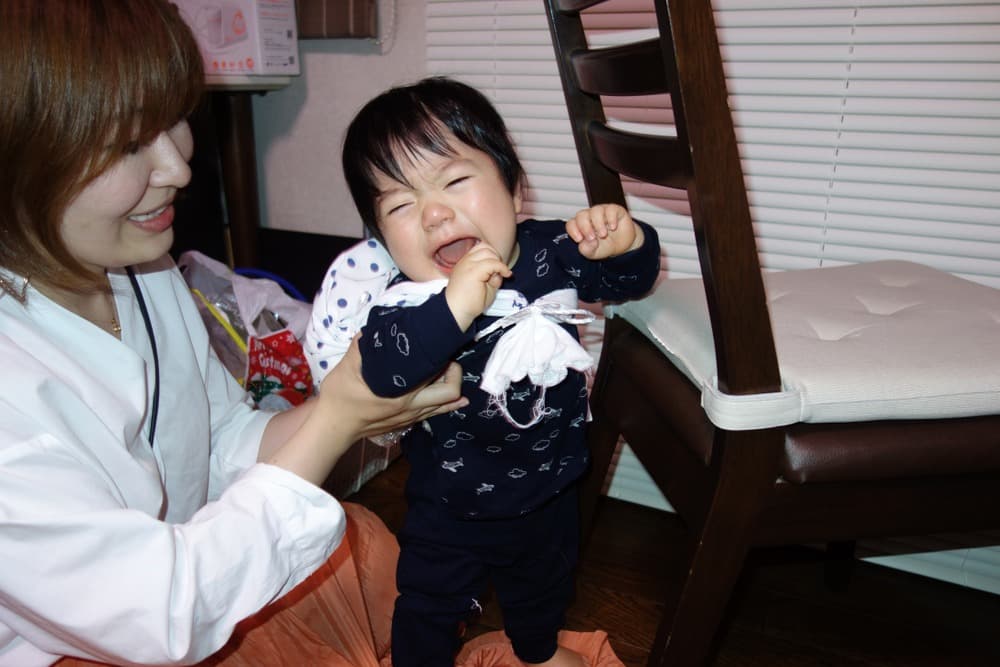
Next, the baby is made to carry (背負う seou = to carry on one's back) the bundle of mochi. But the game won't last long, as the child will quickly cry out in protest and demand to be relieved of their burden.
A remarkable custom indeed, which seems to symbolize a turning point, and carries the parents' wishes for happiness for this child embarking on life.
Frequently asked questions
In Japan, when a baby celebrates their first birthday, they are made to carry a package of mochi (glutinous rice cake) weighing approximately 3.3 kilograms on their back, wrapped in a furoshiki. This tradition, called 'isshô mochi', symbolizes the wish that the child will have enough to eat for their entire life.
The quantity of mochi corresponds to 10 gô, or 1 shô (一升, isshô, approximately 1800cc). This word isshô sounds like the Japanese word 一生 meaning 'a lifetime', thus symbolizing that the child will never lack food throughout their life.
The mochi for a first birthday is typically wrapped in two colors: pink (representing red) and white. In Japan, red and white are the colors of celebration and happiness, also used during the Japanese New Year. The character 寿 (kotobuki), meaning happiness and longevity, often adorns the packaging.
The furoshiki (風呂敷) is a versatile traditional Japanese fabric, its name literally meaning 'to spread (a fabric) for the bath'. For the first birthday ceremony, it serves to wrap the package of mochi, which the baby will then carry on their back.
Yes, despite its ancient origins, this custom is still observed in many Japanese families today. It constitutes a symbolic moment and is often amusing, as the baby quickly voices their disapproval of the weight of the bundle!