Travel to Japan: Our Complete Guide to a Successful Trip
There are countless reasons to travel to Japan, as the destination boasts numerous tourist attractions. Whether you're fascinated by medieval Japan, its culture and traditions
There are countless reasons to travel to Japan, as the destination boasts numerous tourist attractions. Whether you're fascinated by medieval Japon, its culture and traditions, a manga enthusiast and fan of Japanese pop culture, a foodie who appreciates local gastronomy, or simply looking to unwind in the peaceful atmosphere of a Japanese garden or in an Onsen, you have a thousand reasons to want to visit Japan, and you're absolutely right.
Yet the destination remains distant, with a reputation for being expensive and difficult to access. We've therefore decided to compile in this guide the essential information to help you organize your stay in Japan.
When to Travel to Japan?

Japan benefits from a distinct seasonality, with each season having its own characteristics. Choosing the right time for your Japan trip is therefore crucial.
Spring, from mid-March to late May, combines numerous advantages, with ideal weather and of course the bloom period of the Sakura, the famous Japanese cherry blossoms. However, it's the peak tourist season, and the country's major attractions will be crowded.
In Autumn, nature dons its magnificent fall coat in October and November, which are the two other months most sought after by travelers after spring.
During summer, it's inadvisable to visit major Japanese cities due to the hot and humid climate that sets in. However, it remains quite pleasant to explore high-altitude regions like the Japanese Alps and especially the Hokkaido region in the northern part of the country, whose cool climate is very enjoyable in the heart of summer.
Japan is not known for its beaches, and yet the sea breeze pleasantly cools the coastal regions which can be a good option in summer.
Finally, winter, from December to February, sees fewer travelers due to the cold that befalls the country and less sumptuous colors than the rest of the year. However, as the climate remains dry and sunny, this is a season that should be considered by travelers wishing to discover Japan in peace and quiet, and enjoy more favorable rates!
You can also enjoy winter sports, and an Onsen is never as pleasant as when temperatures hover around 0°C outside.
Finally, it's best to avoid national holidays when many Japanese take the opportunity to visit their country. Result: hotel occupancy rates increase and prices skyrocket. Each year, the Japanese enjoy a Golden Week spanning the last days of April and the first week of May.
Preparing Your Trip to Japan

You've decided to take the leap and travel to Japan! You won't regret it, but first, benefit from a few tips to be fully prepared on the day.
What to Pack?
For some, a trip to Japan will mean chic restaurants, fine hotels, and city discoveries. You should therefore pack one or two formal outfits for your nights out, while not neglecting comfortable clothes for your daytime excursions, and notably a good pair of sneakers in addition to your city shoes. Since rain showers are frequent throughout the year, a waterproof jacket will always be useful.
Overall, it's important to check weather forecasts before departure because depending on the season and regions you'll visit, your needs won't be the same, and it may be warmer in Okinawa in the dead of winter than in Hokkaido in the height of summer.
LEARN MORE: packing for Japan
Passport and Formalities
European visitors benefit from a visa exemption for tourist stays of less than 90 days. You'll only need to bring your valid passport and your return flight ticket.
LEARN MORE: visa and administrative formalities for staying in Japan
Travel Insurance
The Japanese healthcare system is of high quality but remains expensive. Should you fall ill during your stay and need hospitalization, you'll need to provide proof of funds necessary to cover treatment costs. As with any trip, we recommend travelers obtain comprehensive health and evacuation coverage. We recommend the health coverage offered by Chapka Assurance for this purpose.
GET INSURED WITH Chapka Assurance for my trip to Japan
Electricity and Adapters
The voltage used in Japan is 100 Volts compared to 220 Volts in Europe. Normally your electrical devices should work without problem, but check that the transformer indicates « INPUT 100-240 C ».
Electrical outlets are Type A, with 2 flat pins, and you'll need a European/Japan power adapter to plug in your devices. You can plan to bring an adapter and a multi-outlet strip so you can connect all your electrical devices.
How to Get to Japan?

Unless you're on a round-the-world trip, it's quite likely that you'll reach Japan from Europe by plane. Connections with Europe are numerous, and you can choose between:
One of the direct flights from Paris offered by Air France, Japan Airlines or All Nippon Airways. You'll need to count on 12 hours of flight time.
A flight with a stopover, often cheaper but with varying flight times. The least expensive flights are generally offered by Air China with a stopover in Shanghai.
The most common arrival airport is Narita in Tokyo.
In terms of cost, prices vary depending on the season and booking period. The earlier you book, the better rates you'll get. The average price observed is 600 Euros round-trip, but ranges from 350 to 950 Euros. July and August are the most expensive months to travel to Japan.
LEARN MORE: getting to Japan
How Long Should You Stay in Japan?
Japan is a large archipelago that requires at least two weeks from its visitors to reveal its different facets. In 14 days, you can experience a good number of attractions, but if you really want to enjoy each stop without rushing, opt for a trip of three weeks to a month.
What to Do in Japan?

Whether it's city or nature, leisure or discovery, everyone finds something for themselves in Japan.
Must-See Cities
Tokyo, Japan's capital, is captivating with its futuristic skyline and famous traditional temples. Discover otaku culture in Akihabara and the vibrant nightlife in Shinjuku.
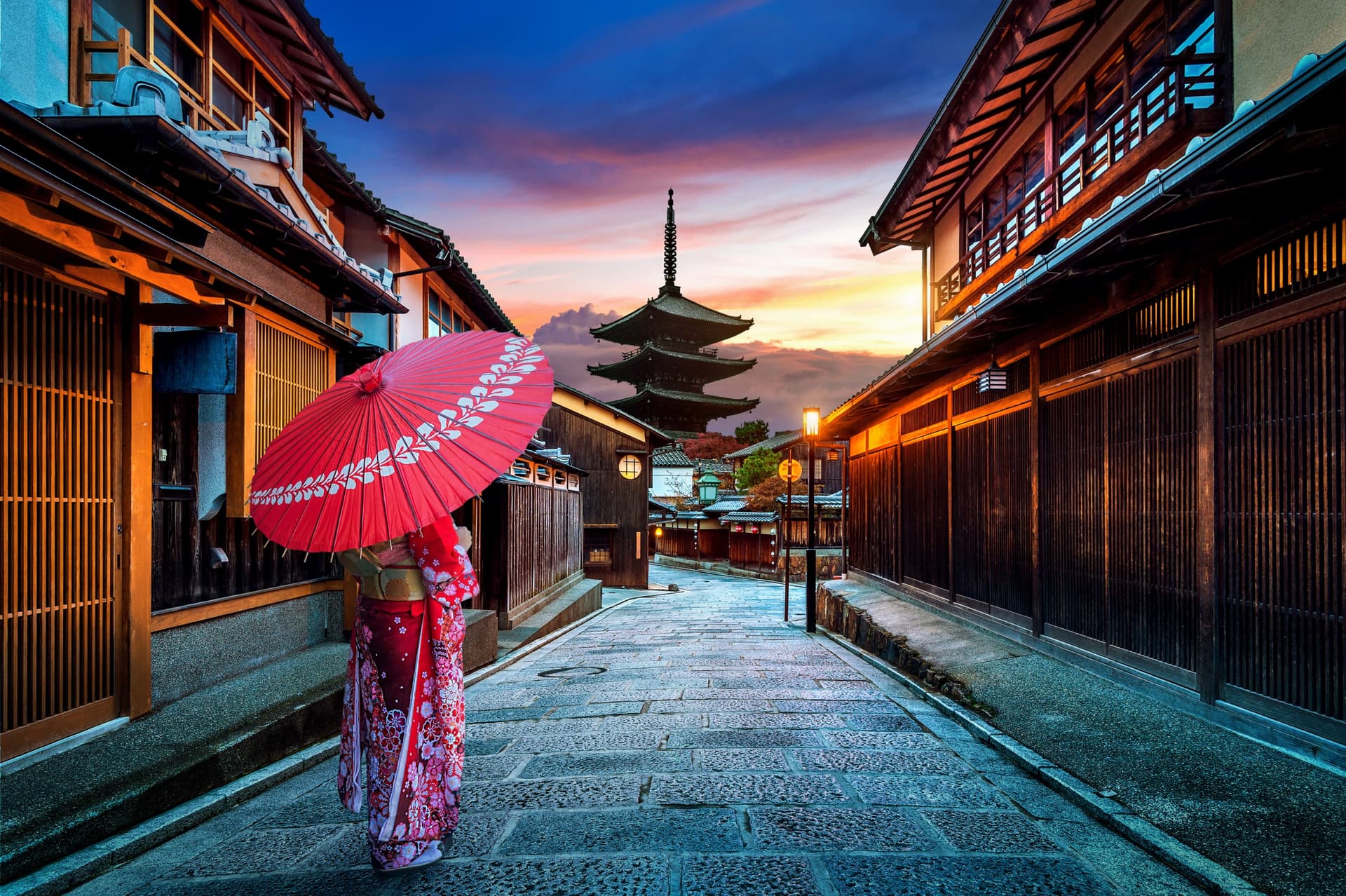
Kyoto, the most charming destination in the country, is also its religious center. 1 000 temples, including the magnificent Kiyomizu-dera, will immerse you in the Japan of monks.
Discover Osaka next, Japan's third most populated city, and above all a hub of national economy. Osaka is worth visiting for its rich gastronomy. Okonomiyaki, takoyaki, kushikatsu and other dishes will delight your palate.
If you enjoy history, you've likely heard of Hiroshima, sadly famous for being the victim of a nuclear bomb during World War II. Visit the Hiroshima Peace Memorial Park to pay your respects, then explore the shops in the Hondori district.
In the south, Fukuoka stands out as the main destination. If you're looking for a beautiful coastal city, go discover Kamakura in Sagami Bay. For a return to the age of samurai, visit Kanazawa.
Must-Do Activities?
To immerse yourself in Japan's rich culture, explore major temples such as Todai-Ji in Nara, imperial castles like Himeji-jō west of Kobe, as well as museums including the Tokyo National Museum.
Taste authentic Japanese sushi. If you're in Tokyo, visit the Tsukiji Fish Market which gathers 450 varieties of fish and other seafood daily to supply the itamae (Japanese sushi masters).
Relax in an onsen. Japan has over 3 000 hot springs. They exist both in cities and countryside, in mountains and forests, on coasts…
Hiking at Mount Fuji, water activities in Okinawa, visiting the Arashiyama bamboo grove, taking a Mario Kart tour in Tokyo… The range of leisure activities in Japan is still vast!
Budget for Your Trip to Japan
Accommodation Budget
Hotel offerings are extremely varied in Tokyo and Osaka. The choice is more limited in the provinces. Rates range from 8 000 Yen per night for a standard hotel room to over 60 000 Yen for the most prestigious establishments.
Minshukus, the Japanese equivalent of bed and breakfasts, represent an attractive option for families and small groups, at a price of 6 500 to 8500 Yen per person for half-board, including kitchen access.
If you want to experience traditional Japanese living, stay in a ryokan (traditional Japanese inn) for 20 000 to 30 000 Yen per person (meals and breakfast included), or in a shukubo (temple accommodation) starting from 8 000 Yen.
For tight budgets, there are youth hostels charging from 3 500 Yen per bed, as well as Capsule hotels available from 2 000 Yen.
Food Budget
With a daily budget of approximately 2 500 Yen, you'll have plenty to satisfy your culinary desires in Japan. Restaurant chains offer dishes starting from 300 Yen, but if you really want to enjoy Japanese cuisine, you should budget more. On days when you want to be mindful of your wallet, you can buy onigiris which cost between 100 and 140 Yen each.
Transportation Budget
Car Rental in Japan
Rent a vehicle to travel freely and reach the most remote areas of Japan. Starting from 42 Euros per day, you can get a 5-seater car, and 91 Euros for an 8-passenger minivan.
The JR Pass
Travel smart and affordably by getting a Japan Rail Pass! This pass is very convenient for traveling between Tokyo and Kyoto. The offer is also valid in the North of the country in the Wakkanai region and in the South around Kagoshima. Standard rates break down as follows:
7 days: 29 650 Yen
14 days: 47 250 Yen
21 days: 60 450 Yen
Activities Budget
Most Japanese temples are free to access. Some charge around 400 Yen for entry, like Kiyomizu-dera in Kyoto. City parks are also free. Regarding museums and other popular attractions, there are special passes depending on the region that allow you to combine several visits in one day. In Tokyo for example, with the Grutto Pass, you can explore nearly 80 locations for 2 000 Yen.
Shopping Budget
Beyond major retailers, focus on Japan's 100 Yen stores to shop at bargain prices. For less than a euro, you'll find a wide range of products: food, beauty items, decorative objects, souvenirs…
Our Tips While You're There
Pocket Wifi
Pocket Wifi is the solution to have high-speed internet connection throughout your trip to Japan. It's compact and easy to use, covering 90% of the national internet network, and you can connect 5 devices at the same time. Pocket Wifi devices are available at airports and most urban hotels. Expect approximately 7 Euros per day for rental.
LEARN MORE: Stay connected during your trip to Japan with Pocket Wifi
Luggage Transport
Luggage often causes headaches during vacations. But rejoice, thanks to various door-to-door delivery services, your worries will be quickly resolved. Takkyubin offers an option of affordable luggage transport (from 1 500 Yen) and secure, without the need to book in advance, from your airport arrival and throughout your travels. When you stop in a city, you can entrust your belongings to storage services at airports, train stations or large department stores for a fee of 300 to 1 000 yen per day.
Frequently asked questions
No, European citizens benefit from a visa exemption for tourist stays of less than 90 days. You just need to travel with a valid passport and a return flight ticket.
Spring (mid-March to late May) and autumn (October-November) are the best seasons to visit Japan. Spring offers cherry blossom blooms (sakura) and autumn magnificent autumn colors. Winter (December to February) is ideal for traveling peacefully with more favorable rates.
It takes at least two weeks to discover the main facets of Japan. A stay of 3 weeks to a month is recommended if you want to explore the country without rushing and visit less touristy regions.
The average price observed for a Paris-Tokyo round-trip flight is approximately 600 €, with variations ranging from 350 € to 950 € depending on the season and booking anticipation. July and August are the most expensive months.
The Japan Rail Pass (JR Pass) is an unlimited pass on the Japanese railway network, ideal for traveling between Tokyo, Kyoto, Osaka and other major cities. It's available for 7 days (29,650 Yen), 14 days (47,250 Yen) or 21 days (60,450 Yen). It pays for itself if you make several Shinkansen (high-speed train) trips.
A daily budget of 2,500 Yen is sufficient for meals. Adding accommodation (from 2,000 Yen in a capsule hotel or 3,500 Yen in a youth hostel) and transportation, expect between 8,000 and 15,000 Yen per day depending on your travel style.