These Unusual Temples and Shrines Not to Miss in Tokyo
Planning a trip to Tokyo and want to venture off the beaten path? Far from the tourist masses
Planning a trip to visit Tokyo and want to venture off the beaten path? Far from the tourist masses, we invite you to discover another facet of Japan's capital by exploring our top 4 most unusual temples and shrines in Tokyo. One thing is certain—these atypical sanctuaries will spark your curiosity…
1. Rurikō-in Byakurenge-dō with Futuristic Architecture
Located in Shijuku, one of the most bustling neighborhoods in Tokyo, the Rurikō-in Byakurenge-dō temple certainly stands out. Resembling a spacecraft or futuristic museum, you would never guess that this building is actually a Japanese temple! Indeed, this impressive concrete structure envisioned by architect Kiyoshi Sey Takeyama bears little resemblance to the classical Buddhist temples we're accustomed to. Built vertically across six stories, the cube-shaped temple appears to lift off the ground, its base resting on a narrow pedestal that echoes the form of a lotus flower. Inside, the atmosphere is remarkably serene and peaceful, offering a meditation hall, a hall for religious music concerts, and more. Without doubt, a visit to Rurikō-in Byakurenge-dō temple is well worth the detour!
2. Gotokuji, the Temple Dedicated to Maneki Neko
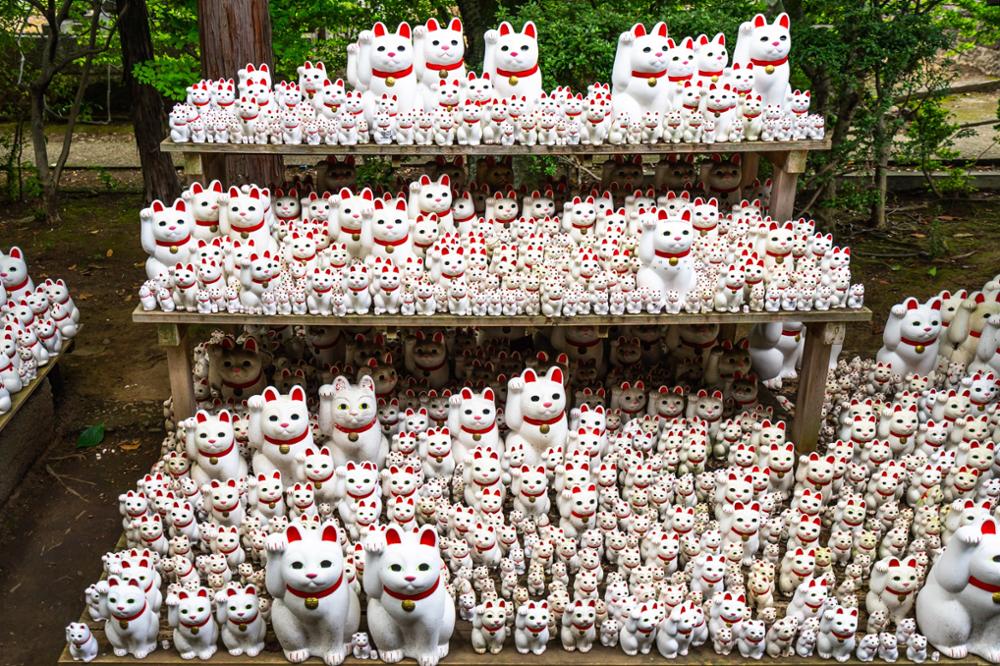
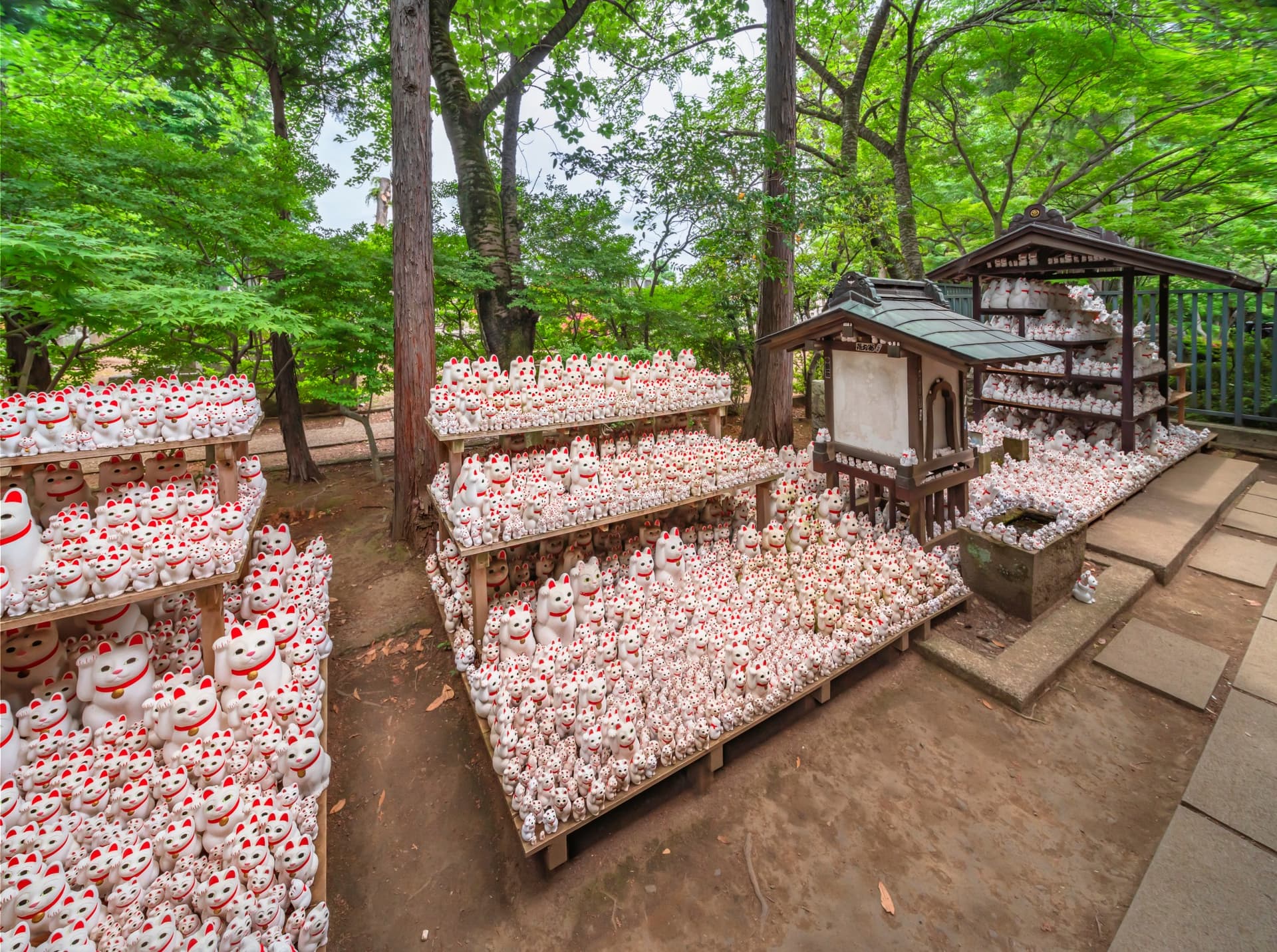
We continue our journey through unusual temples in Tokyo in the upscale residential neighborhood of Setagaya to discover Gotoku-ji temple. This Buddhist complex comprises several buildings, including a main pavilion, a pagoda, the Ii clan cemetery, and a beautiful garden with stunning Japanese maples. What makes this temple particularly special is that it is considered a place of worship dedicated to the Maneki-Neko. Literally translated as "the cat that beckons," it is a lucky cat figurine believed to bring fortune and prosperity, commonly found in shop windows throughout Asia. Here, you'll find an impressive collection of these white and red cat statues, their raised paw said to bring good luck. An atypical visit not to be missed during your time in Japan's capital.
3. Sugamo Oudai Kannondō and Its Unusual Design
Head to the Sugamo neighborhood to discover the small temple Sugamo Oudai Kannon-do. Nicknamed "Kamodai Sazaedo" due to its snail-like appearance, it is a Buddhist cultural institution based on the principles of Mahayana Buddhism. Although built within Taisho University, the temple is open to all visitors. What makes it special? Its octagonal construction, with an interior structure in the form of a double spiral that makes it impossible to cross paths while ascending or descending. On the top floor, you'll find a statue of Kannon, the Buddhist goddess of compassion. Note: A flower festival is held on the third Saturday of each month to showcase the work of students from Taisho University's Faculty of Buddhism.
4. Fukagawa fudo-do and the Goma Fire Ritual
When it comes to Fukagawa fudo-do temple, don't be fooled by appearances! While its exterior may seem ultra-modern, what happens inside reveals the unexpected. On one hand, you'll find an impressive collection of remarkable antiquities as well as a prayer corridor with psychedelic touches composed of nearly 9,500 crystal statues of Fudōmyō (a fierce representation of Buddha's determination). On the other hand, you may have the opportunity to witness the Goma fire ritual, which takes place daily approximately every two hours starting at 9 o'clock in the morning. Belonging to an esoteric branch of Shingon Buddhism, the temple practices this religious purification ritual during which fire rises from the main altar as an offering to the deity, while monks and worshippers chant sutras to the sound of drums and conch shells. That's certainly an unusual experience not to miss during your stay in Tokyo!
Frequently asked questions
Gotokuji temple is located in the residential neighborhood of Setagaya, Tokyo. It is accessible by train from Gotokuji Station. It is the original home of the lucky cat figurine, the maneki neko, and you'll find hundreds of statues offered by visitors.
The Goma fire ritual at Fukagawa fudo-do temple takes place daily approximately every two hours starting at 9:00 in the morning. This esoteric Shingon Buddhist purification ritual is open to visitors and constitutes a unique cultural experience in Tokyo.
Yes, although Sugamo Oudai Kannondō temple is located within Taisho University in the Sugamo neighborhood, it is accessible to all visitors. Its octagonal structure with a double spiral design and the statue of the goddess Kannon on the top floor make it an unusual visit not to be missed.
Rurikō-in Byakurenge-dō temple is located in Shinjuku, one of Tokyo's best-served neighborhoods. This area is accessible from numerous subway and train lines, including Shinjuku Station, which is a major transportation hub. The temple, with its futuristic concrete architecture, is easy to spot.
Yes, most of these atypical temples are family-friendly. Gotokuji temple with its numerous maneki neko cat statues is particularly enjoyed by younger visitors. Fukagawa fudo-do temple with its 9,500 crystal statues can also fascinate children, though the fire ritual requires a certain level of discretion.